New technologies help scientists track fish species
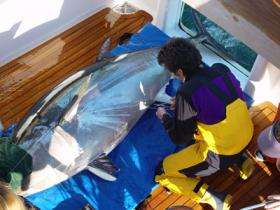
(PhysOrg.com) -- New tracking and observing technologies are giving marine conservationists a fish-eye view of conditions, from overfishing to climate change, that are contributing to declining fish populations, according to a new study.
Until recently, scientists provided fishery managers only such limited data as stock counts and catch estimates, said Charles Greene, Cornell professor of ocean sciences and lead author of the study published in the March issue (Vol. 22, No. 1) of the journal Oceanography.
But new advances in miniature sensors and fish-tracking tags, ocean observing systems and computer models are providing much more insight into environmental changes and how fish are responding behaviorally and biologically to such changes, thereby enabling better modeling to predict fish populations. As a result, researchers are making more informed recommendations for strategies to address falling fish populations.
Obtaining real-world data is essential, stressed Greene. "Many of the commercial fish populations in the world are pretty highly depressed. It's a bleak picture in terms of the status of many wild marine fish populations."
For example, the Atlantic bluefin tuna fishery, which can garner more than $15,000 per fish, is managed as two separate stocks, one in the eastern Atlantic basin, with a breeding ground in the Mediterranean, and another in the western basin, with a breeding ground in the Gulf of Mexico. Both stocks are not sustainably harvested, and the western population has declined by roughly 90 percent over the last 25 years, despite strict quotas.
A project known as Tag A Giant (TAG) uses an implanted tag in the tuna to record external pressure, internal and external temperature and ambient light, though the tuna must be recaptured to recover these data. TAG also uses a pop-up tag that is attached to the tuna but self releases, floats to the surface and transmits data on each tuna's external conditions via satellite. The tags help researchers estimate geo-locations and track each fish's daily movements.
According to the study, new TAG data have revealed that as tuna grow, they swim all over the Atlantic, and that the fish from the two stocks commingle. Past failure to account for this mixing of the two stocks has led to unsustainable management practices, especially for tuna originating in the Gulf of Mexico, Greene said. New strategies must account for mixing stocks, since fishing in the eastern basin has undermined the quotas and recovery plans for the western basin stock.
With regard to Pacific salmon, fishery managers have assumed that juveniles traveling from spawning grounds to the ocean face great mortality along heavily dammed rivers, like the Snake-Columbia river system, than in undammed rivers. Thus, they collected juveniles and transported them past the Snake-Columbia river system's eight dams before releasing them downstream. However, adult salmon numbers returning from the ocean did not increase.
The Pacific Ocean Shelf Tracking project, which tagged juvenile fish, showed that the smaller, less developed fish were dying in high numbers in the lower river and coastal ocean. This kind of knowledge will help managers test and adapt their strategies in wild-fish systems, which historically have been hard to monitor.
This work was supported by more than a dozen entities, including the Gordon and Betty Moore, Packard, Monterey Bay Aquarium and Sloan foundations, and the Bonneville Power Administration.
Provided by Cornell University (news : web)


