HoloTV Images Jump off the Screen, into Tomorrow's Homes (w/Video)
March 12, 2009 By Lisa Zyga HoloTV Images Jump off the Screen, into Tomorrow's Homes

Enlarge

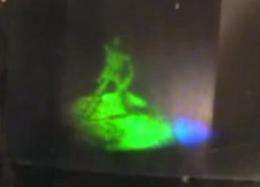
A holoTV image of a man walking appears in front of a transparent screen. Excerpt from video below. Credit: José J. Lunazzi, et al.

(PhysOrg.com) -- Unlike today’s biggest and most realistic LCD and plasma TVs, 3D TV screens can project images that seem to float in mid-air beyond the screen. That means, for instance, that viewers could watch basketball players dribble in front of, next to, or behind the TV screen as they go for a lay-up.

In a recent study, a team of researchers has developed a type of 3D called “holoTV,” which works a bit differently than a standard system. The holoTV system projects a or animation onto a white-light screen, creating an image that appears to float in front of the screen. Viewers don’t need to wear special to view the floating images, which have the appearance of , although the system is not volumetric. The scientists, from the University of Campinas in Sao Paulo, Brazil, and the High Polytechnic Institute José Antonio Echeverría in Havana, Cuba, have published their study in a recent issue of Optics Letters.

Join PhysOrg.com on Facebook!
Follow PhysOrg.com on Twitter!

“3D TV is a general term, which can be applied to all systems where depth is perceived, but usually requires goggles,” lead author José Lunazzi, a professor at the University of Campinas, explained to PhysOrg.com. “Only holoTV and holography have continuous parallax, which means that when the observer moves his head, he can see different views without discontinuities.”

As Lunazzi explained, holography is academically defined as an object’s light wave interfering with a reference wave. One proposed technique for holographic TV involves using a laser to render the images, as in conventional holography, but registering electronically. However, this scheme requires the detection to have 10 times more resolution than is currently available, even to produce very small images, making holographic TV impractical for now.

In contrast, Lunazzi and his colleagues refer to their technique as holoTV, a term they adopted in 1990. Unlike holographic TV, holoTV doesn’t involve a reference wave. Instead, as in the researchers’ current holoTV system, holographic images are created from projection in a diffractive screen made by the splitting and subsequent interference of a light beam on a holographic film.

“3D images are impressive when they appear in front of a support, like ghosts which your hand goes through,” Lunazzi said. “These images are often named ‘floating images,’ which don’t require goggles. The support may be so transparent that it is not perceived. Other systems show images on transparent screens which are 2D, and to be more impressive they say ‘holographic images’ when they are actually ‘ghost images.’ These can be of large size, as seen in shows, but viewers who are close can notice the lack of depth.”

In the researchers’ set-up to make the screen, a laser emits a beam that is divided in two by a beam splitter. One of the beams is reflected by a mirror and then reaches a spatial filter, which causes the beam to diverge. The second beam travels through a cylindrical lens that causes that beam to diverge in only one direction, and then passes through a diffuser.

Then the two wide beams intersect at a 45° angle, and their interference is recorded on a holographic film, which becomes the 60cm x 30cm screen. When projecting on the screen, each wavelength of the white-light beam converges at a different position beyond the screen, so that a viewer’s left and right eyes receive light at different wavelengths (different colors), each composed of many beams converging toward the eyes. The projection makes each eye receive a different view to compose the scene as a natural one.

Using a diffraction grating, the researchers demonstrated how to project the image in front, behind, or next to the screen. The diffraction causes a blur on the screen, and the wider the blur, the greater the distance between the image and the diffraction grating - and the greater the depth of the image. One example the researchers demonstrated is an image of a man walking, which is projected 27cm in front of the screen. When sitting 140cm from the screen, a viewer would have a narrow field of view of 24cm (or 11°), enough to accommodate small head movements.

“Two or three persons can watch, in fact, if seated along a line,” Lunazzi said. “To achieve a larger angle, greater diffractive power is needed and could be obtained by larger interference angles on the recording of the screen. New materials should in fact be used to obtain higher diffraction efficiency to reduce the effect of the ambient light.” The researchers have already constructed improved screens, and plan to publish the results in upcoming papers.

Many other recent studies have been investigating 3D TV technology, which is already commercially available in Japan, although viewers must wear goggles. There is still limited viewing content, since only specially recorded shows can be viewed on 3D TVs: a scene must be filmed from many sides and then incorporated into a single image to be projected in 3D. Ideally, a holoTV would produce floating images that can be viewed at any angle, be updated quick enough to allow for smooth TV viewing, and be affordable. Whether hung flat on a wall or set like a checkerboard on a coffee table, holographic and holoTV displays could bring TV action into the living room.

Besides TV, other applications could include 3D advertisements in department store windows, as well as medical uses. For example, surgeons currently need to take multiple 2D scans to view organs from different angles, but 3D imaging could give them a fuller, more realistic view.

More information: José J. Lunazzi; Daniel S. F. Magalhães; Noemí I. R. Rivera; and Rolando L. Serra. “Holo-television system with a single plane.” February 15, 2009 / Vol. 34, No. 4 / Optics Letters.

Copyright 2009 PhysOrg.com.
All rights reserved. This material may not be published, broadcast, rewritten or redistributed in whole or part without the express written permission of PhysOrg.com.


print this article email this article download pdf blog this article bookmark this article     Stumble it Digg this share on Facebook retweet share on Reddit add to delicious
Rate this story - 3.9 /5 (19 votes)

Rank Filter

Move the slider to adjust rank threshold, so that you can hide some of the comments.


Display comments: newest first

  • OregonWind - Mar 12, 2009
    • Rank: 5 / 5 (1)
    The idea is great and their effort is commendable unfortunately the video is not very good.
  • SciTechdude - Mar 12, 2009
    • Rank: 5 / 5 (1)
    The idea is great and their effort is commendable unfortunately the video is not very good.


    Everything starts with something small.
  • mattytheory - Mar 12, 2009
    • Rank: 3 / 5 (2)
    The idea is great and their effort is commendable unfortunately the video is not very good.


    Everything starts with something small.


    EXCEPT GOD! (Apparently...)
  • OregonWind - Mar 12, 2009
    • Rank: 5 / 5 (1)
    'EXCEPT GOD! (Apparently...)"

    Did God start? Actually, did anything really start? Maybe even the big bang is only a cycle, not a start..

    Maybe not even me, maybe I never started, I just got in this forever cycle of birth and rebirth...with no beginning and no end... maybe I will be born again in some other universe and then after in another one...

    Maybe, I am not.

  • JohnSawyer - Mar 12, 2009
    • Rank: 5 / 5 (2)
    Please please please don't turn this comments thread into a debate about religion. It's an article about holoTV.

    Too bad systems like this can't be properly demonstrated on a 2D screen like the ones we're all looking at while reading this article. Makes most people wonder what the big deal is. Given that, the article states that the major factor that gives a sense of depth, is how blurry more distant parts of the image are. If that's all it can do, this method will never be adopted to replace TV, movie theaters, etc., where crispness of detail in both foreground and background is tantamount.
  • el_gramador - Mar 12, 2009
    • Rank: 5 / 5 (1)
    Let's not slip into existentialism here OregonWind. Bypassing the fact that god started or ended, and whether things are part of a cycle or not, we do know one thing. 3D TV's would be cool. No matter how they are rendered.
  • OregonWind - Mar 12, 2009
    • Rank: not rated yet
    el_gramador and JohnSawyer

    Sorry for slipping...into existentialism remarks.

    I visited Campinas State University once in the State of Sao Paulo, Brazil. They have some pretty smart graduate students down there.
  • docknowledge - Mar 13, 2009
    • Rank: not rated yet
    The Japanese just released their first commercial notebook with a 3D screen. So, these guys are a little behind the curve, at least commercially.
  • LuckyBrandon - Mar 13, 2009
    • Rank: 3 / 5 (4)
    mattytheory-actually yes, god would have had a start...his start was the day someone made him up in their imagination and started talking about their imaginary friend.

    now onto the real topic...i couldnt pass that up.

    the real trick here is to NOT make people want to keep sittin on their fat asses in front of ANY KIND of screen (for comparisons made earlier of this vs. conventional tv and movie theaters).
    will it be cool when it works decently, yes. is it a waste of time and money, a humongous yes....
  • weewilly - Mar 13, 2009
    • Rank: 5 / 5 (1)
    The first airplane only flew a few hundred feet. "A journey of a thousand miles begins with a single step."

March 12, 2009 all stories

Comments: 10

3.9 /5 (19 votes)
  • Stumble this up

  • Digg this

  • share this

  • hide
  • Related Stories

  • The Ultimate Home Cinematic 21:9 Viewing Experience
    created Jan 20, 2009 | popularity not rated yet | comments 0
  • 3D Display Offers Glimpse of Future Media
    created Nov 10, 2008 | popularity not rated yet | comments 0
  • Foldable phone opens into large OLED screen
    created Nov 24, 2008 | popularity not rated yet | comments 0
  • Japanese Researchers Develop Portable 3D Display System
    created Sep 29, 2006 | popularity not rated yet | comments 0
  • Starwars style holographic 3DTV could be a reality by 2018, experts say
    created Dec 02, 2008 | popularity not rated yet | comments 0


  • hide
  • Relevant PhysicsForums posts

  • Has einsteins experient with time been proven, why hasn't it been applied or used
    created 1hour ago
  • Drop of Water
    created 2 hours ago
  • Generalized Coordinate Systems
    created 2 hours ago
  • Electromagnet design
    created 4 hours ago
  • Magnet and Motors?
    created 8 hours ago
  • Effect of Volume on Revolution
    created 9 hours ago
  • More from Physics Forums - General Physics

Other News

Stars Fueled by Dark Matter Could Hold Secrets to the Universe

Stars Fueled by Dark Matter Could Hold Secrets to the Universe

Physics / General Physics

created Nov 03, 2009 | popularity 4.5 / 5 (51) | comments 41

(PhysOrg.com) -- The first stars in the universe may have been very different from the stars we see today, yet they may hold clues to understanding some of the mysterious features of the universe. These "dark ...


Second Law of Thermodynamics May Explain Economic Evolution

Second Law of Thermodynamics May Explain Economic Evolution

Physics / General Physics

created Nov 02, 2009 | popularity 4.3 / 5 (30) | comments 28

(PhysOrg.com) -- Terms such as the "invisible hand," laissez-faire policy, and free-market principles suggest that economic growth and decline in capitalist societies seem to be somehow self-regulated. Now, ...


High-performance plasmas may make reliable, efficient fusion power a reality

High-performance plasmas may make reliable, efficient fusion power a reality

Physics / Plasma Physics

created Nov 02, 2009 | popularity 4.7 / 5 (39) | comments 33

In the quest to produce nuclear fusion energy, researchers from the DIII-D National Fusion Facility have recently confirmed long-standing theoretical predictions that performance, efficiency and reliability ...


'Teapot effect' solved

Solving Teapot Effect

Physics / General Physics

created Nov 02, 2009 | popularity 4.9 / 5 (11) | comments 10

(PhysOrg.com) -- A team of scientists from France have worked out why teapots dribble at low flow rates, and how to stop them. The effect is called the "teapot effect", and solving it could finally put an ...


Laser accelerated protons to the highest energies so far

Researchers use trident laser to accelerate protons to record energies

Physics / General Physics

created Nov 02, 2009 | popularity 4.7 / 5 (6) | comments 10

An international team of physicists at Los Alamos National Laboratory has succeeded in using intense laser light to accelerate protons to energies never before achieved. Using this technique, scientists can ...