Researchers progress toward AIDS vaccine
March 12, 2009
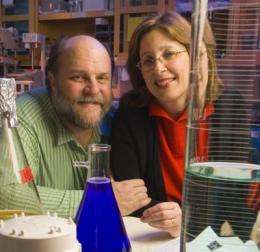
These are Rutgers professors Eddy and Gail Ferstandig Arnold. Credit: Nick Romanenko
Rutgers AIDS researchers Gail Ferstandig Arnold and Eddy Arnold may have turned a corner in their search for a HIV vaccine. In a paper just published in the Journal of Virology, the husband and wife duo and their colleagues report on their research progress.
With the support of the National Institutes of Health, the Arnolds and their team have been able to take a piece of HIV that is involved with helping the virus enter cells, put it on the surface of a common cold virus, and then immunize animals with it. They found that the animals made antibodies that can stop an unusually diverse set of HIV isolates or varieties.
Some researchers have previously been able to elicit effective antibodies, but usually only against a very limited number of HIV types. With HIV’s known propensity to mutate, antibodies developed against one local strain may not recognize and combat mutant varieties elsewhere. These geographic varieties with different mutations constitute one of the great challenges to finding a broad spectrum vaccine capable of protecting against the vast array of HIV varieties.
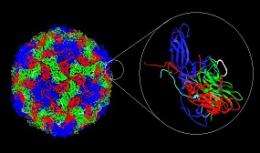
Human rhinovirus showing pieces of HIV (red) that stimulate helpful immune responses displayed on the rhinovirus surface, thereby creating a safe mimic of HIV. Credit: Gail Ferstandig Arnold
The approach taken by the Arnolds and their colleagues has been to identify a part of the AIDS virus that is crucial to its viability - something the virus needs in order to complete its life cycle - and then target this Achilles heel.“The part that we targeted plays a role in the ability of HIV to enter cells, and is common to most HIV varieties,” Gail Ferstandig Arnold said. “That is a mechanism that would not be easy for the virus to reinvent on the fly, so it turns out to be a really helpful target.”
The Arnolds are both members of the Center for Advanced Biotechnology and Medicine, a joint center of Rutgers, The State University of New Jersey, and the University of Medicine and Dentistry of New Jersey. Also, Gail Ferstandig Arnold is a research professor and Eddy Arnold is a professor, both in Rutgers’ Department of Chemistry and Chemical Biology.
While most vaccines are actually made from the pathogen itself, employing weakened or inactivated organisms to stimulate antibody production, HIV is just too dangerous to use as the basis for a vaccine vehicle. What the Arnolds have done is to use the relatively innocuous cold-causing rhinovirus and attach the target portion of the HIV. This must be done in a way that maintains the HIV part’s shape so that when the immune system sees it, it will actually mount an immune response as it would to the real HIV.
“The idea is to trick the immune system into thinking it is acting upon HIV before the virus shows actually shows up on the scene,” said Eddy Arnold.
To actually accomplish this is a big problem in engineering. The goal was to take a small piece of the HIV out of its native context, put it in a completely different system (rhinovirus), and have it look the same and act the same. Eddy Arnold likens this to taking the Rocky Mountains, putting them on India and having them look exactly right.
Using recombinant engineering, the research team developed a method to systematically test millions of varied presentations of the HIV segment with the rhinovirus. They tried millions of different variations on how to graft (or splice) one onto the other, creating what are called combinatorial libraries.
“It’s like the lottery,” Eddy Arnold commented. “The more tickets you buy the better chance you have of winning.”
“The really exciting part is that we were able to find viruses that could elicit antibodies against a huge variety of isolates of HIV. That is an immense step and a very important step,” said Gail Ferstandig Arnold.
“However, we need to be careful to not overstate things because the quantity of response is not huge, but it is significant,” added Eddy Arnold. “This is actually the first demonstration of this particular Achilles heel being presented in way to generate a relevant immune response. It is probably not potent enough by itself to be the vaccine or a vaccine, but it is a proof of principle that what we are trying to do is a very sound idea.”
-
How HIV vaccine might have increased odds of infection
Nov 03, 2008 |
not rated yet |
0
-
HIV isolate from Kenya provides clues for vaccine design
Jan 02, 2008 |
not rated yet |
0
-
Exhausted B cells hamper immune response to HIV
Jul 14, 2008 |
not rated yet |
0
-
Exhausted B cells fail to fight HIV
Jul 14, 2008 |
not rated yet |
0
-
Scientists find another key to HIV success
Mar 22, 2006 |
not rated yet |
0
-
Engineers build first sub-10-nm carbon nanotube transistor
Feb 01, 2012 |
4.9 / 5 (32) |
30
-
Something old, something new: Evolution and the structural divergence of duplicate genes
Jan 31, 2012 |
4.6 / 5 (7) |
1
-
The hidden nanoworld of ice crystals: Revealing the dynamic behavior of quasi-liquid layers
Jan 30, 2012 |
5 / 5 (4) |
1
-
Stock market network reveals investor clustering
Jan 27, 2012 |
3.9 / 5 (23) |
8
-
Of microchemistry and molecules: Electronic microfluidic device synthesizes biocompatible probes
Jan 26, 2012 |
5 / 5 (2) |
0
-
Classical and Quantum Mechanics via Lie algebras
Apr 15, 2011
- More from Physics Forums - Independent Research
More news stories
Starve a virus, feed a cure? Findings show how some cells protect themselves against HIV
A protein that protects some of our immune cells from the most common and virulent form of HIV works by starving the virus of the molecular building blocks that it needs to replicate, according to research published online ...
2 hours ago |
5 / 5 (1) |
0
|
Injured boomers beware: Know when to see doctor
(AP) -- It happened to nurse Jane Byron years after an in-line skating fall, business owner Haralee Weintraub while doing "men's" push-ups, and avid cyclist Gene Wilberg while lifting a heavy box.
3 hours ago |
5 / 5 (1) |
0
FDA-approved drug rapidly clears amyloid from the brain, reverses Alzheimer's symptoms in mice
Neuroscientists at Case Western Reserve University School of Medicine have made a dramatic breakthrough in their efforts to find a cure for Alzheimer's disease. The researchers' findings, published in the journal Science, show t ...
Medicine & Health / Neuroscience
Feb 09, 2012 |
4.9 / 5 (55) |
21
|
Green tea found to reduce disability in the elderly
(Medical Xpress) -- A lot of research has been done over the past several years looking into the health benefits of green tea. As a result, scientists have found that regular consumption of the beverage leads ...
Teen school drop-outs three times as likely to be on benefits in later life
Teen school drop-outs are almost three times as likely to be on benefits in later life as their peers who complete their schooling, indicates research published online in the Journal of Epidemiology and Community Health.
Feb 06, 2012 |
not rated yet |
13
Scientists discover molecular secrets of 2,000-year-old Chinese herbal remedy
For roughly two thousand years, Chinese herbalists have treated Malaria using a root extract, commonly known as Chang Shan, from a type of hydrangea that grows in Tibet and Nepal. More recent studies suggest that halofuginone, ...
New method to examine batteries -- MRI from the inside
There is an ever-increasing need for advanced batteries for portable electronics, such as phones, cameras, and music players, but also to power electric vehicles and to facilitate the distribution and storage of energy derived ...
Lab study raises questions over nano-particle impact
Tests involving chickens have raised questions about the impact on health from engineered nano-particles, the ultra-fine grains commonly used in drugs and processed foods, scientists said on Sunday.
Google might launch Drive for cloud storage soon
(PhysOrg.com) -- Google's next big move, according to the Wall Street Journal, is a cloud storage service called Drive. Hardly first to the plate, Google is simply catching up to introducing its cloud reposi ...
A mitosis mystery solved: How chromosomes align perfectly in a dividing cell
Although the process of mitotic cell division has been studied intensely for more than 50 years, Whitehead Institute researchers have only now solved the mystery of how cells correctly align their chromosomes during symmetric ...
Researchers find extensive RNA editing in human transcriptome
In a new study published online in Nature Biotechnology, researchers from BGI, the world's largest genomics organization, reported the evidence of extensive RNA editing in a human cell line by analysis of RNA-seq data, demons ...
