Space station's close call with junk: More to come (Update 2)
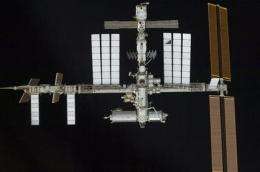
(AP) -- The near-hit of space junk Thursday was a warning shot fired across the bow of the international space station, experts said. There's likely more to come in the future. With less than an hour's notice, the three astronauts were told they'd have to seek shelter in a Russian capsule parked at the space station in case a speeding piece of space junk hit Thursday.
If it hit and they were in the main part of the station, they'd have only 10 minutes of safety, Mission Control told them. A hole in the space station could mean loss of air, loss of pressure and eventual loss of life.
The crew moved so fast that they may have left their instruction manual on the other side of a closed hatch. Inside the Soyuz, they waited for 10 minutes, ready to flee to Earth if the worst happened. On the ground, space debris experts fretted.
"We were watching it with bated breath," NASA space debris scientist Mark Matney said. "We didn't know what was going to happen."
The debris missed. Engineers still don't even know by how much and may never get a good figure. It could have been a few hundred feet or a couple miles.
In space, Commander Mike Fincke said they watched out the Soyuz window.
"We didn't see anything of course. We were wondering how close we were," he radioed Houston.
Matney, who has been with NASA since 1992 called it the closest call he can ever remember.
But it happened a month after two satellites collided in orbit, adding several hundred pieces into the space litter belt. And in the last few years, the problem of debris in space has gotten much worse with satellites destroyed on purpose.
"It's yet another warning shot that we really have to do something about space debris now. We have to do something on an international level," said Harvard astrophysicist Jonathan McDowell, who tracks everything in orbit.
"As we continue to put stuff up there, the predictions are that the rate (of close calls) will increase," added William Ailor, director of the Center for Orbital and Reentry Debris Studies at the Aerospace Corp. in El Segundo, Calif.
The U.S. Space Command tracks 13,943 orbiting objects 4 inches or larger. Only about 900 of those are working satellites, McDowell said. The rest is litter. There are thousands more smaller pieces of junk that can't be tracked as easily.
In space, size doesn't matter too much after about 3 or 4 inches. Speed does. The object that put the scare into the space station was probably 5 inches, Matney said. McDowell figures it was even bigger, maybe a foot: "a long thin thing" with a thread or string attached.
It was traveling 5.5 miles per second - about 20,000 mph, according to NASA spokesman Josh Byerly.
At that speed, something 5 inches "will wreck your whole day," Matney said.
Usually with enough warning, NASA will just move the space station out of harm's way. But NASA didn't learn of the threat until Wednesday night. This piece was in an odd orbit that kept dipping into Earth's atmosphere, making it hard to track, Matney said.
NASA didn't notify the astronauts until a couple hours after they woke on Thursday because they wanted to try to get more information about the debris, said NASA spokesman Kyle Herring
The object likely was a "yo weight" used to stabilize a global positioning satellite placed in orbit in 1993, McDowell and Matney said. It is ejected when the satellite is in its proper position.
NASA spokesman Byerly said station crews have used Soyuz as a precaution five times because of debris. But NASA space junk expert Matney said he couldn't it recall ever being used because of space debris.
The space station and space shuttle have been hit by debris in the past. But so far the only holes have been in the station's solar panels and in the shuttle radiator, neither of them dangerous, McDowell said.
"It just needs to hit at exactly the wrong place and then you have a problem," McDowell said.
The trash is even worse in the orbit of the Hubble Space Telescope. The February satellite crash increased the risk of junk hitting the space shuttle when it repairs Hubble. NASA is still calculating whether it's safe enough to do the repairs later this year.
Smaller space debris often falls into lower orbit and eventually burns up as it returns to Earth. But David Wright, a physicist with the Union of Concerned Scientists, said, "some of the big things will be up there for centuries and those are the ones that can really wreak havoc."
Lately, countries and companies launching satellites design their rockets and satellites to limit debris. But that needs to be made mandatory, McDowell said. And the latest problems may spur that type of action, Ailor said.
Russia's state-run Vesti-24 television reported on a lighter moment in the space station evacuation. Apparently the crew members left an instruction manual on board and Fincke had to be told by Mission Control how to go about getting back onto the station once the threat had passed.
---
On the Net:
NASA's International Space Station: http://www.nasa.gov/mission-pages/station/main/index.html
Associated Press Writer Steve Gutterman contributed to this report from Moscow.
©2009 The Associated Press. All rights reserved. This material may not be published, broadcast, rewritten or redistributed.


