Tracking tigers in 3-D
March 12, 2009 Tracking tigers in 3-D

Enlarge

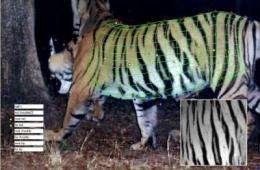
This is a three-dimensional model fitted to a camera trap image of a tiger. Credit: WCS

New software developed with help from the Wildlife Conservation Society will allow tiger researchers to rapidly identify individual animals by creating a three-dimensional model using photos taken by remote cameras. The software, described in an issue of the journal Biology Letters, may also help identify the origin of tigers from confiscated skins.

The new , developed by Conservation Research Ltd., creates a 3D model from scanned photos using algorithms similar to fingerprint-matching software used by criminologists.

The study's authors include Lex Hiby of Conservation Research Ltd., Phil Lovell of the Gatty Marine Laboratory's Sea Mammal Research Unit, and Narendra Patil, N. Samba Kumar, Arjun N. Gopalaswamy and K. Ullas Karanth all of the Wildlife Conservation Society's India Program.

Researchers currently calculate by painstakingly reviewing hundreds of photos of animals caught by camera "traps" and then matching their individual , which are unique to each animal. Using a formula developed by renowned tiger expert Ullas Karanth of WCS, researchers accurately estimate local populations by how many times individual are "recaptured" by the camera trap technique.

It is expected that the new software will allow researchers to rapidly identify animals, which in turn could speed up tiger conservation efforts.

"This new software will make it much easier for conservationists to identify individual tigers and estimate populations," said Ullas Karanth, Senior Conservation Scientist at the and one of the study's co-authors. "The fundamentals of tiger conservation are knowing how many tigers live in a study area before you can start to measure success."

The study's authors found that the software, which can be downloaded for free at: http://www.conservationresearch.co.uk, was up to 95 percent accurate in matching tigers from scanned photos. Researches were also able to use the software to identify the origin of confiscated tiger skins based on solely on photos. Development of the software was funded through a Panthera project in collaboration with WCS.

Facilities for obtaining the images used for the construction of the three-dimensional surface model were provided by the Thrigby Hall Zoo, Norfolk, England. Centre for Wildlife Studies, Bangalore and the Wildlife Conservation Society, India Program provided images, local resources and staff time for this study, which was supported in part by a grant from the Liz Claiborne / Art Ortenberg Foundation.

Source: Wildlife Conservation Society (news : web)


print this article email this article download pdf blog this article bookmark this article     Stumble it Digg this share on Facebook retweet share on Reddit add to delicious
Rate this story - not rated yet


March 12, 2009 all stories

Comments: 0

not rated yet
  • Stumble this up

  • Digg this

  • share this

  • hide
  • Related Stories

  • Wild tigers need cat food
    created Dec 13, 2006 | popularity not rated yet | comments 0
  • Study says 2000 tigers possible in Thailand
    created Dec 20, 2007 | popularity not rated yet | comments 0
  • Want to Count Wild Tigers? Go to YouTube
    created Mar 09, 2009 | popularity not rated yet | comments 0
  • WCS study finds potential to double tiger numbers in South Asia
    created Nov 05, 2007 | popularity not rated yet | comments 0
  • Photos reveal Myanmar's large and small predators
    created Sep 09, 2008 | popularity not rated yet | comments 0


  • hide
  • Relevant PhysicsForums posts

Other News

Federal agencies not taking chances to keep carp from invading Great Lakes

Biology / Ecology

created 2 hours ago | popularity not rated yet | comments 0

A group of federal agencies criticized in the past for failing to move quickly to stop Asian carp from entering the Great Lakes announced Friday that they're taking every precaution to keep them out, even poisoning thousands ...


Salmon migration mystery explored on Idaho's Clearwater River

Salmon migration mystery explored on Idaho's Clearwater River

Biology / Ecology

created 6 hours ago | popularity not rated yet | comments 0

(PhysOrg.com) -- Temperature differences and slow-moving water at the confluence of the Clearwater and Snake rivers in Idaho might delay the migration of threatened juvenile salmon and allow them to grow larger ...


Ancient penguin DNA raises doubts about accuracy of genetic dating techniques

Ancient penguin DNA raises doubts about accuracy of genetic dating techniques

Biology / Evolution

created Nov 10, 2009 | popularity 4.8 / 5 (22) | comments 13

Penguins that died 44,000 years ago in Antarctica have provided extraordinary frozen DNA samples that challenge the accuracy of traditional genetic aging measurements, and suggest those approaches have been ...


Rasberry crazy ant

Rapacious Rasberry ants march north

Biology / Plants & Animals

created Nov 13, 2009 | popularity 4.3 / 5 (7) | comments 10

Poor Texas. First it was killer bees, then fire ants. Now, it's the Rasberry ants.


Striped skunk

Skunk's Strategy Not Just Black and White

Biology / Plants & Animals

created Nov 10, 2009 | popularity 4.3 / 5 (4) | comments 4

Predators with experience of skunks avoid them both because of their black-and-white coloration and their distinctive body shape, according to UC Davis wildlife researcher Jennifer Hunter. The study was published ...