Biologists Discover Missing Piece of Plant Clock
March 12, 2009 By Susan Brown Clock Protein

Enlarge

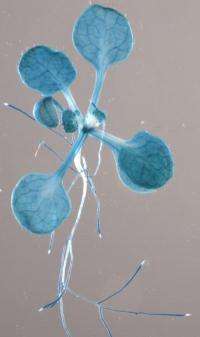
This mustard seedling is stained blue wherever the newly discovered clock protein CHE occurs. Credit: Jose Pruneda-Paz

(PhysOrg.com) -- Biologists at the University of California, San Diego have identified a key protein that links the morning and evening components of the daily biological clock of plants.

Their discovery, detailed in the March 13 issue of Science, solves a longstanding puzzle about the underlying that control plant clocks and could provide a new way to increase the growth and yield of agricultural crops.

The finding is the first outcome of a larger effort to assemble a complete library of all proteins called transcription factors, which regulate genes, in Arabidopsis, a plant often used as a .

Scientists previously had identified two primary feedback loops in the plant daily - one that detects the onset of light in the morning and another that tracks when light fades in the evening.

"The best way to construct a robust clock would be to connect the loops so that they both communicate that information to each other," said Steve Kay, dean of the Division of Biological Sciences at UC San Diego whose research team made the discovery. "Now a protein we call CHE has provided that link."

CHE, first predicted nearly a decade ago, has proved difficult to find. Multiple backup systems for many important functions in , including timekeeping, frustrate efforts to identify the function of an individual molecule or gene.

"In plants there are a lot of redundancies - proteins that do similar things," said Jose Pruneda-Paz, a postdoctoral fellow at UC San Diego and the first author of the study. "In the clock, on top of the redundancies, you have feedback loops that are interconnected. So it's difficult to perturb the system."

Disrupting a protein will fail to reveal its function if the system can compensate for its loss, so the team took a different approach. They sorted through proteins with the ability to bind to DNA, and therefore to regulate genes, and selected candidates mostly likely to be part of a clock: the ones that cycle between abundant and scarce.

Of those cyclical proteins, only CHE stuck specifically to the part of plant DNA that controls a critical component of the morning loop. Further experiments demonstrated that CHE also binds to an evening loop protein providing the missing link.

Pruneda-Paz and his co-authors "solve a major puzzle in our understanding of the plant clock," wrote C. Robertson McClung, professor of biology at Dartmouth College, in a commentary on the article that will appear in the same issue of Science.

Evidence increasingly points to the clock as a critical component of functions growth and the timing of flowering. A recent paper published in Nature by a group at the University of Texas, Austin reports that an altered clock contributes to hybrid vigor, suggesting that targeting clock genes may be a way to improve the growth of crops. "It's going to be a way to come up with rational design for increasing yield in the field," Kay said.

Kay expects the growing catalog of transcription factors to be completed by the end of the year with more than 2,000 entries, he said. "This is going to be a significant resource for the plant science community developed here at UC San Diego."

Source: University of California - San Diego (news : web)


print this article email this article download pdf blog this article bookmark this article     Stumble it Digg this share on Facebook retweet share on Reddit add to delicious
Rate this story - 5 /5 (5 votes)

Rank Filter

Move the slider to adjust rank threshold, so that you can hide some of the comments.


Display comments: newest first

  • HenisDov - Mar 14, 2009
    • Rank: not rated yet
    "Missing piece of plant clock found", about "the underlying biochemical mechanisms that control plant clocks". 2009 Passe Mantra.
    http://www.physor...384.html

    - A coming research report will re-affirm, in sophisticated sciencelingo, that the rooster indeed brings on sunrise, or that Gazania flowers switch the sun on and off. There is no "biochemical mechanisms that control bio clocks". Bio-clocks are products of the innate active-sleep pattern of genes and genomes, parents of all Earth's Life, since in their days of genesis and early evolution direct sunlight was the only source of energy in pre-metabolism Earth life. Melatonin and some proteins are dark-and-light que signals evolved by later monocellular communities for timing intercells processes when intracell processes are at rest.

    Dov Henis
    http://blog.360.y...Q--?cq=1
    (Comments From The 22nd Century)

March 12, 2009 all stories

Comments: 1

5 /5 (5 votes)
  • Stumble this up

  • Digg this

  • share this

  • hide
  • Related Stories

  • Internal clock, external light regulate plant growth
    created Jul 09, 2007 | popularity not rated yet | comments 0
  • New research alters concept of how circadian clock functions
    created Dec 13, 2007 | popularity not rated yet | comments 0
  • Molecular basis and regulation of circadian rhythms in plants
    created Jul 01, 2008 | popularity not rated yet | comments 0
  • Clock-work plants
    created Jul 22, 2005 | popularity not rated yet | comments 0
  • Circadian clock controls plant growth hormone
    created Aug 13, 2007 | popularity not rated yet | comments 0


  • hide
  • Relevant PhysicsForums posts

Other News

Scientists successfully reprogram blood cells

Biology / Cell & Microbiology

created 6 hours ago | popularity 5 / 5 (2) | comments 0

Researchers have transplanted genetically modified hematopoietic stem cells into mice so that their developing red blood cells produce a critical lysosomal enzyme -preventing or reducing organ and central nervous system damage ...


Iowa State University researcher discovers key to vital DNA, protein interaction

Researchers discover key to vital DNA, protein interaction

Biology / Other

created 2 hours ago | popularity not rated yet | comments 0

(PhysOrg.com) -- A researcher at Iowa State University has discovered how a group of proteins from plant pathogenic bacteria interact with DNA in the plant cell, opening up the possibility for what the scientist ...


Study shows that some malignant tumors can be shut down after all

Biology / Cell & Microbiology

created 10 hours ago | popularity 5 / 5 (3) | comments 1

Oncologists have had their hands tied because more than half of all human cancers have mutations that disable a protein called p53. As a critical anti-cancer watchdog, p53 masterminds several cancer-fighting operations within ...


New discovery allows scientists for the first time to experimentally annotate genomes

New discovery allows scientists for the first time to experimentally annotate genomes

Biology / Biotechnology

created 5 hours ago | popularity 5 / 5 (3) | comments 0

Over the last 20 years, the sequencing of the human genome, along with related organisms, has represented one of the largest scientific endeavors in the history of mankind. The information collected from genome ...


Wasp

Well-traveled wasps provide hope for vanishing species

Biology / Plants & Animals

created 6 hours ago | popularity not rated yet | comments 0

They may only be 1.5mm in size, but the tiny wasps that pollinate fig trees can travel over 160km in less than 48 hours, according to research from scientists at the University of Leeds. The fig wasps are transporting ...