Scientists reveal interaction between supersonic fuel spray and its shock wave
March 12, 2009 Scientists reveal interaction between supersonic fuel spray and its shock wave

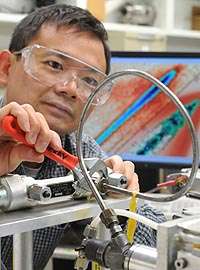
Argonne physicist Jin Wang makes adjustments to a machine used for examining high speed jets at the Advanced Photon Source.

(PhysOrg.com) -- Shock waves are a well tested phenomenon on a large scale, but scientists at the Argonne National Laboratory and their collaborators from Wayne State University and Cornell University have made a breakthrough that reveals the interaction between shockwaves created by high-pressure supersonic fuel jets.

Shockwaves have been studied in the past by such methods as solid impacts and shock generators, but the high-pressure liquid created by micrometer sized nozzles can also reach supersonic speeds.

" occur in nature and have been studied for many years, but it has been difficult to examine the of shock waves created by high-pressure jets," Argonne scientist Jin Wang said. "High-intensity X-rays can penetrate the normally opaque jet stream allowing us to see the spray's internal structure and the gaseous environment around the jet, where the shock waves are generated.

Due to the supersonic spray's opaque nature, scientists have been unable to examine the internal structure of these jets and that has limited the improvement of high-pressure and high-speed jets and spray technologies, which are essential for numerous industrial and consumer applications, such as fuel combustions in engines, paint sprays, and industrial sprays. Using high-intensity X-rays created by the Advanced Photon Source and the Cornell High Energy Synchrotron Source at Cornell University, the scientists were able to examine the interaction between the shockwaves and liquid jets with a time resolution of one-millionth of a second. The scientists made the breakthrough by also developing a complex fluid dynamics simulation to understand the experimental observation of such a dynamical event.

In the case of fuel sprays for a , such a transient interaction can affect fuel breakup and thus efficiency and emissions. Researchers have quantitatively characterized the dynamic behaviors of the shock waves and shown that this combined experimental and computational approach can be applied to the fluid dynamics of many other systems including shock-wave-induced microbubble jetting, primary breakup modeling and cavitating flows.

The unique insights provided by the simulations were validated with time-resolved x-radiograph experiments. Because understanding the complex multiphase flow occurring in shock wave/fuel jet is extremely difficult, the agreement shown between the multiphase simulations and the experimental data provides an understanding of jet-gas interactions that has not been possible.

More information: A research article reporting this study can be seen in Physical Review Letters.

Source: Argonne National Laboratory


print this article email this article download pdf blog this article bookmark this article     Stumble it Digg this share on Facebook retweet share on Reddit add to delicious
Rate this story - 4.7 /5 (3 votes)


March 12, 2009 all stories

Comments: 0

4.7 /5 (3 votes)
  • Stumble this up

  • Digg this

  • share this

  • hide
  • Related Stories

  • New X-ray technique may lead to better, cleaner fuel injectors for automobiles
    created Feb 19, 2008 | popularity not rated yet | comments 0
  • Lancets Flights Probe Supersonic Shockwaves
    created Jan 22, 2009 | popularity not rated yet | comments 0
  • Nanoparticles Generate Supersonic Shock Waves to Target Cancer
    created Jan 16, 2008 | popularity not rated yet | comments 0
  • Tycho's Remnant Provides Shocking Evidence for Cosmic Rays
    created Sep 22, 2005 | popularity not rated yet | comments 0
  • Researchers find new source of coherent light
    created Jan 13, 2006 | popularity not rated yet | comments 0


  • hide
  • Relevant PhysicsForums posts

  • Work
    created 1hour ago
  • I need some help with this project (optics and lens design)
    created 2 hours ago
  • black hole gravity
    created 3 hours ago
  • Photoelectric effect
    created 6 hours ago
  • More from Physics Forums - General Physics

Other News

The LHC tunnel

Peckish bird briefly downs big atom smasher

Physics / General Physics

created 2 hours ago | popularity 3.7 / 5 (3) | comments 2

A peckish bird briefly knocked out part of the world's biggest atom smasher by causing a chain reaction with a piece of bread, the European Organisation for Nuclear Research (CERN) said Monday.


Ginzburg helped develop the Soviet Union's hydrogen bomb in the late 1940s and early 1950s

Russian bomb physicist Ginzburg dead at 93

Physics / General Physics

created 3 hours ago | popularity 5 / 5 (2) | comments 0

Nobel Physics prize winner Vitaly Ginzburg, who helped develop the Soviet hydrogen bomb, has died at the age of 93, the Russian Academy of Sciences said Monday.


Stars Fueled by Dark Matter Could Hold Secrets to the Universe

Stars Fueled by Dark Matter Could Hold Secrets to the Universe

Physics / General Physics

created Nov 03, 2009 | popularity 4.5 / 5 (51) | comments 41

(PhysOrg.com) -- The first stars in the universe may have been very different from the stars we see today, yet they may hold clues to understanding some of the mysterious features of the universe. These "dark ...


Second Law of Thermodynamics May Explain Economic Evolution

Second Law of Thermodynamics May Explain Economic Evolution

Physics / General Physics

created Nov 02, 2009 | popularity 4.3 / 5 (31) | comments 28

(PhysOrg.com) -- Terms such as the "invisible hand," laissez-faire policy, and free-market principles suggest that economic growth and decline in capitalist societies seem to be somehow self-regulated. Now, ...


High-performance plasmas may make reliable, efficient fusion power a reality

High-performance plasmas may make reliable, efficient fusion power a reality

Physics / Plasma Physics

created Nov 02, 2009 | popularity 4.7 / 5 (40) | comments 34

In the quest to produce nuclear fusion energy, researchers from the DIII-D National Fusion Facility have recently confirmed long-standing theoretical predictions that performance, efficiency and reliability ...