Wind shifts may stir CO2 from Antarctic depths
March 12, 2009 Deep Sea Sediments

Enlarge

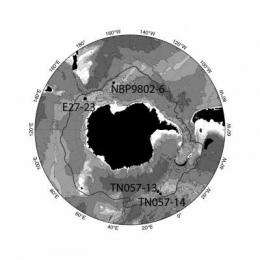
This pictures shows the locations of cores showing Antarctic upwelling. Credit: Robert Anderson, Lamont-Doherty Earth Observatory

Natural releases of carbon dioxide from the Southern Ocean due to shifting wind patterns could have amplified global warming at the end of the last ice age--and could be repeated as manmade warming proceeds, a new paper in the journal Science suggests.

Many scientists think that the end of the last ice age was triggered by a change in Earth's orbit that caused the northern part of the planet to warm. This partial climate shift was accompanied by rising levels of the , records show, which could have intensified the warming around the globe. A team of scientists at Columbia University's Lamont-Doherty Earth Observatory now offers one explanation for the mysterious rise in CO2: the orbital shift triggered a southward displacement in , which caused heavy mixing in the around Antarctica, pumping dissolved carbon dioxide from the water into the air.

"The faster the ocean turns over, the more deep water rises to the surface to release CO2," said lead author Robert Anderson, a geochemist at Lamont-Doherty. "It's this rate of overturning that regulates CO2 in the atmosphere." In the last 40 years, the winds have shifted south much as they did 17,000 years ago, said Anderson. If they end up venting more CO2 into the air, manmade warming underway now could be intensified.

Scientists have been studying the oceans for more than 25 years to understand their influence on CO2 levels and the that have periodically heated and chilled the planet for more than 600,000 years. Ice cores show that the ends of other ice ages also were marked by rises in CO2.

Two years ago, J.R. Toggweiler, a scientist at the National Oceanic and Atmospheric Administration (NOAA), proposed that westerly winds in the around Antarctica may have undergone a major shift at the end of the last ice age. This shift would have raised more CO2-rich deep water to the surface, and thus amplified warming already taking place due to the earth's new orbital position. Anderson and his colleagues are the first to test that theory by studying sediments from the bottom of the Southern Ocean to measure the rate of overturning.

The scientists say that changes in the westerlies may have been triggered by two competing events in the northern hemisphere about 17,000 years ago. The earth's orbit shifted, causing more sunlight to fall in the north, partially melting the ice sheets that then covered parts of the United States, Canada and Europe. Paradoxically, the melting may also have spurred sea-ice formation in the North Atlantic Ocean, creating a cooling effect there. Both events would have caused the westerly winds to shift south, toward the Southern Ocean. The winds simultaneously warmed Antarctica and stirred the waters around it. The resulting upwelling of CO2 would have caused the entire globe to heat.

Anderson and his colleagues measured the rate of upwelling by analyzing sediment cores from the Southern Ocean. When deep water is vented, it brings not only CO2 to the surface but nutrients. Phytoplankton consume the extra nutrients and multiply.

In the cores, Anderson and his colleagues say spikes in plankton growth between roughly 17,000 years ago and 10,000 years ago indicate added upwelling. By comparing those spikes with ice core records, the scientists realized the added upwelling coincided with hotter temperatures in Antarctica as well as rising CO2 levels.

In the same issue of Science, Toggweiler writes a column commenting on the work. "Now I think this really starts to lock up how the CO2 changed globally," he said in an interview. "Here's a mechanism that can explain the warming of Antarctica and the rise in CO2. It's being forced by the north, via this change in the winds."

At least one model supports the evidence. Richard Matear, a researcher at Australia's Commonwealth Scientific and Industrial Research Organisation, describes a scenario in which winds shift south and produce an increase in CO2 venting in the Southern Ocean. Plants, which incorporate CO2 during photosynthesis, are unable to absorb all the added nutrients, causing atmospheric CO2 to rise.

Some other climate models disagree. In those used by the Intergovernmental Panel on Climate Change, the westerly winds do not simply shift north-south. "It's more complicated than this," said Axel Timmermann, a climate modeler at the University of Hawaii. Even if the winds did shift south, Timmermann argues, upwelling in the Southern Ocean would not have raised CO2 levels in the air. Instead, he says, the intensification of the westerlies would have increased upwelling and plant growth in the Southeastern Pacific, and this would have absorbed enough atmospheric CO2 to compensate for the added upwelling in the Southern Ocean.

"Differences among model results illustrate a critical need for further research," said Anderson. These, include "measurements that document the ongoing physical and biogeochemical changes in the Southern Ocean, and improvements in the models used to simulate these processes and project their impact on atmospheric CO2 levels over the next century."

Anderson says that if his theory is correct, the impact of upwelling "will be dwarfed by the accelerating rate at which humans are burning fossil fuels." But, he said, "It could well be large enough to offset some of the mitigation strategies that are being proposed to counteract rising CO2, so it should not be neglected."

More information: "Wind-Driven Upwelling in the Southern Ocean and the Deglacial Rise in Atmospheric CO2," Science

Source: The Earth Institute at Columbia University


print this article email this article download pdf blog this article bookmark this article     Stumble it Digg this share on Facebook retweet share on Reddit add to delicious
Rate this story - 4.2 /5 (69 votes)

Rank Filter

Move the slider to adjust rank threshold, so that you can hide some of the comments.


Display comments: newest first

  • jonnyboy - Mar 12, 2009
    • Rank: 1.6 / 5 (7)
    may, might, could, possibly, if, I think,

    This is science? really??

    morons!!!!!!!!!!!!
  • Velanarris - Mar 12, 2009
    • Rank: 3.8 / 5 (5)
    The original paper is rather interesting and has a lot of good reference work as well as experimental and observation evidence.

    Only issue is, this paper doesn't really deal with CO2 as a primary agent in heating or cooling but as a secondary effect of heating or cooling. The abstract isn't really speaking to the premise of the article.
  • Commentateur - Mar 12, 2009
    • Rank: 2 / 5 (3)
    To me this article suffered by leaving me hanging on how and why the earth's orbit changed 17,000 years ago to trigger increased insolation in the northern hemisphere, and leading to the alleged effects in the Antarctic. Fortunately one of the related articles mentioned Milankovitch cycles, which google-enabled me to learn the answer I sought. Wikipedia has a fine discussion that I recommend to others who might share the question that bothered me.
  • CWFlink - Mar 13, 2009
    • Rank: 3 / 5 (4)
    Poorly written article. Thanks to the commentators above for pointing this out.

    Note critical issue in climate debate: do CO2 levels lead to, or follow from, a warming trend?

    The CO2 level is determined by a balance between many processes that push in opposite directions. Human activities such as clearing of the land and burning of carbon-based fuels push CO2 levels up, and CO2 levels are pushed down through other human activities such as farming, fertilizers (especially when they flow into oceans causing algae blooms), and forest management (when it actually REDUCES large destructive burns through small controlled burns). And there are much larger swings due to natural events (volcanoes, etc.) We are VERY far from having a good grasp of the balance of all the physical, chemical and biological processes at work.

    When I was growing up, 'scientific' predictions made it very clear we'd all have starved to death by now due to population explosion and would have killed off all the birds decades ago!

    Patience and humility is fundamental to good science. Keep politics and panic out of science!
  • Velanarris - Mar 13, 2009
    • Rank: 3 / 5 (4)
    When I was growing up, 'scientific' predictions made it very clear we'd all have starved to death by now due to population explosion and would have killed off all the birds decades ago!
    I remember this as well. It's funny, the same groups are the ones touting all the alarm behind global warming and pointing towards CO2 as the evil monster of man made industry.

    Some geologists think the CO2 is a response to heating of the ocean and increased volcanism since the 50's. A warming ocean coupled with the observed volcanic activity would cause a large amount of CO2 to be outgassed, in line with the observations of CO2 lagging behind temperature swings.
  • rubberman - Mar 16, 2009
    • Rank: 3 / 5 (2)
    It's funny that two separate climate models view the effects of upwelling in complete opposition to one another. Then again that makes easier to prove ones point....no matter what it is.

March 12, 2009 all stories

Comments: 6

4.2 /5 (69 votes)
  • Stumble this up

  • Digg this

  • share this

  • hide
  • Related Stories

  • Southern Ocean Could Slow Global Warming
    created Dec 05, 2006 | popularity not rated yet | comments 0
  • Carbon dioxide did not end the last Ice Age
    created Sep 27, 2007 | popularity not rated yet | comments 0
  • Southern Ocean resistant to changing winds
    created Dec 08, 2008 | popularity not rated yet | comments 0
  • Impact of sea-level rise on atmospheric CO2 concentrations
    created Jan 13, 2009 | popularity not rated yet | comments 0
  • Voyage to Southern Ocean aims to study air-sea fluxes of greenhouse gases
    created Feb 26, 2008 | popularity not rated yet | comments 0


  • hide
  • Relevant PhysicsForums posts

  • The IPCC and the term "most"
    created Nov 23, 2009
  • Is global warming a fact?
    created Nov 23, 2009
  • Random variability of wind patterns
    created Nov 23, 2009
  • Record precipitation in the UK
    created Nov 22, 2009
  • How to move cloud from one time to another..
    created Nov 22, 2009
  • Which countries around the world cause the most destruction to the rain forest
    created Nov 21, 2009
  • More from Physics Forums - Earth

Other News

Monster Waves on the Sun are Real

Monster Waves on the Sun are Real (w/ Video)

Space & Earth / Astronomy

created 6 hours ago | popularity 5 / 5 (8) | comments 1

Sometimes you really can believe your eyes. That's what NASA's STEREO (Solar Terrestrial Relations Observatory) spacecraft are telling researchers about a controversial phenomenon on the sun known as the "solar ...


Cosmic 'dig' reveals vestiges of the Milky Way's building blocks

Cosmic 'Dig' Reveals Vestiges of the Milky Way's Building Blocks

Space & Earth / Astronomy

created 11 hours ago | popularity 4.9 / 5 (13) | comments 1

(PhysOrg.com) -- Peering through the thick dust clouds of our galaxy's "bulge" (the myriads of stars surrounding its center), a team of astronomers has unveiled an unusual mix of stars in the stellar grouping ...


No Wheel Stall in Diagnostic Drive

Spirit Mars Rover: No Wheel Stall in Diagnostic Drive

Space & Earth / Space Exploration

created 7 hours ago | popularity 4.5 / 5 (2) | comments 0

(PhysOrg.com) -- On Sol 2095 (Tuesday, Nov. 24), Spirit performed a set of diagnostic actions related to a stall of the right-rear wheel on the previous drive, three days earlier.


Climate experts debate strategies for reducing atmospheric carbon and future warming

Climate experts debate strategies for reducing atmospheric carbon and future warming

Space & Earth / Environment

created 7 hours ago | popularity 2.8 / 5 (6) | comments 6

(PhysOrg.com) -- Reducing carbon dioxide to safe levels may require extracting carbon from the air, says Cornell climate researcher.


Oceanic crust formation is dynamic after all

Oceanic crust formation is dynamic after all

Space & Earth / Earth Sciences

created 10 hours ago | popularity 4.6 / 5 (5) | comments 0

Imagine the Earth's crust as the planet's skin: Some areas are old and wrinkled while others have a fresher, more youthful sheen, as if they had been regularly lathered with lotion.