March 12, 2009 weblog
Fusion-io Deliveries The Worlds Fastest SSD
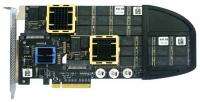
(Physorg.com) -- Fusion-io, a leader in high-performance I/O solutions, announced their new ioDrive Duo. The new ioDrive Duo is one of the fastest and most innovative server-based solid-state storage solutions. Utilizing PCI Express, the server-based solid-state storage offers up to 640 gigabytes of capacity and 1.5 gigabytes per-second of sustained throughput.
With performance for multiple ioDrive Duos scaling linearly, database and system administrators can scale performance to six gigabytes per-second of read bandwidth and over 500,000 read IOPS by using just four ioDrive Duos!
The performance of ioDrive Duo is based on the PCI Express x8 or PCI Express 2.0 x4 standards. This allows the ioDrive Duo to easily sustain 1.5 Gb/sec of read bandwidth and nearly 200,000 read IOPS.
The reliability of the ioDrive Duo offers unmatched solid-state protection for data integrity and reliability with triple redundancy for a single storage component. Each ioDrive Duo incorporates multi-bit error detection and correction, flashback protection with chip-level N+1 redundancy and on-board self-healing so that no servicing is required. There is also optional RAID-1 mirroring between two ioMemory modules for complete redundancy on a single PCIe card.
The ioDrive Duo comes in four capacities of 160 Gigs, 320 Gigs, 640 Gigs, and 1.28 TB (in second half of 2009). The ioDrive Duo will be available in April 2009. Additional information can be found on Fusion-io website.
© 2009 PhysOrg.com


