Nanoball Batteries Could Charge Electric Cars in 5 Minutes
March 12, 2009 by Lisa Zyga Nanoball battery

Enlarge

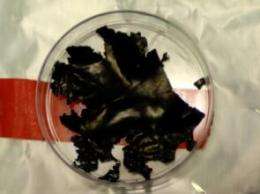
A sample of the new battery material that could allow quick charging of portable devices. Image credit: Donna Coveney.

(PhysOrg.com) -- Researchers at MIT have designed a new battery that can recharge devices about 100 times faster than conventional lithium ion batteries. The design could lead to electric car batteries that charge in 5 minutes (compared with 8 hours in today's electric cars) and cell phone batteries that charge in just 10 seconds.

Byoungwoo Kang and Gerbrand Ceder of MIT have improved the design of a "nanoball ," which has a that is composed of nanosized balls of lithium iron phosphate. As the battery charges, the nanoballs release lithium ions that travel across an to the anode. As the battery discharges, the opposite occurs, and the lithium ions are reabsorbed by the nanoballs in the cathode.

The key to the nanoball battery's quick charge time is the speed at which the lithium iron phosphate nanoballs in the cathode can release and absorb lithium ions. In conventional batteries, detaching the ions from the normal cathode takes a relatively long time. By coating each nanoball with a thin layer of lithium phosphate, Kang and Ceder showed that they could detach the lithium ions from the nanoballs even quicker than previous studies have found.

To demonstrate the technology, the researchers fabricated a small battery that could be fully charged or discharged in 10 to 20 seconds, which would otherwise have taken six minutes. The scientists' tests showed that the new material degrades less than other battery materials after repeated charges and discharges. This means that the battery could be made with less material, which could possibly lead to smaller, lighter batteries.

More information: Byoungwoo Kang and Gerbrand Ceder. "Battery materials for ultrafast charging and discharging." Nature 458, 190-193 (12 March 2009), doi:10.1038/nature07853.

© 2009 PhysOrg.com


print this article email this article download pdf blog this article bookmark this article     Stumble it Digg this share on Facebook retweet share on Reddit add to delicious
Rate this story - 4.8 /5 (25 votes)

Rank Filter

Move the slider to adjust rank threshold, so that you can hide some of the comments.


Display comments: newest first

  • el_gramador - Mar 12, 2009
    • Rank: 2 / 5 (2)
    What about memsistors? It is essentially the movement of Li( ) why not try it on a memsistor?
  • Bob_B - Mar 12, 2009
    • Rank: 1 / 5 (1)
    Where will all this lithium come from? It is very rare isn't it?
  • derricka - Mar 13, 2009
    • Rank: not rated yet
    According to the Wikipedia entry for Lithium:
    "Lithium is about as common as chlorine in the Earth's upper continental crust, on a per-atom basis."

    Now considering that salt is half chlorine...
  • holmstar - Mar 16, 2009
    • Rank: 1 / 5 (1)
    Nice easily mine-able deposits of lithium are relatively rare though.

    These articles that shout "New discovery may allow electric cars to be charged in XXX minutes" are all ignoring a key point... You can't realistically supply enough power to the car to charge it that quickly. You would need ridiculously high voltage in order to make the cable small enough to handle, but then the risk of electrocuting yourself becomes unacceptably high. And you also have to worry about arc flash: http://en.wikiped...rc_Flash

    Charging an electric car in single digit minutes is just not going to happen. Ever.
  • ezcheese15 - Mar 16, 2009
    • Rank: not rated yet
    SSC Green Inc. claims to have the technology to charge electric vehicles in as little as 10 minutes. They have yet to release anything on how they are doing it but they are supposed to demonstrate the technology at one of America's Superspeedways sometime this year. According to their website:
    "Not only does the Ultimate Aero EV have a range of 150-200 miles on a single charge, but SSC's "Charge on the RunTM" onboard charging system allows for full battery recharges in as little as 10 minutes." The statement was released on 1/22/09, so it will be interested to see what they unveil later this year on this technology.
  • Soylent - Mar 17, 2009
    • Rank: 1 / 5 (1)
    Where will all this lithium come from? It is very rare isn't it?


    No, but it's very inhomogenously distributed(South America and China, particularly Bolivia, having most of the worlds lithium).

    Choosing the most pesimistic estimates for lithium reserve base I can find, 15 million tonnes, and the most pessimistic estimate for lithium per kWh(0.3 kg) that's enough for ~1 billion Teslas(56 kWh, 250 mile range) or ~4 billion Aptera 2e's(13 kWh, 160 km range) or ~15 billion GPR-S(3.3 kWh electric motorcycle, 60-70 mph top speed, 35-60 mile range depending on circumstances).

    Mining companies don't go looking for more lithium when they have decades worth at current rates; it doesn't make any financial sense. Lithium is where oil was in 1890 in terms of how much effort has been spent looking for it.

    If you're a worrier, worry about the politics, how much the lithium will cost and in what time frame you may have it.
  • Velanarris - Apr 01, 2009
    • Rank: 3 / 5 (2)
    These articles that shout "New discovery may allow electric cars to be charged in XXX minutes" are all ignoring a key point... You can't realistically supply enough power to the car to charge it that quickly. You would need ridiculously high voltage in order to make the cable small enough to handle, but then the risk of electrocuting yourself becomes unacceptably high. And you also have to worry about arc flash: http://en.wikiped...rc_Flash
    What are you referring to? Most small businesses have a switch gear capable of delivering up to 1000V sustained at very high amperages without incident if built properly. Your average IT guy deals with UPS systems that deliver that much juice no problem, without any fear of arc flash due to the insulation methods and engineering of the delivery system. Arc flash would be about as dangerous as filling your car with gasoline while smoking.

    Protip: don't smoke while filling your car with gas.
    Future Protip: Don't strip insulation from a switchgear while recharging your car.
  • NOM - Apr 16, 2009
    • Rank: not rated yet
    A laboratory at Stanford University has a program similar to ours.
    Admit it Farbstein, you don't actually employ anyone. So you are talking about yourself in the plural. Are you royal?
  • bronzecheetah - May 25, 2009
    • Rank: 5 / 5 (1)
    There is a lot of talk about getting batteries to charge faster. If this is not possible, could we all have removable batteries on our cars? Then, pull into a gas station and exchange the used battery for a fully charged battery? It seems like this scenario would work.
  • jerryd - Jun 07, 2009
    • Rank: not rated yet

    While one to charge that fast would be hard, 1000 would be impossible as the grid would die. About 15 minute charges would be better to keep reliability and things from breaking.
    While surface Li is not as great as some would like, we really haven't started looking for it yet as before recently there was no demand. Present surface supplies are good for a decade or 2 and there are probably billions of underground salt deposits, many trap oil, NG we already know about that have untold resources of Li.

March 12, 2009 all stories

Comments: 10

4.8 /5 (25 votes)
  • Stumble this up

  • Digg this

  • share this

  • hide
  • Related Stories

  • New battery material could lead to rapid recharging of many devices
    created Mar 11, 2009 | popularity not rated yet | comments 0
  • Researchers power up new lithium battery for hybrid cars
    created Feb 16, 2006 | popularity not rated yet | comments 0
  • Scientists Working Toward Better Batteries
    created Mar 09, 2006 | popularity not rated yet | comments 0
  • Coming Soon: Improved Lithium Ion Batteries?
    created Nov 19, 2008 | popularity not rated yet | comments 0
  • Industry's First Tin-Based Anode Battery With 30 Percent More Capacity
    created Feb 15, 2005 | popularity not rated yet | comments 0


  • hide
  • Relevant PhysicsForums posts

Other News

Using superconducting probes to get a picture of what it's like inside CNTs

Nanotechnology / Nanophysics

created Nov 20, 2009 | popularity 4.9 / 5 (7) | comments 0

(PhysOrg.com) -- "Carbon nanotubes are exciting for fundamental physics, and for potential technological applications," Nadya Mason tells PhysOrg.com. "However, we are generally limited in the way that we can study them. ...


Nanoparticles used in common household items caused genetic damage in mice

Nanotechnology / Bio & Medicine

created Nov 16, 2009 | popularity 4.7 / 5 (22) | comments 11

Titanium dioxide (TiO2) nanoparticles, found in everything from cosmetics to sunscreen to paint to vitamins, caused systemic genetic damage in mice, according to a comprehensive study conducted by researchers at UCLA's Jonsson ...


Nanotube defects equal better energy and storage systems

Nanotube defects equal better energy and storage systems

Nanotechnology / Nanomaterials

created Nov 19, 2009 | popularity 4.4 / 5 (9) | comments 2

(PhysOrg.com) -- Most people would like to be able to charge their cell phones and other personal electronics quickly and not too often. A recent discovery made by UC San Diego engineers could lead to carbon ...


When It Comes to Drug Delivery, Size Matters

Nanotechnology / Bio & Medicine

created Nov 20, 2009 | popularity 5 / 5 (1) | comments 0

(PhysOrg.com) -- One of the great promises of nanotechnologies lies in its ability to create drug-containing nanoparticles decorated with targeting molecules that recognize and bind to cancer cells, providing drug delivery ...


Scientists synthesize graphene-like material: Polymer with honeycomb structure

Scientists synthesize graphene-like material: Polymer with honeycomb structure

Nanotechnology / Nanomaterials

created Nov 19, 2009 | popularity 4.5 / 5 (6) | comments 1

Two-dimensional carbon layers, so-called graphenes, are regarded as a possible substitute for silicon in the semiconductor industry. The electronic properties of these layers can be varied by "building in" ...