Culture skews human evolution
March 12, 2009
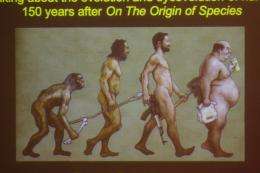
‘Our bodies are not that well-designed for the world we have created,’ said anthropology professor Daniel Lieberman. He illustrated it with this drawing. Photograph by Kris Snibbe/Harvard News Office
(PhysOrg.com) -- The rise of agriculture 10,000 years ago meant the end of the hunter-gatherer lifestyle for which human beings had been optimized by millions of years of evolution and the beginning of an era where culture encourages habits unhealthy for us and for the world around, with uncertain evolutionary outcomes.
“Our bodies are not that well designed for the world we have created,” said anthropology professor Daniel Lieberman.
Lieberman spoke March 5 in the third of the Harvard Museum of Natural History’s (HMNH) “Evolution Matters” lecture series. His talk, called “Survival of the Fleetest, Smartest or Fattest?” reviewed the evolutionary trends that led to modern humans and discussed the cultural reasons for some of today’s major health ills, such as obesity and diabetes.
Lieberman, who was introduced by HMNH Executive Director Elisabeth Werby, said the four most significant events in human history were our separation from apes; the evolutionary development of the genus Homo, shared by modern humans, Neanderthals, and Homo erectus; and the separation of our species, Homo sapiens, from our common ancestor with other Homo species.
The final event, Lieberman said, was a cultural one, not an evolutionary one. The beginnings of agriculture 10,000 years ago created lasting change that led to modern society and our modern way of life.
Farming culture allowed human women to give birth more frequently, spurring population growth. It also led to the spread of disease, as humans were in close contact with a variety of animal species, such as chickens, pigs, and cows, providing an environment in which animal viruses could pass into humans. It also led to the protection of people who physically might not survive in a hunter-gatherer society, and the rise of conditions and ailments such as myopia and diabetes.
The result, Lieberman said, is a cultural buffering of evolution’s harsh rule of “survival of the fittest” that may be leading to the “dysevolution” of Homo sapiens.
Though scientific opinion varies on whether evolution is still acting on humans, Lieberman said it probably is, pointing to relatively recent developments of lactose tolerance in adults — allowing them to consume dairy products long after weaning — and of pale skins in those from northern climates.
To understand the roots of “dysevolution,” one must understand where humans came from, Lieberman said. Descended from a common ancestor with chimpanzees between 6 million and 8 million years ago, early primitive humans like Sahelanthropus and Ardipithecus were very chimplike but walked upright. Lieberman traced this adaptation to climate change, namely a planetary cooling that transformed large tracts of thick jungle to open woodlands where walking would be a more efficient form of locomotion than either the climbing or knuckle-walking at which chimps excel.
The next change, Lieberman said, was driven by an additional cooling, which led to further thinning of the forests and the rise of savannah. From these changes arose the genus Homo between 2 million and 3 million years ago. Early human ancestors evolved different adaptations to survive on the savannah, with an Australopithecus species becoming adapted to large amounts of low-quality food, as evidenced by their large teeth.
The Homo genus evolved a different way of life, adapting for high-quality, high-energy foods, and becoming good at running in the heat of the day to engage in “persistence hunting” to run down exhausted prey species.
The first Homo sapiens appeared about 200,000 years ago and may have evolved from Homo heidelbergensis, Lieberman said, and continued to invent new tools and technology, spreading out of Africa to Europe, Asia, and other parts of the world. We were smart, inventive, highly mobile endurance athletes who cooked our food to get more energy from it. We were also relatively fast breeders when compared with other apes, with a baby every three years.
These evolutionary solutions were successful, Lieberman said, but energy intensive. The problem today, Lieberman said, is that humanity’s “gas guzzling” strategies, which enabled them to survive on the African savannah and expand around the world, aren’t always helpful in an era with ready fast food, sugar-rich snacks, and steadily decreasing demand for physical exertion.
“Obviously, they stood us in good stead until the very recent past,” Lieberman said.
Since we can’t will ourselves to evolve so that we don’t crave high-energy foods, Lieberman said we should instead encourage our inner hunter-gatherer by requiring more physical activity of our kids in schools, raising gasoline taxes to discourage driving, outlawing fast food, and restricting access to elevators, escalators, and moving sidewalks to force us to walk more.
“We need to think more like Darwin and act more like hunter-gatherers,” Lieberman said.
-
Humans hot, sweaty, natural-born runners
Apr 16, 2007 |
not rated yet |
0
-
Early human ancestors had a wobble in their walk
Feb 08, 2006 |
not rated yet |
0
-
The 'spread of our species'
Nov 08, 2005 |
not rated yet |
0
-
Neanderthal Man Was An Innovator, Study Says
Jun 19, 2007 |
not rated yet |
0
-
Fossil shows human growth at least 160,000 years ago
Mar 13, 2007 |
not rated yet |
0
-
Engineers build first sub-10-nm carbon nanotube transistor
Feb 01, 2012 |
4.9 / 5 (30) |
30
-
Something old, something new: Evolution and the structural divergence of duplicate genes
Jan 31, 2012 |
4.6 / 5 (7) |
1
-
The hidden nanoworld of ice crystals: Revealing the dynamic behavior of quasi-liquid layers
Jan 30, 2012 |
5 / 5 (3) |
1
-
Stock market network reveals investor clustering
Jan 27, 2012 |
3.9 / 5 (23) |
8
-
Of microchemistry and molecules: Electronic microfluidic device synthesizes biocompatible probes
Jan 26, 2012 |
5 / 5 (1) |
0
-
Pertubance in a model
1 hour ago
-
Cancer drugs and Alzheimer's, Oh my!
9 hours ago
-
Squishing cells
10 hours ago
-
Any books/articles for evolutionary stable strategy models in humans?
21 hours ago
-
Science behind the bore feeling?
Feb 09, 2012
-
Homo Sapien vs. Chimpanzee - Divergence Timeline
Feb 09, 2012
- More from Physics Forums - Biology
More news stories
Miami battling invasion of giant African snails
No one knows how they got there. But an invasion of African giant snails has southern Florida in a panic over potential crop damage, disease and general yuckiness surrounding the slimy gastropods.
3 hours ago |
not rated yet |
1
Cure of ADPKD by selection for spontaneous genetic repair events in Pkd1-mutated iPS cells
A research group including Kyoto University researchers demonstrates that mouse iPS cells, in which genetic correction occurs spontaneously through mitotic recombination, is selectable from the population of genetically mutated ...
1 hour ago |
not rated yet |
0
An eye for the tsetse fly
(PhysOrg.com) -- Geoffrey M. Attardo was one of those little boys who made pets of the spiders outside his bedroom window, feeding them and watching as they spun intricate webs. Age has not diminished his ...
1 hour ago |
not rated yet |
0
Protein libraries in a snap
(PhysOrg.com) -- A Rice University undergraduate will depart with not only a degree but also a possible patent for his invention of an efficient way to create protein libraries, an important component of biomolecular ...
3 hours ago |
5 / 5 (1) |
0
|
Fighting crimes against biodiversity: How to catch a killer weed
Invasive species which have the potential to destroy biodiversity and influence global change could be tracked and controlled in the same way as wanted criminals, according to new research from Queen Mary, University of London.
4 hours ago |
not rated yet |
0
Clam fields found at deep, low-temperature Mariana vents
(PhysOrg.com) -- Scientists have marveled at the unusual life forms thriving at high temperature hydrothermal vents of the deep ocean.
Seeing colors in music, tasting flavors in shapes may happen in life's early months
Famed violinist Itzhak Perlman sees a deep forest green whenever he plays a B-flat on his Stradivarius' G string. The A on the E string is red.
Could Venus be shifting gear?
(PhysOrg.com) -- ESAs Venus Express spacecraft has discovered that our cloud-covered neighbour spins a little slower than previously measured. Peering through the dense atmosphere in the infrared, the ...
Team isolates nerve cells involved in storing long term memory and gene proteins associated with them
(Medical Xpress) -- A research team in Taiwan has succeeded in isolating two nerve cells in fruit fly brains that are believed to be the major players in allowing for the formation of long term memories. Furthermore, ...
Is that sleepiness during pregnancy normal or a sign of sleep apnea?
(Medical Xpress) -- Most pregnant women complain of being tired. Some of them however, could be suffering more than normal fatigue associated with their pregnancy; they may have developed obstructive sleep apnea (OSA), a ...
Engineering images bring life to submerged city
(PhysOrg.com) -- Photo-realistic 3D mapping and digital reconstruction of an ancient underwater city in Greece have earned a team from the University of Sydney's Faculty of Engineering and Information Technologies ...
Mar 13, 2009
Rank: 2.3 / 5 (3)
This has got to be a joke. Only an IDIOT would suggest such a thing.
Ok gotta go on my 30 mile walk to work this morning...phhh...moron...
Mar 13, 2009
Rank: 5 / 5 (1)
Mar 13, 2009
Rank: 5 / 5 (1)
Mar 14, 2009
Rank: not rated yet
http://www.physor...530.html
"...(there is a) cultural buffering of evolution%u2019s harsh rule of %u201Csurvival of the fittest%u201D that may be leading to the %u201Cdysevolution%u201D of Homo sapiens.
- This is a confused concept-comprehension of evolution. Genetic evolution does not occur in accordance with an evolution rule-law, and it is not a result of survival of the fittest. Genetic evolution, i.e. changes in expressions of genes, are mostly not random and are not the source of evolution but the consequences of cultural evolution, i.e. of evolved survival patterns. First evolves the culture of the organism, i.e. its pattern of assessing of/reaction to its circumstances, then the organism's cultural pattern impacts the genes-genome and consequently the genes change their expressions.
Dov Henis
http://blog.360.y...Q--?cq=1
(Comments From The 22nd Century)
Life's Manifest
http://www.the-sc...page#578
EVOLUTION Beyond Darwin 200
http://www.physfo...ic=14988&st=405entry396201
Mar 15, 2009
Rank: not rated yet
Not a law, a process.
Horse manure. Genetic evolution is due to changes in the genome by mutations of various kinds and selection by the environment acting on the expression of the genetic data. Whether the environmental changes are due to culture or non-cultural effects.
Only for organisms that have cultural adaptations.
Are you sure you wanted that to sound Lamarkian?
Change in the genome is initiated by largely random changes and then shaped by death or failure to reproduce due to interactions with the environment and often just plain luck as in founder effects.
Ethelred
Jun 17, 2009
Rank: not rated yet
I wish someone more familiar with the study would post an explaination/rationalization/refutation of that observation.
Jun 17, 2009
Rank: not rated yet
The problem there is the concept of the survival of the fittest. That is not evolution. Its shorthand for evolution by people that don't quite have the hang of the idea.
Evolution is the name or tag we use to talk about a process of change. An inevitable process. It can't be buffered, at least without genetic engineering. As long as there are mutations and death before successful reproduction there will be evolution by the process of natural selection.
Perhaps Lieberman understands all this and was just taking linguistic shortcuts. Our culture is part of our environment. We not only evolve to adapt to the non-human parts of our environment we also adapt to the human parts. Sexual selection would be the oldest form of cultural adaptation and it effects non-humans as well.
Ethelred