'Self-correcting' gates advance quantum computing
March 12, 2009 Researchers' 'self-correcting' gates advance quantum computing

Enlarge

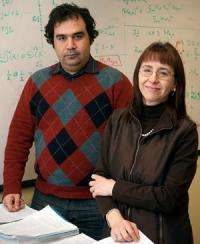
Post-doctoral Fellow Kaveh Khodjasteh and Associate Professor of Physics and Astronomy Lorenza Viola (photo by Joseph Mehling '69)

(PhysOrg.com) -- Two Dartmouth researchers have found a way to develop more robust “quantum gates,” which are the elementary building blocks of quantum circuits. Quantum circuits, someday, will be used to operate quantum computers, super powerful computers that have the potential to perform extremely complex algorithms quickly and efficiently.

Associate Professor of Physics and Astronomy Lorenza Viola and Post-doctoral Fellow Kaveh Khodjasteh report their findings in the Feb 27, 2009 issue of . Their study is titled “Dynamically Error-Corrected Gates for Universal .”

The futuristic realm of quantum computing considers units of information called , or , which can be carried by quantum-mechanical objects such as electrons or atoms. Unlike today’s computers, which use of 0s and 1s, a quantum computer uses qubits that can each be in a superposition of 0 and 1. As a result, quantum computers could efficiently solve computational problems beyond the reach of today’s computers.

“An outstanding challenge stems from the fact that quantum bits are incredibly more prone to errors than their traditional-sized counterparts,” says Viola, who is the director of Dartmouth’s Quantum Information Science Initiative. “All quantum gates, the building blocks for implementing complex quantum-mechanical circuits, are plagued by errors originating from both the interaction with the surrounding quantum environment or operational imperfections.”

Viola’s and Khodjasteh’s study showed how to construct new quantum gates that can be “dynamically corrected” out of sequences from the available faulty gates. In this manner, the researchers say, the net total error is approximately canceled.

“The key idea is to carefully exploit known relationships between unknown errors,” says Viola. “Dynamically corrected gates allow for substantially higher fidelity to be reaching quantum circuits, and can thus bring the implementation of reliable quantum-computing devices closer to reality.”

Provided by Dartmouth College


print this article email this article download pdf blog this article bookmark this article     Stumble it Digg this share on Facebook retweet share on Reddit add to delicious
Rate this story - 4.6 /5 (14 votes)

Rank Filter

Move the slider to adjust rank threshold, so that you can hide some of the comments.


Display comments: newest first

  • NeilFarbstein - Mar 12, 2009
    • Rank: 1 / 5 (4)
    the incredible part; some believe that quantum teleportation is already causing telepathic phenomena where large amounts of coherent information are being transferred between people. There is some type of natural error correcting mechanism or quantum pheonomenon that like superconductivity causes long range cohenrency.
  • Smellyhat - Mar 12, 2009
    • Rank: 5 / 5 (1)
    the incredible part; some believe that quantum teleportation is already causing telepathic phenomena where... [etc.]


    That's not particularly incredible. "Some" is a group of people with a long track record of believing all sorts of thing.
  • nilbud - Mar 13, 2009
    • Rank: 1 / 5 (1)
    NFarbstein what a wonderful world you live in, any time you have difficulty with reality just invent a whole new swath of "special" knowledge. Then you are the only one who knows and it takes as much effort as a children's fairytale.
  • johanfprins - Mar 14, 2009
    • Rank: not rated yet
    the incredible part; some believe that quantum teleportation is already causing telepathic phenomena where large amounts of coherent information are being transferred between people. There is some type of natural error correcting mechanism or quantum pheonomenon that like superconductivity causes long range cohenrency.

    Long range coherency is found within a laser beam: It is wrong to claim that it also manifests within a traditional superconductor. In a traditional superconductor current is transported by correlated movement of adjacent charge-carriers: i.e. a local mechanism. Coherent superconduction is only possible when it occurs without having localised charge-carriers conveying the current.

    The charge is then teleported across the phase. I have already generated this phase 8 years ago by extracting electrons with an anode from n-type diamond: When doing this and the electron density becomes high enough the electrons between the diamond and anode condense to form a single macro-wave. This wave is coherent and does therefore superconduct by teleportation (no local correlated movement of charge-carriers involved). This macro- electron wave is on a smaller scale like a covalent bond (2 condensed electrons) or a double bond (4 condensed electrons) or a triple bond (6 condensed electrons) except that consists of milliosn of electrons.

    When such a wave exist of neutral matter, one obtains "dark matter". The latter should also be able to teleport: This could explain telepathy.
    It is highly likely that a similar condensation of electrons form along a DNA string.

March 12, 2009 all stories

Comments: 4

4.6 /5 (14 votes)
  • Stumble this up

  • Digg this

  • share this

  • hide
  • Related Stories

  • 2 qubits in action, new step towards the quantum computer
    created Jun 14, 2007 | popularity not rated yet | comments 0
  • Quantum breakup is no heartbreaker
    created Feb 14, 2006 | popularity not rated yet | comments 0
  • A Quantum CPU: the Pentium Q?
    created May 23, 2006 | popularity not rated yet | comments 0
  • Quantum computers could excel in modeling chemical reactions
    created Nov 20, 2008 | popularity not rated yet | comments 0
  • 12-qubits reached in quantum information quest
    created May 08, 2006 | popularity not rated yet | comments 0


  • hide
  • Relevant PhysicsForums posts

  • Why are Horizontal Axis Wind Turbines used other than Vertical Axis?
    created 2 hours ago
  • Reverse Universe
    created 6 hours ago
  • Self Study From Books
    created 7 hours ago
  • Fresnel Biprism
    created 10 hours ago
  • More from Physics Forums - General Physics

Other News

Building a more versatile laser

Building a more versatile laser

Physics / Optics & Photonics

created 11 hours ago | popularity 4.4 / 5 (8) | comments 0

(PhysOrg.com) -- One of the drawbacks associated with using semiconductor lasers is that many of them can only produce a beam of a single wavelength, and can only send that beam in one direction at a time. ...


Engineer Discovers Why Particles Like Flour Disperse on Liquids

Engineer Discovers Why Particles Like Flour Disperse on Liquids

Physics / General Physics

created 3 hours ago | popularity 4.3 / 5 (6) | comments 0

(PhysOrg.com) -- Even if you are not a cook, you might have wondered why a pinch of flour (or any small particles) thrown into a bowl of water will disperse in a dramatic fashion, radiating outward as if it ...


Measuring Electron Orbitals

Measuring Electron Orbitals

Physics / General Physics

created 12 hours ago | popularity 5 / 5 (4) | comments 0

(PhysOrg.com) -- For the first time, it has been possible to measure electron density in individual molecular states using what is known as the photoelectric effect. Now published in Science, this method repres ...


Scientists demonstrate 'universal' programmable quantum processor

Scientists demonstrate 'universal' programmable quantum processor

Physics / Quantum Physics

created Nov 15, 2009 | popularity 4.6 / 5 (19) | comments 11

Physicists at the National Institute of Standards and Technology have demonstrated the first "universal" programmable quantum information processor able to run any program allowed by quantum mechanics -- th ...


Do we need dark matter?

Do we need dark matter?

Physics / General Physics

created Nov 12, 2009 | popularity 4.1 / 5 (18) | comments 33

It's the biggest problem in physics: the matter we can see in the universe accounts for just five per cent of the observed gravity that holds galaxies together.