Students Launch Cockroaches and Cameras Into Space
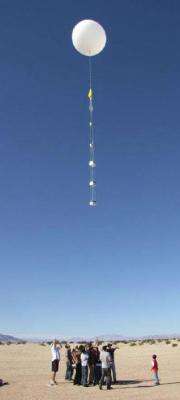
(PhysOrg.com) -- A group of cockroaches recently took a ride on a high-altitude balloon launched into space by freshmen aerospace engineering students from the University of California, San Diego. The cockroaches were put in a variety of capsules to see how they would survive in different extreme environments, including cold temperatures (-40 degrees F), minimal atmosphere and high solar radiation. The capsules were first ground tested in a cold vacuum chamber to insure the chambers would survive the cold and near vacuum of space without bursting. The high-altitude balloon experiment came off without a hitch--all the cockroaches survived.
Twenty-two engineering students, working in six teams, along with graduate teaching assistants Andrew Cavender and Zach Lovering, designed and built payload boxes that were hung from a high-altitude balloon, which was launched from the desert near Plaster City, Calif, into near space at 85,000 feet and then recovered nearly 65 miles east in the North Algodones Dunes Wilderness Area. Besides the cockroaches, other experiments and payloads included programmable digital cameras to take images from space, and atmosphere monitoring sensors for future investigation of weather patterns and air pollution control. The students will also use data collected from the balloon-satellite to evaluate solar cell efficiency. The data collected from the experiment will be used for future balloon launches. The students may even launch a UC San Diego high-altitude balloon club.
The first-time UC San Diego balloon-satellite project was part of an Introduction to Aerospace Engineering class taught by John Kosmatka and Keiko Nomura, professors in the Jacobs School of Engineering.
“What makes this project unique is that it’s a hands-on project that allowed students to launch a high-altitude balloon into near space, which is something that our students have never done before,” said Kosmatka, a structural engineering professor. “We also wanted to expose students to a teaming project environment.”
Kosmatka said some of these experiments could lead to future, real-life engineering solutions.
"For example, the purpose of the atmosphere monitoring experiment was to encourage future students to investigate changing atmospheric patterns, which could set the stage for future air quality and weather monitoring and prediction studies,” he said. “For example, if we have more wild fires in San Diego, our students could launch a high-altitude balloon and monitor the air quality and pollution at different altitudes; this could aid future environmental studies.”
Kosmatka pointed to another student team that investigated and monitored the performance of solar cells at different altitudes.
“Solar cells have different efficiency ratings and the question is, how do the efficiencies change with altitude?” he said. “There is a big push in the aerospace industry to develop unmanned aircraft that act like low-earth orbiting satellites powered by solar cells. The research our students are doing could help determine the best flight altitudes based upon aircraft and solar cell performance.
“Through these types of projects, our best and brightest students in engineering recognize that they can make a difference and that they can change the world,” Kosmatka added.
One of those students is David Hernandez, an undergrad aerospace engineering student, who was on the Vitals Team for the balloon-satellite project, which was responsible for gathering data as the balloon ascended, including recording pressure, temperature solar radiation, and wind speed.
“A lot of us are concerned about global warming and we want to find out more about this trend,” Hernandez said. “We want to look at the data we collected and try to determine why there are such discrepancies in temperatures. … We won’t know until there are more tests conducted.”
Hernandez. said he would like to continue these types of experiments that will hopefully, one day, lead to a cleaner and healthier environment.
“Engineers don’t get into engineering because it’s easy,” he said. “We do it because we like the challenge and finding solutions to the things that haven’t been done. Since this was the first time for UC San Diego to launch a high-altitude balloon, we started from scratch and had to figure out what type of sensors to utilize, as well as what measurements and payloads to do.
“Not everybody can say they launched a high-altitude balloon 85,000 feet in the air and have the pictures to prove it,” Hernandez added. “It’s really inspiring for first-year aerospace engineering students to be able to do something tangible rather than just read about it in a book.”
David Gross, another aerospace engineering undergrad, said the balloon-satellite was the most interesting scientific project he’s ever done.
“It affirmed my belief that aerospace engineering is a complex, important, and intriguing profession,” Gross said. “The entire design process - from laying it out on paper, to purchasing the components, to building it, to finally actually flying and retrieving the balloon - was exciting and definitely something that I want to be a part of with future projects.
“UC San Diego gives freshman the opportunity to participate in great projects like this,” he added. “When it was first announced that we would be doing this project this year, I was very satisfied that I chose UCSD's aerospace program over some of the other options I had coming into college. I mean, just look at some of the pictures our on-board cameras took and tell me that isn't cool.”
As part of its balloon-satellite payload experiment, Gross’s team developed a solar cell array to measure solar energy as the balloon ascended in the atmosphere and used a Geiger counter to measure alpha, beta, gamma, and x-ray radiation. Indiana-based StratoStar Systems focused on launch integration and provided the team with a system to relay data and the balloon location to laptop computers on the ground.
The balloon-satellite project was sponsored by NASA’s California Space Grant Consortium, whose purpose is to promote aerospace engineering education as well as the development of the STEM ((Science, Technology, Engineering, and Math) workforce of the future.
Provided by University of California, San Diego


