Metal Becomes Transparent Under High Pressure
March 12, 2009 Metal Becomes Transparent Under High Pressure

Enlarge

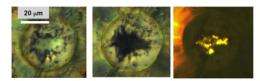
Sodium, a white metal at pressures below 1.5 Mbar (left -- picture at 1.1 Mbar, 1 Mbar = 1 million atmospheres), turns black at 1.5 Mbar (center -- picture at 1.56 Mbar) and becomes red transparent at 1.9 Mbar (right -- picture at 1.99 Mbar). It is predicted to become colorless and transparent like glass at ~3 Mbar.

An international team of scientists have discovered a transparent form of the element sodium (Na). The team, led by Artem Oganov, Professor of Theoretical Crystallography at Stony Brook University, and Yanming Ma, the lead author and professor of physics at Jilin University in China, was able to demonstrate that sodium defies normal physical expectations by going transparent under pressure. The results are published in the March 12 edition of the journal Nature.

“It is well known that at sufficiently high compression all materials must go metallic,” said Oganov. “This is seen in the metallization of hydrogen at high pressures and temperatures inside planets Jupiter and Saturn.”

However, as the researchers found, element does just the opposite. A perfect white metal at atmospheric , on increasing pressure sodium first turns black, then (at the pressure of 2 million atmospheres) red transparent, and eventually becomes a colorless - just like glass.

“This fundamental result is important for understanding properties of highly compressed matter, particularly within stars and ,” said Oganov.

The unexpected transformation was first predicted by Professor Ma. His sophisticated calculations clearly indicated that sodium adopts unusual crystal structures and becomes an insulator at high pressures. Together with Professor Oganov, Ma was able to demonstrate that, at very high compressions, overlapping sodium atoms force their into the “holes” between the atoms.

“In these holes electrons demonstrate an extremely localized behavior, responsible for the collapse of the ,” said Ma. “These electrons behave as ‘fake atoms,’ just like in electrides - where the role of the anion is played by localized electrons.”

To test this unexpected prediction, Ma and Oganov contacted Mikhail Eremets, the leader of an experimental group at Max Planck Institute of Chemistry, Mainz (Germany). Eremets was initially skeptical of the Ma-Oganov predictions, yet he was undeterred by extreme technical challenges of reaching pressures of over 2 million atmospheres. Eremets and his group initiated a cohort of several extremely difficult experiments, using a tiny micrometer-size sample. Through these experiments, the group was able to confirm the predictions of a new structure and transparency of sodium (see Figure).

“What fascinated us most is that the pressures at which this transformation was predicted were experimentally reachable,” Oganov said, “and that at these conditions such a remarkable change of chemistry occurs”.

Provided by Stony Brook University


print this article email this article download pdf blog this article bookmark this article     Stumble it Digg this share on Facebook retweet share on Reddit add to delicious
Rate this story - 4.5 /5 (19 votes)

Rank Filter

Move the slider to adjust rank threshold, so that you can hide some of the comments.


Display comments: newest first

  • SciTechdude - Mar 12, 2009
    • Rank: 2.9 / 5 (8)
    Save the whales with your transparent sodium fish tank in your spacecraft! Yay!
  • Mercury_01 - Mar 12, 2009
    • Rank: 1.3 / 5 (12)
    This is totally fake.
  • pseudophonist - Mar 13, 2009
    • Rank: 4.5 / 5 (4)
    This is totally fake.

    Actually its very believable since most of our scientific knowledge is based around 1atmosphere.
  • Alexa - Mar 13, 2009
    • Rank: 2.6 / 5 (5)
    I'm missing an information, when we could expect first sun glasses made of transparent sodium?
  • tkjtkj - Mar 13, 2009
    • Rank: 1 / 5 (4)
    "It is predicted to become colorless and transparent like glass at ~3 Mbar."

    Well, what is going on here!? Is this a prediction?? or an observation??? There IS a difference, you know!

    How do articles like this get into the press!? Are they not edited for clarity? And why must i even ask about this? Can't it be expected that an article 'speaks for itself'??

  • raron - Mar 13, 2009
    • Rank: 3.7 / 5 (3)
    SciTechdude: lol. They almost got it right. Thats the funniest Star Trek movie btw!
  • docatomic - Mar 13, 2009
    • Rank: 3 / 5 (2)
    Ah, yes; of course - the initial discovery of superinsulators.
  • Alexa - Mar 13, 2009
    • Rank: 3 / 5 (1)
    "It is predicted to become colorless and transparent like glass at ~3 Mbar." Well, what is going on here!? Is this a prediction??
    Usage of "predicted" word usually denotes a prediction - or am I wrong?
  • Mercury_01 - Mar 13, 2009
    • Rank: 1 / 5 (4)
    This is totally fake.

    Actually its very believable since most of our scientific knowledge is based around 1atmosphere.


    Its called bullshitting. try it out sometime.
  • andrzejmiklaszewski - Mar 17, 2009
    • Rank: not rated yet
    I'm wondering about the pressure, which method was used to get so big amount??the authors only suggesting the small size of sample

March 12, 2009 all stories

Comments: 10

4.5 /5 (19 votes)
  • Stumble this up

  • Digg this

  • share this

  • hide
  • Related Stories

  • Novel forms of the elements predicted by simulation
    created Jun 22, 2006 | popularity not rated yet | comments 0
  • Sodium loses its luster: A liquid metal that's not really metallic
    created Sep 26, 2007 | popularity not rated yet | comments 0
  • Discovery of ionic elemental crystal against chemical intuition
    created Jan 29, 2009 | popularity not rated yet | comments 0
  • Crystal structure prediction made possible
    created Dec 22, 2005 | popularity not rated yet | comments 0
  • Polymeric nitrogen synthesised
    created Aug 05, 2004 | popularity not rated yet | comments 0


  • hide
  • Relevant PhysicsForums posts

Other News

First Bose-Einstein condensation of strontium

First Bose-Einstein condensation of strontium

Physics / Quantum Physics

created 1hour ago | popularity 5 / 5 (1) | comments 0

In an international first, scientists from the Institute of Quantum Optics and Quantum Information (IQOQI, Austria) produced a Bose-Einstein condensate of the alkaline-earth element strontium, thus narrowly ...


The LHC tunnel

Peckish bird briefly downs big atom smasher

Physics / General Physics

created 7 hours ago | popularity 3.6 / 5 (8) | comments 10

A peckish bird briefly knocked out part of the world's biggest atom smasher by causing a chain reaction with a piece of bread, the European Organisation for Nuclear Research (CERN) said Monday.


Ginzburg helped develop the Soviet Union's hydrogen bomb in the late 1940s and early 1950s

Russian bomb physicist Ginzburg dead at 93

Physics / General Physics

created 9 hours ago | popularity 5 / 5 (2) | comments 0

Nobel Physics prize winner Vitaly Ginzburg, who helped develop the Soviet hydrogen bomb, has died at age 93, the Russian Academy of Sciences said Monday.


Stars Fueled by Dark Matter Could Hold Secrets to the Universe

Stars Fueled by Dark Matter Could Hold Secrets to the Universe

Physics / General Physics

created Nov 03, 2009 | popularity 4.5 / 5 (52) | comments 43

(PhysOrg.com) -- The first stars in the universe may have been very different from the stars we see today, yet they may hold clues to understanding some of the mysterious features of the universe. These "dark ...


Second Law of Thermodynamics May Explain Economic Evolution

Second Law of Thermodynamics May Explain Economic Evolution

Physics / General Physics

created Nov 02, 2009 | popularity 4.3 / 5 (31) | comments 28

(PhysOrg.com) -- Terms such as the "invisible hand," laissez-faire policy, and free-market principles suggest that economic growth and decline in capitalist societies seem to be somehow self-regulated. Now, ...