New experiments constrain Higgs mass (w/Videos)
March 13, 2009
New experiments constrain Higgs mass

Enlarge

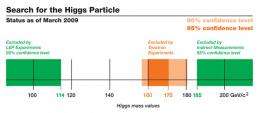
Scientists from the CDF and DZero collaborations at DOE's Fermilab have combined Tevatron data from their two experiments to increase the sensitivity for their search for the Higgs boson. While no Higgs boson has been found yet, the results announced today exclude a mass for the Higgs between 160 and 170 GeV/cē with 95 percent probability. A larger area is excluded at the 90 percent probability level. Earlier experiments at the Large Electron-Positron Collider at CERN excluded a Higgs boson with a mass of less than 114 GeV/cē at 95 percent probability. Calculations of quantum effects involving the Higgs boson require its mass to be less than 185 GeV/cē. The results show that CDF and DZero are sensitive to potential Higgs signals. The Fermilab experimenters will test more and more of the available mass range for the Higgs as their experiments record more collision data and as they continue to refine their experimental analyses.

(PhysOrg.com) -- The territory where the Higgs boson may be found continues to shrink. The latest analysis of data from the CDF and DZero collider experiments at the U.S. Department of Energy's Fermilab now excludes a significant fraction of the allowed Higgs mass range established by earlier measurements. Those experiments predict that the Higgs particle should have a mass between 114 and 185 GeV/c2. Now the CDF and DZero results carve out a section in the middle of this range and establish that it cannot have a mass in between 160 and 170 GeV/c2.

"The outstanding performance of the and CDF and DZero together have produced this important result," said Dennis Kovar, Associate Director of the Office of Science for at the U.S. Department of Energy. "We're looking forward to further Tevatron constraints on the Higgs ."

The Higgs particle is a keystone in the theoretical framework known as the of and their interactions. According to the Standard Model, the explains why some elementary particles have mass and others do not.

So far, the Higgs particle has eluded direct detection. Searches at the Large Electron Positron at the European laboratory established that the Higgs boson must weigh more than 114 GeV/c2. Calculations of quantum effects involving the Higgs boson require its mass to be less than 185 GeV/c2.

This video is not supported by your browser at this time.

So far, CDF and DZero each have analyzed about three inverse femtobarns of collision data--the scientific unit that scientists use to count the number of collisions. Each experiment expects to receive a total of about 10 inverse femtobarns by the end of 2010, thanks to the superb performance of the Tevatron. The collider continues to set numerous performance records, increasing the number of proton-antiproton collisions it produces.

Provided by Fermi National Accelerator Laboratory

4.6 /5 (7 votes)  

Rank 4.6 /5 (7 votes)
Related Stories
Relevant PhysicsForums posts
  • Thermodynamics q
    created4 hours ago
  • what is electricity???
    created7 hours ago
  • Can Plasma Be Solid
    created8 hours ago
  • What is delta Δ ?
    created9 hours ago
  • Need some help understanding Hertz–Knudsen formula
    created9 hours ago
  • Anatomy of Fat man: implosion-critical bomb
    created11 hours ago
  • More from Physics Forums - General Physics

More news stories

Explained: Sigma

It's a question that arises with virtually every major new finding in science or medicine: What makes a result reliable enough to be taken seriously? The answer has to do with statistical significance -- but ...

Physics / General Physics

created Feb 09, 2012 | popularity 5 / 5 (20) | comments 78

Quantum physicist explains $100K offer for proof scaled-up quantum computing is impossible

(PhysOrg.com) -- MIT researcher Scott Aaronson has certainly riled the physics community with his offer this past Friday, of $100,000 to anyone who can prove that scaled-up quantum computing is impossible. ...

Physics / Quantum Physics

created Feb 08, 2012 | popularity 4.3 / 5 (15) | comments 37 | with audio podcast weblog

Diamond light, brighter than the sun

It’s the size of five football pitches and generates light 10 billion times brighter than the sun. As the Diamond Light Source celebrates its tenth anniversary this year, Penny Bailey visits one of the ...

Physics / General Physics

created Feb 07, 2012 | popularity 4.1 / 5 (11) | comments 18 | with audio podcast

Physicists 'record' magnetic breakthrough

An international team of scientists has demonstrated a revolutionary new way of magnetic recording which will allow information to be processed hundreds of times faster than by current hard drive technology.

Physics / General Physics

created Feb 07, 2012 | popularity 4.6 / 5 (43) | comments 15 | with audio podcast

Hints of the Higgs - papers are submitted

Back in December 2011, the ATLAS and CMS experiments at CERN presented some exciting results that provided tantalising hints of the Higgs boson.

Physics / General Physics

created Feb 08, 2012 | popularity 4.3 / 5 (8) | comments 10


Scientists discover molecular secrets of 2,000-year-old Chinese herbal remedy

For roughly two thousand years, Chinese herbalists have treated Malaria using a root extract, commonly known as Chang Shan, from a type of hydrangea that grows in Tibet and Nepal. More recent studies suggest that halofuginone, ...

New method to examine batteries -- MRI from the inside

There is an ever-increasing need for advanced batteries for portable electronics, such as phones, cameras, and music players, but also to power electric vehicles and to facilitate the distribution and storage of energy derived ...

Google might launch Drive for cloud storage soon

(PhysOrg.com) -- Google's next big move, according to the Wall Street Journal, is a cloud storage service called Drive. Hardly first to the plate, Google is simply catching up to introducing its cloud reposi ...

A mitosis mystery solved: How chromosomes align perfectly in a dividing cell

Although the process of mitotic cell division has been studied intensely for more than 50 years, Whitehead Institute researchers have only now solved the mystery of how cells correctly align their chromosomes during symmetric ...

Lab study raises questions over nano-particle impact

Tests involving chickens have raised questions about the impact on health from engineered nano-particles, the ultra-fine grains commonly used in drugs and processed foods, scientists said on Sunday.

Starve a virus, feed a cure? Findings show how some cells protect themselves against HIV

A protein that protects some of our immune cells from the most common and virulent form of HIV works by starving the virus of the molecular building blocks that it needs to replicate, according to research published online ...