New Madrid fault system may be shutting down
March 13, 2009 By Elizabeth K. Gardner New Madrid fault system may be shutting down

Enlarge

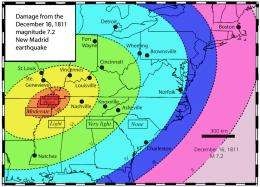
Earthquake damage, Dec. 16, 1811.

(PhysOrg.com) -- The New Madrid fault system does not behave as earthquake hazard models assume and may be in the process of shutting down, a new study shows.

A team from Purdue and Northwestern universities analyzed the motion for eight years measurements and found that it is much less than expected given the 500- to 1,000-year repeat cycle for major earthquakes on that fault. The last large earthquakes in the New Madrid seismic zone were magnitude 7-7.5 events in 1811 and 1812.

Estimating an accurate threat for the area, which includes parts of Illinois, Indiana, Tennessee, Arkansas and Kentucky, is crucial for the communities potentially affected, said Eric Calais, the Purdue researcher who led the study.

"Our findings suggest the steady-state model of quasi-cyclical earthquakes that works well for faults at the boundaries of tectonic plates, such as the San Andreas fault, does not apply to the ," said Calais, who is a professor of earth and atmospheric sciences. "At , faults move at a rate that is consistent with the rate of earthquakes so that past events are a reliable guide to the future. In continents, this does not work. The past is not necessarily a key to the future, which makes estimating particularly difficult."

The team determined that the ground surrounding the is moving at a rate of less than 0.2 millimeters per year and there is likely no motion. A paper detailing the work is published in the current issue of Science magazine.

Seth Stein, co-author of the paper, said this surface movement represents energy being stored that could be released as an earthquake.

"Building up energy for an earthquake is like saving money for a big purchase," said Stein, the William Deering Professor of Earth and Planetary Sciences at Northwestern University. "You put money in over a long period of time and then spend it all at once and have to start saving again."

With an earthquake, it is elastic deformation that must be built up. This can be measured using GPS through movements on the surface, he said.

"The slower the ground moves, the longer it takes until the next earthquake, and if it stops moving, the fault could be shutting down," Stein said. "We can't tell whether the recent cluster of big earthquakes in the New Madrid is coming to an end. But the longer the GPS data keep showing no motion, the more likely it seems."

The U.S. Geological Survey-funded study used data recorded at nine GPS antennas mounted in the ground in the earthquake zone.

"GPS technology can measure movement to the thickness of a fishing line," Stein said. "Use of GPS to study earthquakes shows the impact a new technology can have. It lets us see that the world is different than we thought it was."

In the Midwest there are other faults that show no activity today but have evidence of earthquakes occurring within the past 10,000 to 1 million years, Calais said.

"If other faults in the central and eastern U.S. have been active recently, geologically speaking, they could potentially be activated again in the future," he said. "We need to develop a new paradigm for how earthquakes happen at faults that are inside continents."

Calais and Stein are exploring possible explanations for the behavior of faults like the New Madrid. One possibility is that earthquakes in these areas occur in clusters and then migrate to a nearby fault.

"There is the possibility that seismicity migrates with time as earthquakes trigger earthquakes on nearby faults," Calais said. "Geologists studying the seismic history of faults have found that there have been earthquakes on several faults in the central and eastern U.S. and that they seem to produce bursts of earthquakes and then turn off."

The team is doing additional analysis and modeling to study this further.

More information: Time-Variable Deformation in the New Madrid Seismic Zone, E. Calais and S. Stein, Science.

Source: Purdue University (news : web)


print this article email this article download pdf blog this article bookmark this article     Stumble it Digg this share on Facebook retweet share on Reddit add to delicious
Rate this story - 4 /5 (8 votes)

Rank Filter

Move the slider to adjust rank threshold, so that you can hide some of the comments.


Display comments: newest first

  • Keter - Mar 13, 2009
    • Rank: 5 / 5 (3)
    In terms of disaster preparedness, it is very dangerous to assume that a fault as historically capable of creating disastrous earthquakes - and positioned to affect such a large population - as the New Madrid is just "shutting down." It is equally likely that it is bound up, building potential energy. *When* that bind breaks loose, the resultant quake could be catastrophic. One look at the geological record indicates that there have been sudden upheavals in this planet's past which make even our strongest recorded earthquakes look mild in comparison: there is no reason to assume that this period of geological evolution has ended. We simply have not been observing and recording that long, and the resultant myopia could blind us to longer-wave periodic functions.
  • holmstar - Mar 13, 2009
    • Rank: 4.7 / 5 (3)
    In terms of disaster preparedness, it is very dangerous to assume that a fault as historically capable of creating disastrous earthquakes - and positioned to affect such a large population - as the New Madrid is just "shutting down." It is equally likely that it is bound up, building potential energy.


    The crust is not entirely rigid... A chunk of the crust can be flexed a bit before the stress is released and an earthquake occurs. What they are saying is that they see no movement (flexing) of the crust surrounding the faults. No movement means that there is no significant stress building up at this time.

    Note: this does not preclude the possibility that stress has already built up, and is simply being held in tension, without increasing or decreasing, but I suspect that this would be fairly unlikely, and at least some movement would be noted.
  • Nik_2213 - Mar 13, 2009
    • Rank: 5 / 5 (3)
    Could NewMadrid fault have 'worked' as result of post-glacial isostasis ? Area seems too far South, but I'm reminded of way Hawaii's volcanos produce 'second order' uplift of sea-floor beyond their weight's local dip...
  • Doug_Huffman - Mar 14, 2009
    • Rank: 5 / 5 (3)
    Might 'shutting down' be euphemism for locking-up and storing energy potential for release? Is the local stress/strain decreasing?
  • jonnyboy - Mar 15, 2009
    • Rank: 3 / 5 (2)
    an article with way too many questions and no answers makes me wonder why they bothered to write it in the first place.

March 13, 2009 all stories

Comments: 5

4 /5 (8 votes)
  • Stumble this up

  • Digg this

  • share this

  • hide
  • Related Stories

  • Earthquake in Illinois could portend an emerging threat
    created Apr 24, 2008 | popularity not rated yet | comments 0
  • Geologists study China earthquake for glimpse into future
    created Jul 06, 2008 | popularity not rated yet | comments 0
  • Experts disagree about earthquake risk
    created Dec 15, 2005 | popularity not rated yet | comments 0
  • Ill. earthquake a wake-up call
    created Apr 20, 2008 | popularity not rated yet | comments 0
  • Caribbean Earthquake Model
    created Dec 22, 2006 | popularity not rated yet | comments 0


  • hide
  • Relevant PhysicsForums posts

  • The IPCC and the term "most"
    created Nov 23, 2009
  • Is global warming a fact?
    created Nov 23, 2009
  • Random variability of wind patterns
    created Nov 23, 2009
  • Record precipitation in the UK
    created Nov 22, 2009
  • How to move cloud from one time to another..
    created Nov 22, 2009
  • Which countries around the world cause the most destruction to the rain forest
    created Nov 21, 2009
  • More from Physics Forums - Earth

Other News

Gullies and Flow Features on Crater Wall

Gullies and Flow Features on Crater Wall

Space & Earth / Space Exploration

created 50 minutes ago | popularity not rated yet | comments 0

(PhysOrg.com) -- This image from the High Resolution Imaging Science Experiment (HiRISE) camera on NASA's Mars Reconnaissance Orbiter shows a sample of the variety and complexity of processes that may occur ...


Astronauts surprised by holiday turkey dinners (AP)

Astronauts surprised by holiday turkey dinners

Space & Earth / Space Exploration

created 20 minutes ago | popularity not rated yet | comments 0

(AP) -- Space shuttle Atlantis' astronauts thought they were going to give thanks with pantry leftovers Thursday as their mission drew to a close, but found turkey dinners awaiting them.


Monster Waves on the Sun are Real

Monster Waves on the Sun are Real (w/ Video)

Space & Earth / Astronomy

created 17 hours ago | popularity 4.8 / 5 (13) | comments 2

Sometimes you really can believe your eyes. That's what NASA's STEREO (Solar Terrestrial Relations Observatory) spacecraft are telling researchers about a controversial phenomenon on the sun known as the "solar ...


Russia: no space for space tourists (AP)

Russia: no space for space tourists

Space & Earth / Space Exploration

created 4 hours ago | popularity 2.5 / 5 (2) | comments 2

(AP) -- A top Russian space official says there is no space for tourists wishing to fly to the International Space Station.


Climate experts debate strategies for reducing atmospheric carbon and future warming

Climate experts debate strategies for reducing atmospheric carbon and future warming

Space & Earth / Environment

created 17 hours ago | popularity 2.6 / 5 (7) | comments 10

(PhysOrg.com) -- Reducing carbon dioxide to safe levels may require extracting carbon from the air, says Cornell climate researcher.