Scientists discover new platinum catalysts for the dehydrogenation of propane
March 13, 2009 Scientists discover new platinum catalysts for the dehydrogenation of propane

Enlarge

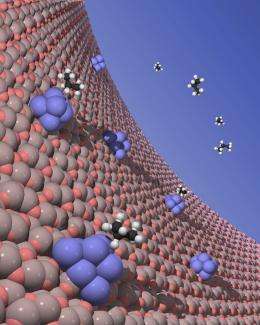
Clusters of 8-10 platinum atoms deposited in pores of an aluminum oxide membrane are highly active and selective catalysts for the oxidative dehydrogenation of propane.

(PhysOrg.com) -- The process to turn propane into industrially necessary propylene has been expensive and environmentally unfriendly. That was until scientists at U.S. Department of Energy's Argonne National Laboratory devised a greener way to take this important step in chemical catalysis.

"Using clusters, we have devised a way to catalyze not only in a more environmentally friendly way, but also using far less energy than previous methods," Argonne scientist Stefan Vajda said.

Alkanes are typical feedstocks for transformation to alkenes, aromatics and chemicals containing value added moieties. is a route to such transformations, but it is an requiring significant energy input.

Oxidative dehydrogenation (ODH) of propane to propylene is a multibillion dollar industrial process. ODH of alkanes is exothermic, and thus an attractive alternative to dehydrogenation. However, current ODH catalysts have limited activity and/or poor selectivity resulting from inability to prevent complete . Two classes of catalysts are used: vanadia and platinum. The vanadia based catalysts are highly selective, but their activity is relatively low. Pt-based catalysts are more active, but their selectivity is low.

Argonne scientists showed that the size preselected Pt8-10 clusters stabilized on high-surface-area supports are 40� times more active for the oxidative dehydrogenation of propane than previously studied platinum and vanadia catalysts, while at the same time maintaining high selectivity towards formation of propylene over by-products.

This new class of catalysts may lead to energy-efficient and environmentally friendly synthesis strategies and the possible replacement of petrochemical feedstocks by abundant small alkanes.

"The oxidative dehydrogenation of alkanes is a reaction that is exothermic and thus an attractive alternative to the endothermic process of dehydrogenation of alkanes," Argonne scientist Larry Curtiss said. "The endothermic process requires a significant energy input with an increased chance of environmentally unfriendly by-products."

Using high performance computing facilities at Argonne and elsewhere, Vajda and his colleagues proved theoretically that attractive interaction between the under-coordinated platinum and propane was the cause for the higher selectivity towards propylene and its high activity.

More information: Subnanometre Platinum Clusters as Highly Active and Selective Catalysts for the Oxidative Dehydrogenation of Propane can be seen Nature Materials 8, 213 (2009).

Source: Argonne National Laboratory


print this article email this article download pdf blog this article bookmark this article     Stumble it Digg this share on Facebook retweet share on Reddit add to delicious
Rate this story - 5 /5 (2 votes)


March 13, 2009 all stories

Comments: 0

5 /5 (2 votes)
  • Stumble this up

  • Digg this

  • share this

  • hide
  • Related Stories

  • Argonne to study fuel cell catalysts
    created May 26, 2005 | popularity not rated yet | comments 0
  • New catalysts may create more, cheaper hydrogen
    created Aug 21, 2007 | popularity not rated yet | comments 0
  • Natural Oils Can Be Hydrogenated Without Making Unhealthy Trans Fats
    created Jan 23, 2009 | popularity not rated yet | comments 0
  • Less expensive fuel cell may be possible
    created Oct 03, 2006 | popularity not rated yet | comments 0
  • Renewable Raw Materials
    created May 29, 2006 | popularity not rated yet | comments 0


  • hide
  • Relevant PhysicsForums posts

  • Putting every element in a box
    created 5 hours ago
  • a question in Lewis structure???
    created 13 hours ago
  • Paint Technology
    created Nov 24, 2009
  • About pH, Metallic electrodes
    created Nov 24, 2009
  • More from Physics Forums - Chemistry

Other News

Blocking biofilms: Alzheimer's research sheds light on potential treatments for urinary tract infections

Chemistry / Biochemistry

created 10 hours ago | popularity 5 / 5 (1) | comments 0

(PhysOrg.com) -- Research into Alzheimer's disease seems an unlikely approach to yield a better way to fight urinary tract infections (UTIs), but that's what scientists at Washington University School of Medicine in St. Louis ...


Chemists get custom-designed microscopic particles to self-assemble in liquid crystal

Chemists get custom-designed microscopic particles to self-assemble in liquid crystal

Chemistry / Materials Science

created 11 hours ago | popularity 5 / 5 (5) | comments 0

(PhysOrg.com) -- The scientists anticipate their "LithoParticles" will have significant applications in photonics, optical communications and other areas.


Study shows flavanol antioxidant content of US chocolate and cocoa-containing products

Chemistry / Other

created 12 hours ago | popularity 1 / 5 (2) | comments 0

A recent study confirms that the antioxidants and other plant-based nutrients in chocolate and cocoa products are highly associated with the amount of non-fat cocoa-derived ingredients in the product. The study expands on ...


Sandia CR5

Machine Converts CO2 into Gasoline, Diesel, and Jet Fuel

Chemistry / Biochemistry

created Nov 23, 2009 | popularity 4.6 / 5 (30) | comments 19

(PhysOrg.com) -- Researchers at Sandia National Laboratories have built a machine that uses the sun's energy to convert carbon dioxide waste from power plants into transportation fuels such as gasoline, diesel, ...


New hydrogen-storage method discovered

New hydrogen-storage method discovered

Chemistry / Materials Science

created Nov 22, 2009 | popularity 4.3 / 5 (41) | comments 15

Scientists at the Carnegie Institution have found for the first time that high pressure can be used to make a unique hydrogen-storage material. The discovery paves the way for an entirely new way to approach ...