The Day the Sun Brought Darkness (w/Video)
March 13, 2009 by Dr. Sten Odenwald, NASA Astronomer
The Day the Sun Brought Darkness

Enlarge

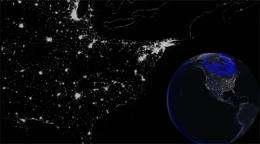
Artist rendition of the 1989 blackout. Credit: NASA

On March 13, 1989 the entire province of Quebec, Canada suffered an electrical power blackout. Hundreds of blackouts occur in some part of North America every year. The Quebec Blackout was different, because this one was caused by a solar storm!

On Friday March 10, 1989 astronomers witnessed a powerful explosion on the sun. Within minutes, tangled magnetic forces on the sun had released a billion-ton cloud of gas. It was like the energy of thousands of nuclear bombs exploding at the same time. The storm cloud rushed out from the sun, straight towards Earth, at a million miles an hour. The that accompanied the outburst immediately caused short-wave , including the jamming of from Radio Free Europe into Russia. It was thought that the signals had been jammed by the Kremlin, but it was only the sun acting up!

This video is not supported by your browser at this time.

Solar flares and coronal mass ejections (CMEs), associated giant clouds of plasma in space, are the largest explosions in the solar system. They are caused by the buildup and sudden release of magnetic stress in the solar atmosphere above the giant magnetic poles we see as sunspots. CMEs can cause magnetic storms affecting communication systems, power grids and astronauts in space. Click on image to view movie. Credit: NASA/ Walt Feimer

On the evening of Monday, March 12 the vast cloud of (a gas of electrically charged particles) finally struck Earth's magnetic field. The violence of this 'geomagnetic storm' caused spectacular 'northern lights' that could be seen as far south as Florida and Cuba. The was incredibly intense. It actually created electrical currents in the ground beneath much of North America. Just after 2:44 a.m. on March 13, the currents found a weakness in the electrical of Quebec. In less than 2 minutes, the entire Quebec power grid lost power. During the 12-hour that followed, millions of people suddenly found themselves in dark office buildings and underground pedestrian tunnels, and in stalled elevators. Most people woke up to cold homes for breakfast. The blackout also closed schools and businesses, kept the Montreal Metro shut during the morning rush hour, and closed Dorval Airport.

The Quebec Blackout was by no means a local event. Some of the U.S. electrical utilities had their own cliffhanger problems to deal with. New York Power lost 150 megawatts the moment the Quebec power grid went down. The New England Power Pool lost 1,410 megawatts at about the same time. Service to 96 electrical utilities in New England was interrupted while other reserves of electrical power were brought online. Luckily, the U.S. had the power to spare at the time…but just barely. Across the United States from coast to coast, over 200 power grid problems erupted within minutes of the start of the March 13 storm. Fortunately none of these caused a blackout.
The Day the Sun Brought Darkness
Enlarge

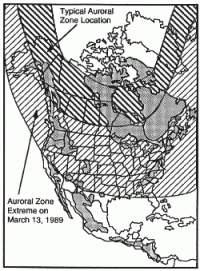
Power systems in areas of igneous rock (gray) are the most vulnerable to the effects of intense geomagnetic activity because the high resistance of the igneous rock encourages geomagnetically induced currents (GICs) to flow in the power transmission lines situated above the rock. Shown in cross-hatching are the auroral zone and the extremes that the aurora can reach during severe disturbances such as March 13, 1989. Credit: American Geophysical Union

In space, some satellites actually tumbled out of control for several hours. NASA's TDRS-1 communication satellite recorded over 250 anomalies as high-energy particles invaded the satellite's sensitive electronics. Even the Space Shuttle Discovery was having its own mysterious problems. A sensor on one of the tanks supplying hydrogen to a fuel cell was showing unusually high pressure readings on March 13. The problem went away just as mysteriously after the solar storm subsided.

Twenty years later, the March 1989 'Quebec Blackout' has reached legendary stature, at least among electrical engineers and space scientists. It is a dramatic example of how solar storms can affect us even here on the ground. Fortunately, storms as powerful as this are rather rare. It takes quite a solar wallop to cause anything like the conditions leading up to a Quebec-style blackout. Typical solar activity 'sunspot' cycles can produce least two or three large storms, so it really is just a matter of chance whether one will cause a blackout or not. As it is for hurricanes and tornadoes, the more we can learn about the sun's 'space weather,' the better we can prepare for the next storm when it arrives!

Source: ADNET/Catholic University/NASA

4.4 /5 (10 votes)  

Filter


Move the slider to adjust rank threshold, so that you can hide some of the comments.


Display comments: newest first

albert
Mar 13, 2009

Rank: not rated yet
Check out the solar storm of 1859, the most powerful in recorded history.
Rank 4.4 /5 (10 votes)
Related Stories
Relevant PhysicsForums posts
  • Never ending outer space.....
    created14 hours ago
  • Neutron Star fragments?
    created16 hours ago
  • stationary or not?
    created20 hours ago
  • Scale of the Universe
    createdFeb 10, 2012
  • Titan's lack of impact craters
    createdFeb 09, 2012
  • Real pictures of black hole eating a star?
    createdFeb 08, 2012
  • More from Physics Forums - General Astronomy

More news stories

Latin America mining boom clashes with conservation

Latin America is experiencing a mining boom as prices rise fuelled by a hike in global demand, but the region is also being hit by a wave of violent protests, strikes and rallies by environmentalists.

Space & Earth / Environment

created 7 hours ago | popularity not rated yet | comments 0

Political leaders play key role in how worried Americans are by climate change: study

More than extreme weather events and the work of scientists, it is national political leaders who influence how much Americans worry about the threat of climate change, new research finds.

Space & Earth / Environment

created Feb 06, 2012 | popularity 5 / 5 (6) | comments 73

NASA budget will axe Mars deal with Europe: scientists

US President Barack Obama's budget proposal to be submitted next week for 2013 will cut NASA's budget by 20 percent and eliminate a major partnership with Europe on Mars exploration, scientists said Thursday.

Space & Earth / Space Exploration

created Feb 10, 2012 | popularity 5 / 5 (3) | comments 55

Humans may have helped the decline of African rainforests 3000 years ago

(PhysOrg.com) -- Large areas of rainforests in Central Africa mysteriously disappeared over three thousand years ago, to be replaced by savannas. The prevailing theory has been that the cause was a change ...

Space & Earth / Environment

created Feb 10, 2012 | popularity 4.1 / 5 (14) | comments 20 | with audio podcast report

Study shows global glaciers, ice caps, shedding billions of tons of mass annually

Earth's glaciers and ice caps outside of the regions of Greenland and Antarctica are shedding roughly 150 billion tons of ice annually, according to a new study led by the University of Colorado Boulder.

Space & Earth / Earth Sciences

created Feb 08, 2012 | popularity 4.4 / 5 (9) | comments 14 | with audio podcast


Injured boomers beware: Know when to see doctor

(AP) -- It happened to nurse Jane Byron years after an in-line skating fall, business owner Haralee Weintraub while doing "men's" push-ups, and avid cyclist Gene Wilberg while lifting a heavy box.

Google might launch Drive for cloud storage soon

(PhysOrg.com) -- Google's next big move, according to the Wall Street Journal, is a cloud storage service called Drive. Hardly first to the plate, Google is simply catching up to introducing its cloud reposi ...

Love a click away in Indonesia's Twitter Republic

He was a geeky kid from Yogyakarta, she a glamorous city girl in Jakarta. In a country with one of the world's most vibrant social networking scenes they fell in love on Twitter.

Europeans protest controversial Internet pact

Tens of thousands of people marched in protests in more than a dozen European cities Saturday against a controversial anti-online piracy pact that critics say could curtail Internet freedom.

Walney offshore wind farm is world's biggest (for now)

(PhysOrg.com) -- The Walney wind farm on the Irish Sea--characterized by high tides, waves and windy weather--officially opened this week. The farm is treated in the press as a very big deal as the Walney ...

Navy to begin tests on electromagnetic railgun prototype launcher

The Office of Naval Research (ONR)'s Electromagnetic (EM) Railgun program will take an important step forward in the coming weeks when the first industry railgun prototype launcher is tested at a facility ...