Final Piece Of NASA's Next-Generation Rocket Heads To Launch Site
March 13, 2009 Ares I-X rocket

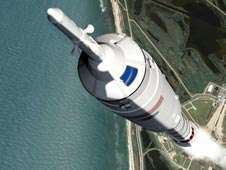
Artist concept of Ares I-X rocket. Image Credit: NASA

(PhysOrg.com) -- The final pieces of the Ares I-X flight test rocket left the Alliant Tech Systems manufacturing facility in Promontory, Utah, Thursday and began a 2,917-mile journey to its launch site at NASA's Kennedy Space Center in Florida.

The first segments are the last shipment of Ares I-X major hardware elements. The hardware will arrive in Florida later this month and undergo final processing and preparations before being stacked with the other portions of the .

"This shipment means great things for the Ares I-X mission," said Ares I-X Deputy Mission Manager, Steve Davis. "It's wonderful to see the next generation of American spaceflight continue to take shape. The excitement is really building now as we start stacking the pieces and preparing for later this year."

The Ares I-X will be the first for the Ares I rocket; the agency's next-generation spacecraft and crew system. The flight will provide NASA an early opportunity to test and prove hardware, analysis models, facilities and ground operations associated with Ares I.

The Ares I-X rocket is a combination of existing and simulator hardware that will resemble the Ares I rocket in size, shape and weight. It will provide valuable data to guide the final design of the Ares I. The test flight also will bring NASA one step closer to its goals of returning to the moon, and traveling to destinations beyond. The Ares I-X launch is scheduled later in 2009.

The Ares I-X first stage uses a four-segment motor, capable of generating 3.3 million pounds of thrust. The motor provides the primary propulsion for the vehicle from liftoff to stage separation 120 seconds into the flight. The motor segments were taken from the existing space shuttle solid inventory for the flight test. The booster used for the Ares I-X flight test is being modified to meet Ares needs by adding new forward structures and a fifth segment simulator to better replicate the size and shape of the Ares I crew launch vehicle.

NASA's Marshall Space Flight Center in Huntsville, Ala., manages the first stage project for the Ares I-X mission, located at NASA's Johnson Space Center in Houston.

Provided by JPL/NASA (news : web)


print this article email this article download pdf blog this article bookmark this article     Stumble it Digg this share on Facebook retweet share on Reddit add to delicious
Rate this story - not rated yet

Rank Filter

Move the slider to adjust rank threshold, so that you can hide some of the comments.


Display comments: newest first

  • holmstar - Mar 13, 2009
    • Rank: not rated yet
    I still think the ares program was the wrong choice. It was only chosen because it was Griffin's pet project. It would have been career suicide to strongly oppose it, so the dissenters gave up and kept quiet.
  • Modernmystic - Mar 17, 2009
    • Rank: not rated yet
    Couldn't agree more. It's not like we had to re-invent the wheel. We could have made upgrades to the Saturn rockets and done just as well for probably 1/2-3/4 the cost.

March 13, 2009 all stories

Comments: 2

not rated yet
  • Stumble this up

  • Digg this

  • share this

  • hide
  • Related Stories

  • First Rocket Parts Of NASA's New Launch System Arrive In Florida
    created Nov 04, 2008 | popularity not rated yet | comments 0
  • NASA Successfully Tests Parachute for Ares Rocket
    created Mar 02, 2009 | popularity not rated yet | comments 0
  • NASA's Ares I Rocket First Stage Igniter Successfully Tested
    created Mar 10, 2009 | popularity not rated yet | comments 0
  • Test in Development of NASA's New Crew Rocket is Successful
    created Jan 30, 2009 | popularity not rated yet | comments 0
  • NASA modifies launch vehicle contract
    created Oct 05, 2006 | popularity not rated yet | comments 0


  • hide
  • Relevant PhysicsForums posts

  • The shape of our solar system's orbits.
    created Nov 07, 2009
  • Above or Below the Line of Nodes
    created Nov 07, 2009
  • Supernova vs. Nova?
    created Nov 07, 2009
  • Supernova's Gamma Rays and Comets
    created Nov 06, 2009
  • More from Physics Forums - General Astronomy

Other News

Deep creep means milder, more frequent earthquakes along Southern California's San Jacinto fault

Deep creep means milder, more frequent earthquakes along Southern California's San Jacinto fault

Space & Earth / Earth Sciences

created 18 hours ago | popularity 4.5 / 5 (4) | comments 0

With an average of four mini-earthquakes per day, Southern California's San Jacinto fault constantly adjusts to make it a less likely candidate for a major earthquake than its quiet neighbor to the east, the ...


Success in 'space elevator' competition (AP)

Success in 'space elevator' competition (Update 3)

Space & Earth / Space Exploration

created Nov 05, 2009 | popularity 4.3 / 5 (33) | comments 50

(AP) -- A robot powered by a ground-based laser beam climbed a long cable dangling from a helicopter on Wednesday to qualify for prize money in a $2 million competition to test the potential reality of the ...


In a Galaxy Far, Far Away...

In a Galaxy Far, Far Away...

Space & Earth / Astronomy

created Nov 06, 2009 | popularity 4.8 / 5 (5) | comments 17

(PhysOrg.com) -- Astronomers have published the discovery of the farthest known object in the cosmos: a star that exploded when the universe was only 630 million years old -- only 4.6% of its current age. ...


'Dropouts' pinpoint earliest galaxies

'Dropouts' pinpoint earliest galaxies

Space & Earth / Astronomy

created Nov 06, 2009 | popularity 4.2 / 5 (10) | comments 13

Astronomers, conducting the broadest survey to date of galaxies from about 800 million years after the Big Bang, have found 22 early galaxies and confirmed the age of one by its characteristic hydrogen signature ...


Space hotel taking bookings for 2012 opening

Space hotel taking bookings for 2012 opening

Space & Earth / Space Exploration

created Nov 05, 2009 | popularity 4.4 / 5 (21) | comments 11

(PhysOrg.com) -- The first orbiting space hotel is on track to open for its first customers in 2012, but hurry, as bookings are filling fast.