Italy dig unearths female 'vampire' in Venice
March 14, 2009 By ARIEL DAVID , Associated Press Writer Italy dig unearths female 'vampire' in Venice (AP)

Enlarge

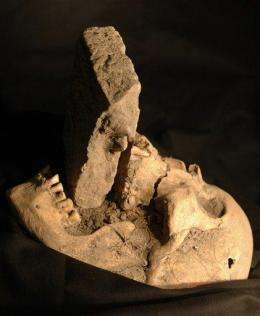
This photo released by forensic archaeologist and anthropologist Matteo Borrini of Florence University, Italy, Friday March 13, 2009, shows the 16th-century remains of a woman with a brick stuck between her jaws unearthed in 2006 in an archaeological dig near Venice, northern Italy. (AP Photo/Matteo Borrini of Florence University) NO SALES **

(AP) -- An archaeological dig near Venice has unearthed the 16th-century remains of a woman with a brick stuck between her jaws - evidence, experts say, that she was believed to be a vampire. The unusual burial is thought to be the result of an ancient vampire-slaying ritual. It suggests the legend of the mythical bloodsucking creatures was tied to medieval ignorance of how diseases spread and what happens to bodies after death, experts said.

The well-preserved skeleton was found in 2006 on the Lazzaretto Nuovo island, north of the lagoon city, amid other corpses buried in a mass grave during an epidemic of plague that hit in 1576.

"Vampires don't exist, but studies show people at the time believed they did," said Matteo Borrini, a forensic archaeologist and anthropologist at Florence University who studied the case over the last two years. "For the first time we have found evidence of an exorcism against a vampire."

Medieval texts show the belief in vampires was fueled by the disturbing appearance of decomposing bodies, Borrini told The Associated Press by telephone.

During epidemics, mass graves were often reopened to bury fresh corpses and diggers would chance upon older bodies that were bloated, with blood seeping out of their mouth and with an inexplicable hole in the shroud used to cover their face.

"These characteristics are all tied to the decomposition of bodies," Borrini said. "But they saw a fat, dead person, full of blood and with a hole in the shroud, so they would say: 'This guy is alive, he's drinking blood and eating his shroud.'"

Modern forensic science shows the bloating is caused by a buildup of gases, while fluid seeping from the mouth is pushed up by decomposing organs, Borrini said. The shroud would have been consumed by bacteria found in the mouth area, he said.

At the time however, what passed for scientific texts taught that "shroud-eaters" were vampires who fed on the cloth and cast a spell that would spread the plague in order to increase their ranks.

To kill the undead creatures, the stake-in-the-heart method popularized by later literature was not enough: A stone or brick had to be forced into the vampire's mouth so that it would starve to death, Borrini said.

That's what is believed to have happened to the woman found on the Lazzaretto island, which was used as a quarantine zone by Venice. Aged around 60, she died of the plague during the epidemic that also claimed the life of the painter Titian.

Much later, someone jammed the brick into her mouth when the grave was reopened. Borrini said that marks and breaks left by blunt instruments on several among more than 100 skeletons found by the archaeologists show that the grave was reused in a later epidemic.

Such a reconstruction of events is plausible, as is the link to the superstitions about "shroud-eaters," said Piero Mannucci, the vice president of the Italian Society of Anthropology and Ethnology.

"Maybe a priest or a gravedigger put the brick in her mouth, which is what was normally done in such cases," Mannucci said.

The anthropologist, who did not take part in Borrini's research, said that at a time when bacteria were unknown, such superstitions were a way for the terrified population to explain the waves of plague epidemics that killed millions during the Middle Ages. Jews were also often accused of spreading the disease.

Borrini said the discovery shows that vampires in popular culture were originally quite different from the elegant, aristocratic blood-drinker depicted in Bram Stoker's 1897 novel "Dracula" and in countless Hollywood revisitations.

"The real vampire of tradition was different," he said. "It was just a decomposing body."

©2009 The Associated Press. All rights reserved. This material may not be published, broadcast, rewritten or redistributed.


print this article email this article download pdf blog this article bookmark this article     Stumble it Digg this share on Facebook retweet share on Reddit add to delicious
Rate this story - 4.7 /5 (7 votes)

Rank Filter

Move the slider to adjust rank threshold, so that you can hide some of the comments.


Display comments: newest first

  • Mercury_01 - Mar 14, 2009
    • Rank: not rated yet
    Serves her right!
  • Suzu - Mar 15, 2009
    • Rank: not rated yet
    If she was real Vampire she should have shattered that brick easily and had a strength of a locomotive.

March 14, 2009 all stories

Comments: 2

4.7 /5 (7 votes)
  • Stumble this up

  • Digg this

  • share this

  • hide
  • Related Stories

  • Professor says today's vampires are more about style than gore
    created Oct 18, 2005 | popularity not rated yet | comments 0
  • Age test of Shroud of Turin planned
    created Feb 25, 2008 | popularity not rated yet | comments 0
  • Laws of physics, math debunk Hollywood portrayals of ghosts, vampires
    created Oct 23, 2006 | popularity not rated yet | comments 0
  • Turin Shroud confirmed as a fake
    created Jun 21, 2005 | popularity not rated yet | comments 0
  • Prof: 'Twilight' film may really bring vampires to life for some
    created Nov 17, 2008 | popularity not rated yet | comments 0


  • hide
  • Relevant PhysicsForums posts

Other News

The first casualty of war: Study finds news reports match misperception of civilian deaths

Other Sciences / Social Sciences

created 4 hours ago | popularity 5 / 5 (1) | comments 0

Researchers reporting in BioMed Central's open access journal Conflict and Health found that the discrepancy in media reporting of casualty numbers in the Iraq conflict can potentially misinform the public and contribute to dis ...


Ancient muscle tissue extracted from 18 million year old fossil

Ancient muscle tissue extracted from 18 million year old fossil

Other Sciences / Archaeology & Fossils

created 15 hours ago | popularity 4.6 / 5 (7) | comments 0

(PhysOrg.com) -- Scientists have extracted organically preserved muscle tissue from an 18 million years old salamander fossil. The discovery by researchers from University College Dublin, the UK and Spain, ...


For improving early literacy, reading comics is no child's play

For improving early literacy, reading comics is no child's play

Other Sciences / Social Sciences

created 19 hours ago | popularity not rated yet | comments 0

Although comics have been published in newspapers since the 1890s, they still get no respect from some teachers and librarians, despite their current popularity among adults. But according to a University ...


Atlanta's Fernbank Museum tracks infamous conquistador through southeast

Team tracks infamous conquistador through southeast

Other Sciences / Archaeology & Fossils

created 22 hours ago | popularity 4.5 / 5 (2) | comments 0

Archaeologists at Atlanta's Fernbank Museum of Natural History have discovered unprecedented evidence that helps map Hernando de Soto's journey through the Southeast in 1540. No evidence of De Soto's path ...


The last European hadrosaurs lived in the Iberian Peninsula

The last European hadrosaurs lived in the Iberian Peninsula

Other Sciences / Archaeology & Fossils

created 22 hours ago | popularity 4.5 / 5 (2) | comments 0

Spanish researchers have studied the fossil record of hadrosaurs, the so-called 'duck-billed' dinosaurs, in the Iberian Peninsula for the purpose of determining that they were the last of their kind to inhabit ...