Poisoned, wounded Calif. condor treated at LA Zoo
March 14, 2009 Poisoned, wounded Calif. condor treated at LA Zoo (AP)

Enlarge

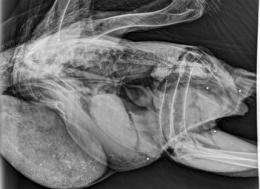
This image provided by the Los Angeles Zoo on Friday March 13, 2009, shows an X-ray of a California condor injured by pellets, shown as white spots at lower right, and suffering from lead poisoning. Zoo curator of birds Susie Kasielke said Friday the bird's prognosis is guarded and it is essentially in intensive care. (AP Photo/Los Angeles Zoo)

(AP) -- A California condor captured because it appeared sickly was found to not only be suffering from lead poisoning but also had been shot, animal experts said Friday.

Unable to eat on its own, the was under intensive care at the Los Angeles and its prognosis was guarded, said Susie Kasielke, curator of birds.

X-rays taken at the zoo turned up embedded in its flesh, she said. Those wounds had healed.

It could not be determined if the pellets were lead or steel, but the poisoning was most likely caused by the bird ingesting spent lead ammunition in carcasses of animals that had been shot by hunters, Kasielke said.

Condors are carrion-eaters and such poisoning by lead ammunition has long been recognized as a problem. California requires hunters to use only non-lead ammunition in the condors' range. It is also illegal to shoot a condor.

Giant California condors are an endangered species, and the federal government has been working for years to establish breeding populations in the wild.

The ailing condor, a nearly 7-year-old dubbed No. 286, was a dominant member of a flock on the central California coast until late January, when biologists from Pinnacles National Monument and the Ventana Wildlife Society noticed it was suddenly being pushed around by younger birds, the said.

Biologists tried to capture it because the behavior indicated health problems. They were unsuccessful until March 4, when it appeared wobbly on its feet. Tests showed a potentially fatal lead exposure and the condor was sent to the zoo.

Kasielke said that if the condor survives it would stay at the zoo for several weeks, but could be returned to the wild.

Exactly how long ago the bird was shot could not be determined, she said.

---

On the Net:

U.S. Fish and Wildlife Service Endangered Species Program: http://www.fws.gov/endangered/i/b0g.html

Ventana Wildlife Society: http://www.ventanaws.org/

Calif. Department of Fish and Game: http://www.dfg.ca.gov/wildlife/hunting/condor/

©2009 The Associated Press. All rights reserved. This material may not be published, broadcast, rewritten or redistributed.


print this article email this article download pdf blog this article bookmark this article     Stumble it Digg this share on Facebook retweet share on Reddit add to delicious
Rate this story - 5 /5 (1 vote)


March 14, 2009 all stories

Comments: 0

5 /5 (1 vote)
  • Stumble this up

  • Digg this

  • share this

  • hide
  • Related Stories

  • California condors dying of lead poisoning
    created Oct 13, 2007 | popularity not rated yet | comments 0
  • California condors making a comeback
    created Mar 29, 2006 | popularity not rated yet | comments 0
  • Lead shot and sinkers: Weighty implications for fish and wildlife health
    created Jul 11, 2008 | popularity not rated yet | comments 0
  • Tracing the Roots of the California Condor
    created Oct 29, 2007 | popularity not rated yet | comments 0


  • hide
  • Relevant PhysicsForums posts

  • What is transpulmonary pressure?
    created 22 hours ago
  • Is there a gay gene?
    created Nov 23, 2009
  • Super quick question about Starling forces?
    created Nov 22, 2009
  • Questions about diffusion
    created Nov 22, 2009
  • More from Physics Forums - Biology

Other News

Redback spiders were first spotted in Japan in 1995

Venomous Aussie redback spiders invading Japan

Biology / Ecology

created 48 minutes ago | popularity not rated yet | comments 0

Australia's venomous redback spiders are on the march in Japan, where they are believed to have arrived years ago as stowaways on cargo ships, a wildlife expert warned Wednesday.


Study explores violent world of raptors

Biology / Plants & Animals

created 48 minutes ago | popularity not rated yet | comments 0

A journey that started with a box of bird feet carried three Montana State University graduate students into the gruesome world of raptors and led to their findings being published in a prominent journal.


Asian carp may have breached barrier protecting Lake Michigan

Biology / Ecology

created 8 hours ago | popularity 5 / 5 (3) | comments 0

Two feared species of Asian carp have zoomed beyond the $9 million electric barriers built to keep them out of Lake Michigan. Now, the only thing left between the carp and the Great Lakes is a lock and dam in southern Chicago.


Got a pain? -- Have a cup of Brazilian mint

Biology / Plants & Animals

created 10 hours ago | popularity 4.6 / 5 (7) | comments 0

For thousands of years it has been prescribed by traditional healers in Brazil to treat a range of ailments from headaches and stomach pain to fever and flu.


Opposites attract: Monkeys choose mating partners with different genes

Biology / Evolution

created 10 hours ago | popularity 5 / 5 (1) | comments 0

The world's largest species of monkey 'chooses' mates with genes that are different from their own to guarantee healthy and strong offspring, according to a new research study.