NASA hopeful repairs will permit Sunday launch
March 14, 2009 By MARCIA DUNN , AP Aerospace Writer
NASA hopeful repairs will permit Sunday launch (AP)

Enlarge

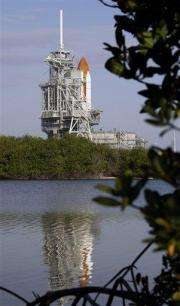
Space Shuttle Discovery is seen on pad 39A at the Kennedy Space Center, Fla Saturday, March 14, 2009. Space Shuttle Discovery's seven member crew are scheduled to lift off Sunday evening on a mission to the International Space Station. (AP Photo/Terry Renna)

(AP) -- NASA is unsure what caused the hydrogen gas leak that prevented space shuttle Discovery from flying, but nonetheless will attempt another launch Sunday.

Shuttle managers are hopeful that repairs at the pad have solved the problem.

There's "a potential risk" that the leak will recur, said Mike Moses, chairman of the mission management team. That would mean yet another delay for the international construction mission, which already is running more than a month late.

"We did everything we could, which is to replace all the hardware," Moses told reporters Saturday. "Yeah, we'd like to have that root cause, because now you'd feel comfortable. But I'm still going to sleep just as good tonight knowing that our chances tomorrow are really good that we did lick this problem."

NASA has until Tuesday to launch Discovery before having to wait for a that is set to blast off to the space station March 26.

The latest delay occurred Wednesday, just hours before liftoff, as NASA was almost finished loading Discovery's . Hydrogen gas began leaking where a vent line hooks up to the tank.

NASA replaced that hookup and a pair of seals and, in fact, fell a few hours behind in countdown preparations because of an assembly issue. Nothing obvious was wrong with the removed parts. One of the seals was slightly rolled up along the edge, and the hookup itself was discolored in one spot. But neither of those issues may have caused the leak, said launch director Mike Leinbach.

"I just don't have a smoking gun," Leinbach said. He acknowledged it's a little unusual to continue the countdown in such a case, but he stressed it's not a launch safety issue because the launch will be canceled again if there's a leak.

Discovery's previous delays - which have stretched over month - were caused by hydrogen in the engine compartment. NASA ordered extra tests and kept replacing the valves to make sure they were safe to fly. One of these valves broke on the last shuttle launch in November.

Waiting to fly since mid-February, Discovery and seven astronauts are set to carry up one last set of solar wings for the space station.

The mission was intended to last 14 days and include four spacewalks. But now it's down to 13 days and three spacewalks at best. That's because Discovery needs to be gone by the time the Soyuz blasts off from Kazakhstan with a fresh space station .

If Discovery isn't flying by Tuesday night, then it will have to wait until April.

NASA's space station program manager, Mike Suffredini, said the first spacewalk is essential for installing the new solar wings. The remaining spacewalks - mostly preparatory work for future missions - could be handed off to the station crew after Discovery leaves.

Suffredini said it's also critical the shuttle drop off a spare urine processor for the space station's water-recyling system, and a flusher for a water dispenser that's showing a high bacteria count.

The urine processor up at the space station needs to be replaced because it's not working properly, and engineers want to flush iodine through the water dispenser to kill any bugs.

This new recycling system - which turns urine and condensate into drinking water - is a keystone in NASA's plan to double the size of the space station crew in another two months.

---

On the Net:

NASA: http://spaceflight.nasa.gov

©2009 The Associated Press. All rights reserved. This material may not be published, broadcast, rewritten or redistributed.

Filter


Move the slider to adjust rank threshold, so that you can hide some of the comments.


Display comments: newest first

Suzu
Mar 15, 2009

Rank: not rated yet
We need bunch of competitors. I know it doesn't sound realistic atm, but one can hope for the future.
Rank 5 /5 (1 vote)
Related Stories
Relevant PhysicsForums posts
  • Never ending outer space.....
    createdFeb 11, 2012
  • Neutron Star fragments?
    createdFeb 11, 2012
  • stationary or not?
    createdFeb 11, 2012
  • Scale of the Universe
    createdFeb 10, 2012
  • Titan's lack of impact craters
    createdFeb 09, 2012
  • Real pictures of black hole eating a star?
    createdFeb 08, 2012
  • More from Physics Forums - General Astronomy

More news stories

Latin America mining boom clashes with conservation

Latin America is experiencing a mining boom as prices rise fuelled by a hike in global demand, but the region is also being hit by a wave of violent protests, strikes and rallies by environmentalists.

Space & Earth / Environment

created 20 hours ago | popularity 5 / 5 (1) | comments 1

Salvage workers begin pumping fuel from Italian shipwreck

Salvage workers Sunday began pumping fuel from the shipwrecked Italian cruise liner Costa Concordia, a day ahead of schedule, officials said.

Space & Earth / Environment

created 12 hours ago | popularity 5 / 5 (2) | comments 0

Political leaders play key role in how worried Americans are by climate change: study

More than extreme weather events and the work of scientists, it is national political leaders who influence how much Americans worry about the threat of climate change, new research finds.

Space & Earth / Environment

created Feb 06, 2012 | popularity 5 / 5 (8) | comments 75

NASA budget will axe Mars deal with Europe: scientists

US President Barack Obama's budget proposal to be submitted next week for 2013 will cut NASA's budget by 20 percent and eliminate a major partnership with Europe on Mars exploration, scientists said Thursday.

Space & Earth / Space Exploration

created Feb 10, 2012 | popularity 5 / 5 (4) | comments 58

Humans may have helped the decline of African rainforests 3000 years ago

(PhysOrg.com) -- Large areas of rainforests in Central Africa mysteriously disappeared over three thousand years ago, to be replaced by savannas. The prevailing theory has been that the cause was a change ...

Space & Earth / Environment

created Feb 10, 2012 | popularity 4.1 / 5 (14) | comments 21 | with audio podcast report


Scientists discover molecular secrets of 2,000-year-old Chinese herbal remedy

For roughly two thousand years, Chinese herbalists have treated Malaria using a root extract, commonly known as Chang Shan, from a type of hydrangea that grows in Tibet and Nepal. More recent studies suggest that halofuginone, ...

New method to examine batteries -- MRI from the inside

There is an ever-increasing need for advanced batteries for portable electronics, such as phones, cameras, and music players, but also to power electric vehicles and to facilitate the distribution and storage of energy derived ...

A mitosis mystery solved: How chromosomes align perfectly in a dividing cell

Although the process of mitotic cell division has been studied intensely for more than 50 years, Whitehead Institute researchers have only now solved the mystery of how cells correctly align their chromosomes during symmetric ...

Google might launch Drive for cloud storage soon

(PhysOrg.com) -- Google's next big move, according to the Wall Street Journal, is a cloud storage service called Drive. Hardly first to the plate, Google is simply catching up to introducing its cloud reposi ...

Lab study raises questions over nano-particle impact

Tests involving chickens have raised questions about the impact on health from engineered nano-particles, the ultra-fine grains commonly used in drugs and processed foods, scientists said on Sunday.

Starve a virus, feed a cure? Findings show how some cells protect themselves against HIV

A protein that protects some of our immune cells from the most common and virulent form of HIV works by starving the virus of the molecular building blocks that it needs to replicate, according to research published online ...