Shuttle Discovery Launches to Fully Power Space Station
March 16, 2009 Shuttle Discovery Launches to Fully Power Space Station

Enlarge

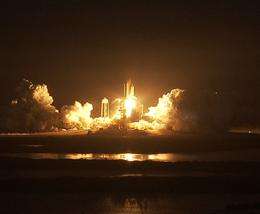
Space shuttle Discovery blazes into the night sky as it lifts off Launch Pad 39A at NASA's Kennedy Space Center in Florida. Photo credit: NASA TV

(PhysOrg.com) -- Space shuttle Discovery and its seven-member crew lifted off from NASA's Kennedy Space Center at 7:43 p.m. EDT Sunday to deliver the final set of power-generating solar array wings and a new crew member to the International Space Station.

Discovery's STS-119 flight is carrying the space station's fourth and final set of , completing the station's truss, or backbone. The arrays will provide the electricity to fully power science experiments and support the station's expanded crew of six in May. The 13-day mission will feature three spacewalks to help install the S6 truss segment to the starboard, or right, side of the station and deploy its . The flight also will replace a failed unit for a system that converts urine to potable water.

Shortly before , Commander Lee Archambault thanked the teams that helped make the launch possible.

"It's truly an honor to be part of this team representing , the nation and the international partners," Archambault said. "See you in a couple of weeks."

Archambault is joined on STS-119 by Pilot Tony Antonelli and Mission Specialists Joseph Acaba, Steve Swanson, Richard Arnold, John Phillips and Japan Aerospace Exploration Agency astronaut Koichi Wakata. Wakata will replace crew member Sandra Magnus, who has been aboard the station for more than four months. He will return to Earth during the next station shuttle mission, STS-127, targeted to launch in June 2009.

Former science teachers Acaba and Arnold are now fully-trained NASA . They are making their first journey to orbit on the mission and will to step outside the station to conduct critical spacewalking tasks.

Discovery's launch was postponed Wednesday, March 11, after a leak associated with the gaseous hydrogen venting system was detected during fueling. Technicians rebuilt and replaced seals and other components associated with the system. No leaks were detected during the Sunday's fueling.

More information: http://www.nasa.gov/shuttle

Provided by JPL/NASA (news : web)


print this article email this article download pdf blog this article bookmark this article     Stumble it Digg this share on Facebook retweet share on Reddit add to delicious
Rate this story - 5 /5 (1 vote)


March 16, 2009 all stories

Comments: 0

5 /5 (1 vote)
  • Stumble this up

  • Digg this

  • share this

  • hide
  • Related Stories

  • NASA Gives 'Go' for Space Shuttle Launch on March 11
    created Mar 06, 2009 | popularity not rated yet | comments 0
  • Atlantis Returns to Kennedy Space Center
    created Jul 03, 2007 | popularity not rated yet | comments 0
  • Space Shuttle Discovery Blasts Off
    created Oct 23, 2007 | popularity not rated yet | comments 0
  • NASA Updates Target Launch Date for Shuttle Discovery
    created Feb 20, 2008 | popularity not rated yet | comments 0
  • Space shuttle launch rescheduled
    created Jan 29, 2007 | popularity not rated yet | comments 0


  • hide
  • Relevant PhysicsForums posts

  • The shape of our solar system's orbits.
    created Nov 07, 2009
  • Above or Below the Line of Nodes
    created Nov 07, 2009
  • Supernova vs. Nova?
    created Nov 07, 2009
  • Supernova's Gamma Rays and Comets
    created Nov 06, 2009
  • More from Physics Forums - General Astronomy

Other News

Deep creep means milder, more frequent earthquakes along Southern California's San Jacinto fault

Deep creep means milder, more frequent earthquakes along Southern California's San Jacinto fault

Space & Earth / Earth Sciences

created 19 hours ago | popularity 4.5 / 5 (4) | comments 0

With an average of four mini-earthquakes per day, Southern California's San Jacinto fault constantly adjusts to make it a less likely candidate for a major earthquake than its quiet neighbor to the east, the ...


Success in 'space elevator' competition (AP)

Success in 'space elevator' competition (Update 3)

Space & Earth / Space Exploration

created Nov 05, 2009 | popularity 4.3 / 5 (33) | comments 50

(AP) -- A robot powered by a ground-based laser beam climbed a long cable dangling from a helicopter on Wednesday to qualify for prize money in a $2 million competition to test the potential reality of the ...


In a Galaxy Far, Far Away...

In a Galaxy Far, Far Away...

Space & Earth / Astronomy

created Nov 06, 2009 | popularity 4.8 / 5 (5) | comments 17

(PhysOrg.com) -- Astronomers have published the discovery of the farthest known object in the cosmos: a star that exploded when the universe was only 630 million years old -- only 4.6% of its current age. ...


'Dropouts' pinpoint earliest galaxies

'Dropouts' pinpoint earliest galaxies

Space & Earth / Astronomy

created Nov 06, 2009 | popularity 4.2 / 5 (10) | comments 13

Astronomers, conducting the broadest survey to date of galaxies from about 800 million years after the Big Bang, have found 22 early galaxies and confirmed the age of one by its characteristic hydrogen signature ...


Space hotel taking bookings for 2012 opening

Space hotel taking bookings for 2012 opening

Space & Earth / Space Exploration

created Nov 05, 2009 | popularity 4.4 / 5 (21) | comments 11

(PhysOrg.com) -- The first orbiting space hotel is on track to open for its first customers in 2012, but hurry, as bookings are filling fast.