NASA eyes debris as Discovery nears space station
March 16, 2009 By MARCIA DUNN , Associated Press Writer Discovery nears space station as debris nears, too (AP)

Enlarge

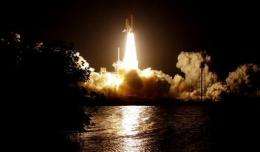
The space shuttle Discovery and a seven member crew liftoff at the Kennedy Space Center in Cape Canaveral, Fla. on Sunday, March 15, 2009. (AP Photo/Chris O'Meara)

(AP) -- NASA kept close tabs on an old piece of space junk Monday that threatened to come too close to the international space station as the shuttle Discovery raced toward the orbiting outpost for a 220-mile-high linkup.

Experts initially warned the debris from a Soviet satellite that broke up in 1981 could veer within a half-mile of the space station. But later, they said it appeared that the piece of junk - about 4 inches in size - might remain at a safe distance.

The debris was in an erratic orbit and experts were watching closely, though it appeared the space station might not have to move out of the way.

If Mission Control orders a space station maneuver to dodge the junk, it would be carried out Monday night, well ahead of the projected close approach between the station and debris early Tuesday morning. If the station were moved, Discovery would have to adjust its course for docking late Tuesday afternoon; the shuttle is delivering one last set of solar wings for the station.

On Thursday, the three space station residents had to move into their emergency getaway capsule because another piece of space junk came uncomfortably close. In that case, there was short notice and the astronauts did not have enough time to steer out of the way.

NASA has moved the space station to dodge debris eight times in the past, most recently in August. Generally, engines on the Russian living quarters or the attached Russian supply ships are fired to alter the path of the entire station. It's a relatively easy job, but uses up precious fuel.

The debris this time is from a Soviet military satellite called Kosmos 1275, which broke up somewhat mysteriously shortly after its 1981 launch. NASA orbital debris scientist Mark Matney said it may have crashed with another object that wasn't being tracked, although the Russians believe a battery explosion did the satellite in. In any event, the result was a cloud of 310 pieces of debris that slowly are falling into lower orbits, he said.

Meanwhile, on board Discovery, the seven astronauts conducted an in-depth inspection of their ship's wings and nose with a laser-tipped boom Monday afternoon. It's standard procedure the day after launch to check for any damage that may have occurred during liftoff.

Late Sunday, NASA officials said a quick look at the launch video showed nothing of significance striking Discovery. Debris has been an overriding concern for NASA since a chunk of foam insulation broke off the external fuel tank and cracked open Columbia's wing in 2003. The shuttle broke apart during re-entry, and all seven astronauts were killed.

Sunday evening's launch of Discovery followed five delays that caused the mission to be shortened by a day and a spacewalk to be cut. Concern over hydrogen valves and a hydrogen leak pushed back the flight by more than a month.

Mission managers said despite the lost day, the astronauts still should be able to complete most of their objectives. Besides installing the new solar wings, the crew will drop off a new urine processor for the space station's water-recycling system, as well as a new station resident, Japanese astronaut Koichi Wakata.

---

Associated Press Writer Mike Schneider in Cape Canaveral and AP Science Writer Seth Borenstein in Washington contributed to this report.

---

On the Net:

NASA: http://spaceflight.nasa.gov

©2009 The Associated Press. All rights reserved. This material may not be published, broadcast, rewritten or redistributed.


print this article email this article download pdf blog this article bookmark this article     Stumble it Digg this share on Facebook retweet share on Reddit add to delicious
Rate this story - 3.8 /5 (4 votes)


March 16, 2009 all stories

Comments: 0

3.8 /5 (4 votes)
  • Stumble this up

  • Digg this

  • share this

  • hide
  • Related Stories

  • NASA shooting for Sunday shuttle Discovery launch
    created Mar 12, 2009 | popularity not rated yet | comments 0
  • NASA fuels Discovery for mission to space station
    created Mar 15, 2009 | popularity not rated yet | comments 0
  • Shuttle Discovery Launches to Fully Power Space Station
    created Mar 16, 2009 | popularity not rated yet | comments 0
  • NASA Gives 'Go' for Space Shuttle Launch on March 11
    created Mar 06, 2009 | popularity not rated yet | comments 0
  • NASA fuels Discovery for flight to space station
    created Mar 11, 2009 | popularity not rated yet | comments 0


  • hide
  • Relevant PhysicsForums posts

  • Question about 2-body gravity
    created Nov 24, 2009
  • life on Mars
    created Nov 24, 2009
  • Semi-major axis from cartesian co-ordinates
    created Nov 23, 2009
  • Primary Mirror grinding
    created Nov 23, 2009
  • More from Physics Forums - General Astronomy

Other News

Aqua satellite sees Tropical Storm Bongani approaching Mozambique Channel

Aqua satellite sees Tropical Storm Bongani approaching Mozambique Channel

Space & Earth / Earth Sciences

created 57 seconds ago | popularity not rated yet | comments 0

NASA's Aqua satellite flew over Cyclone Bongani today and provided some important data that have helped forecasters figure out where the storm is headed, and helped them see that it has changed course.


NASA Aircraft Flies Calif. Wildfire Post-Burn Mission

Space & Earth / Environment

created 43 minutes ago | popularity not rated yet | comments 0

(PhysOrg.com) -- NASA's remotely piloted Predator B aircraft, named Ikhana, recently conducted post-burn assessments of two Southern California wildfire sites, the Piute Fire in Kern County and the Station Fire in the Angeles ...


Cosmic 'dig' reveals vestiges of the Milky Way's building blocks

Cosmic 'Dig' Reveals Vestiges of the Milky Way's Building Blocks

Space & Earth / Astronomy

created 2 hours ago | popularity 5 / 5 (6) | comments 0

(PhysOrg.com) -- Peering through the thick dust clouds of our galaxy's "bulge" (the myriads of stars surrounding its center), a team of astronomers has unveiled an unusual mix of stars in the stellar grouping ...


Oceanic crust formation is dynamic after all

Oceanic crust formation is dynamic after all

Space & Earth / Earth Sciences

created 1hour ago | popularity 4 / 5 (1) | comments 0

Imagine the Earth's crust as the planet's skin: Some areas are old and wrinkled while others have a fresher, more youthful sheen, as if they had been regularly lathered with lotion.


NASA's Aqua satellite sees Nida explode into a category 5 Super typhoon

NASA's Aqua satellite sees Nida explode into a category 5 Super typhoon

Space & Earth / Earth Sciences

created 1hour ago | popularity 5 / 5 (1) | comments 0

Typhoon Nida is in a favorable environment that has enabled it to intensify faster and stronger than previously forecast, and has now exploded into a Super typhoon. NASA's Aqua satellite passed over Nida and ...