Microscope reveals how bacteria 'breathe' toxic metals

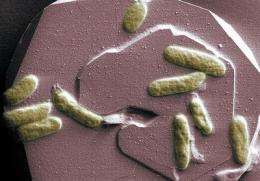
Researchers are studying some common soil bacteria that "inhale" toxic metals and "exhale" them in a non-toxic form.
The bacteria might one day be used to clean up toxic chemicals left over from nuclear weapons production decades ago.
Using a unique combination of microscopes, researchers at Ohio State University and their colleagues were able to glimpse how the Shewanella oneidensis bacterium breaks down metal to chemically extract oxygen.
The study, published online this week in the journal Applied and Environmental Microbiology, provides the first evidence that Shewanella maneuvers proteins within the bacterial cell into its outer membrane to contact metal directly. The proteins then bond with metal oxides, which the bacteria utilize the same way we do oxygen.
The process is called respiration, and it's how living organisms make energy, explained Brian Lower, assistant professor in the School of Environment and Natural Resources at Ohio State. We use the oxygen we breathe to release energy from our food. But in nature, bacteria don't always have access to oxygen.
"Whether the bacteria are buried in the soil or underwater, they can rely on metals to get the energy they need," Lower said. "It's an ancient form of respiration."
"This kind of respiration is fascinating from an evolutionary standpoint, but we're also interested in how we can use the bacteria to remediate nasty compounds such as uranium, technetium, and chromium."
The last two are byproducts of plutonium. The United States Department of Energy is sponsoring the work in order to uncover new methods for treating waste from nuclear weapons production in the 1960s and '70s.
Shewanella is naturally present in the soil, and can in fact be found at nuclear waste sites such as the Hanford site in the state of Washington, Lower explained.
With better knowledge of the bacterium's abilities, scientists might one day engineer a Shewanella that would remediate such waste more efficiently.
"For instance, if you could enhance this bacterium's ability to reduce uranium by having it make more of these key proteins, that could perhaps be one way to clean up these sites that are contaminated," he said.
The danger at such waste sites is that the toxic metals are soluble, and so can leak into the local water supply. But these bacteria naturally convert the metals into an insoluble form. Though the metals would remain in place, they would be stable solids instead of unstable liquids.
For this study, Lower and his colleagues used an atomic force microscope (AFM) to test how the bacterium responded to the metallic mineral hematite.
An AFM works somewhat like a miniaturized phonograph needle: a tiny tip dangles from a cantilever above a surface that's being studied. The cantilever measures how much the tip rises and falls as it's dragged over the surface. It can measure features smaller than a nanometer (billionth of a meter), and detect atomic forces between the probe tip and the surface material.
They combined the AFM with an optical microscope to get a precise map of the bacteria's location on the hematite.
Though the bacteria are very small -- several hundred thousand of them could fit inside the period at the end of a sentence -- they are still thousands of times bigger than the tip of an AFM probe. So the microscope was able to slide over the surface of individual bacteria to detect protein molecules on the cell surface and in contact with the metal.
The researchers coated their probe tip with antibodies for the protein OmcA, which they suspected Shewanella would use to "breathe" the metal.
Whenever the probe slid over an OmcA protein, the antibody coating would stick to the protein. By measuring the tiny increase in force needed to pull the two apart, the researchers could tell where on the bacteria surface the proteins were located.
The microscope detected OmcA all around the edges of the bacteria, wherever the cell membrane contacted the hematite -- which suggests that the protein does indeed enable the bacteria to "breathe" hematite. The protein was even present in a gelatinous ooze that was seeping from the bacteria. This suggests that Shewanella might create the ooze in order to obtain energy from a wider portion of the metal than it can directly touch, Lower said.
In the future, he and his partners want to test their new microscope technique on other types of cells. They also want to test whether Shewanella produces OmcA on the cell surface when exposed to uranium and technetium.
Source: The Ohio State University (news : web)


