Egypt to open inner chambers of 'bent' pyramid
March 16, 2009 By PAUL SCHEMM , Associated Press Writer Egypt to open inner chambers of 'bent' pyramid (AP)

Enlarge

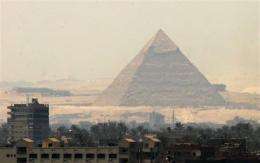
The crowded environment around the famous great pyramid of Giza which are surrounded by hundreds of hawkers and Cairo's buildings, is seen in this April 14, 2007 file photo. Travellers to Egypt will soon be able to explore the inner chambers of the 4,500-year-old "bent" pyramid, announced the Egyptian antiquities chief Monday March 16, 2009, as part of a comprehensive plan to conserve the area around the ancient monuments.(AP Photo/Amr Nabil)

(AP) -- Travelers to Egypt will soon be able to explore the inner chambers of the 4,500-year-old "bent" pyramid, known for its oddly shaped profile, and other nearby ancient tombs, Egypt's antiquities chief announced Monday.

The increased access to the south of Cairo is part of a new sustainable development campaign that hopes will attract more visitors but also to avoid some of the problems of the urban sprawl that have plagued the famed pyramids of Giza.

Egypt's chief archaeologist, Zahi Hawass, said the chambers of the 330-foot-pyramid outside the village of Dahshur, 50 miles south of Cairo, will be opened for the first time to tourists within the next "month or two." "This is going to be an adventure," he told reporters.

Dahshur's is famous for its irregular profile. The massive tomb's sides rise at a steep angle but then abruptly tapers off at a more shallow approach to the pyramid's apex.

Archaeologists believe the pyramid-builders changed their minds while constructing it out of fear the whole structure might collapse because the sides were too steep.

The pyramid is entered through a cramped 80 meter-long tunnel that opens into an immense vaulted chamber. From there, passageways lead to other rooms including one that has cedar wood beams believed to have been imported from ancient Lebanon.

Hawass said archaeologists believe the 4th dynasty founder Pharaoh Sneferu's burial chamber lies undiscovered inside the pyramid.

The inner chambers of the nearby Red pyramid, also built by Sneferu, are already accessible to visitors. Hawass said several other nearby pyramids, including one with an from the Middle Kingdom, would also be opened in the next year.

"It is amazing because of a maze of corridors underneath this pyramid - the visit will be unique," said Hawass, about the pyramid of Amenhemhat III, who ruled during Egypt's 12th dynasty from 1859-1813 BC.

"Twenty-five years ago, I went to enter this pyramid, and I was afraid I would never come back, and I had to ask the workmen to tie ropes around my leg so I wouldn't lose my way," he recalled.

Only 5 percent of tourists coming to Egypt visit the three pyramids of Dahshur, Hawass said.

He hoped increasing access to the monuments would bring more visitors. But he also cautioned that the Western fast food restaurants and hundreds of hawkers selling kitschy souvenirs near the Giza pyramids would not be allowed at Dahshur, which is currently surrounded by agricultural fields on one side and open desert on the other.

As part of an effort announced Monday by Hawass and the United Nations, villagers near Dahshur will be given economic opportunities to increase local development including microfinance loans for small businesses. They did not release specifics but said they hoped to create a master plan for Dahshur and its surrounding villages by the end of the year.

©2009 The Associated Press. All rights reserved. This material may not be published, broadcast, rewritten or redistributed.


print this article email this article download pdf blog this article bookmark this article     Stumble it Digg this share on Facebook retweet share on Reddit add to delicious
Rate this story - 4.5 /5 (8 votes)


March 16, 2009 all stories

Comments: 0

4.5 /5 (8 votes)
  • Stumble this up

  • Digg this

  • share this

  • hide
  • Related Stories

  • Probing Question: How were the Egyptian pyramids built?
    created Mar 27, 2008 | popularity not rated yet | comments 0
  • Scientists say pyramids could be concrete
    created Apr 23, 2008 | popularity not rated yet | comments 0
  • Briefs: Egyptian pharaoh's tomb is not a tomb
    created Mar 15, 2006 | popularity not rated yet | comments 0


  • hide
  • Relevant PhysicsForums posts

Other News

Growth in secular attitudes leaves Americans room for belief in God

Other Sciences / Social Sciences

created Oct 31, 2009 | popularity 4 / 5 (6) | comments 118

(PhysOrg.com) -- The nature of the American religious experience is changing as a rising number of people report having no formal religious affiliation, even though the number of Americans who say they pray is increasing, ...


Forest clearances sealed ancient civilisation's downfall

Forest clearances sealed ancient civilisation's downfall

Other Sciences / Archaeology & Fossils

created Nov 02, 2009 | popularity 4.9 / 5 (9) | comments 6

(PhysOrg.com) -- An ancient South American civilisation which disappeared around 1,500 years ago helped to cause its own demise by damaging the fragile ecosystem that held it in place, a study has found. ...


Oscar Pistorius

New study further disputes notion that amputee runners gain advantage from protheses

Other Sciences / Other

created Nov 04, 2009 | popularity 5 / 5 (4) | comments 5

A study by six researchers, including a University of Colorado at Boulder associate professor and his former doctoral student, shows that amputees who use running-specific prosthetic legs have no performance ...


New theory on fairness in economics targets CEO pay

Other Sciences / Economics

created Nov 03, 2009 | popularity 4.3 / 5 (11) | comments 3

(PhysOrg.com) -- Chief executives in 35 of the top Fortune 500 companies were overpaid by about 129 times their "ideal salaries" in 2008, according to a new type of theoretical analysis proposed by a Purdue University researcher ...


Racial segregation key factor in subprime lending

Other Sciences / Economics

created Nov 06, 2009 | popularity 3 / 5 (2) | comments 2

(PhysOrg.com) -- New study examines impact of segregation on the prevalence of high-cost loans in U.S. metro areas. Subprime loans disproportionately located in segregated areas.