Researchers Develop Wireless Method of Brain Stimulation
March 16, 2009 Researchers Develop Wireless Method of Brain Stimulation

Enlarge

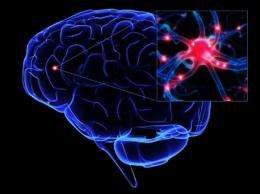
(PhysOrg.com) -- A new, wireless method of brain stimulation has the potential to activate specific regions of the brain or restore function to damaged or cut nerves, according to a study by Case Western Reserve University researchers.

Ben Strowbridge, an associate professor in the neurosciences department at Case Western Reserve’s School of Medicine, and Clemens Burda, an associate professor in chemistry, collaborated on the project. They say that by using as very tiny solar cells they can excite neurons in single cells or groups of cells with visible, or infrared, light.

In their study, the researchers embedded light-activated nanoparticles, which require neither wires nor electrical power, directly into non-human tissue and were able to activate neurons. A next step would be to use the technology to activate dispersed groups of neurons at the same time. This would represent a new way of re-creating the complex activity patterns that normally occur in the brain.

In contrast, the researchers say, traditional electrical stimulation of the brain requires arrays of metal electrodes to be implanted. The closer the traditional metal technique gets to re-creating “real” patterns, the more invasive it becomes. Burda adds that with conventional electrodes can have potentially damaging side effects, ranging from simple of cells to chemical reactions from exposure to the electrode materials.

“There are many different reasons you’d want to stimulate neurons—such as repairing injury or restoring function to severed or damaged nerves—and right now you have to put a wire in there, and then connect that to some control system. It is both very invasive and a difficult thing to do,” Strowbridge says.

The researchers expect to be able to implant nanoparticles next to nerves, eliminating the need for wired connections. They can then use light to activate the particles.

The study used brain slices to show that light can trigger neural activity. Their next step is assessing whether the technology can be used to stimulate longer pathways within the intact brain. Clinical development of the technology could lead numerous biomedical applications.

“The long-term goal of this work is to develop a light-activated brain interface that restores function following nerve or brain impairments,” Strowbridge says. “Our findings may open up a whole new world of research possibilities.”

The study is the first report of brain stimulation using light-activated semiconductor nanoparticles. It was published in the journal Angewandte Chemie.

Provided by Case Western Reserve University (news : web)


print this article email this article download pdf blog this article bookmark this article     Stumble it Digg this share on Facebook retweet share on Reddit add to delicious
Rate this story - 4.5 /5 (6 votes)

Rank Filter

Move the slider to adjust rank threshold, so that you can hide some of the comments.


Display comments: newest first

  • zevkirsh - Mar 16, 2009
    • Rank: 5 / 5 (2)
    "This would represent a new way of re-creating the complex activity patterns that normally occur in the brain."

    no..it wouldnt. it is a new way of stimulating the brain, thats all.

March 16, 2009 all stories

Comments: 1

4.5 /5 (6 votes)
  • Stumble this up

  • Digg this

  • share this

  • hide
  • Related Stories


  • hide
  • Relevant PhysicsForums posts

  • kinetics and surface chemistry
    created 2 hours ago
  • Molarity and Rate Law
    created 2 hours ago
  • pH in solutions
    created 4 hours ago
  • Few questions about aldehydes and ketones?
    created 4 hours ago
  • More from Physics Forums - Chemistry

Other News

Study reveals why certain drug combinations backfire

Chemistry / Biochemistry

created 22 hours ago | popularity 4.5 / 5 (4) | comments 0

Combination drug therapy has become a staple for treating many infections. For instance, doctors treat extensively drug resistant forms of tuberculosis with one drug that breaks down the pathogen's protective barriers and ...


H1N1 Virus Can Be Killed by Acidic Ozone Water

H1N1 Virus Can Be Killed by Acidic Ozone Water

Chemistry / Biochemistry

created Nov 09, 2009 | popularity 4.8 / 5 (29) | comments 12

(PhysOrg.com) -- Scientists have found that acidic ozone water can deactivate H1N1 viruses very effectively, offering a promising disinfectant for the millions of people trying to avoid the disease. Acidic ...


New evidence that dark chocolate helps ease emotional stress

New evidence that dark chocolate helps ease emotional stress

Chemistry / Biochemistry

created Nov 11, 2009 | popularity 5 / 5 (3) | comments 2

The "chocolate cure" for emotional stress is getting new support from a clinical trial published online in ACS' Journal of Proteome Research.


Energy-saving powder

Energy-saving powder: Converting methane to methanol

Chemistry / Other

created Nov 11, 2009 | popularity 3.6 / 5 (5) | comments 2

It is currently estimated that natural gas resources will be exhausted in 130 years; however, those reserves where extraction is cost-effective will only flow for another 60 years or so.


The Future in Two Words: Ionic Liquids

The Future in Two Words: Ionic Liquids

Chemistry / Materials Science

created Nov 13, 2009 | popularity 4.4 / 5 (7) | comments 0

(PhysOrg.com) -- Ionic liquids are molecular solutions that have a wide range of potential applications, including next-generation solar cells, hydrogen fuel cells and lithium batteries.