Four of Saturn's moons parade by their parent
March 17, 2009 Four of Saturn's moons parade by their parent

Enlarge

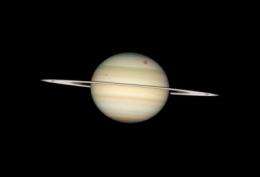
On Feb. 24, 2009, the NASA/ESA Hubble Space Telescope captured a photo sequence of four moons of Saturn passing in front of their parent planet. The moons, from far left to right, are the white icy moons Enceladus and Dione, the large orange moon Titan, and icy Mimas. Due to the angle of the sun, they are each preceded by their own shadow. Credit: NASA, ESA and the Hubble Heritage Team (STScI/AURA)

On 24 February 2009, the NASA/ESA Hubble Space Telescope captured a photo sequence of four moons of Saturn passing in front of their parent planet. The moons, from far left to right, are the white icy moons Enceladus and Dione, the large orange moon Titan, and icy Mimas. Due to the angle of the Sun, they are each preceded by their own shadow.

These rare transits only happen when the tilt of Saturn's is nearly "edge on" as seen from the . Saturn's rings will be perfectly edge on to our line of sight on 10 August and 4 September 2009. Unfortunately, will be too close to the Sun to be seen by viewers on Earth at that time. This "ring plane crossing" occurs every 14-15 years. In 1995-96 Hubble witnessed the previous ring plane crossing, as well as many moon transits, and helped to discover several new moons of Saturn.

Early 2009 was a favourable time for viewers with small telescopes to watch moon and shadow transits crossing the face of Saturn. , Saturn's largest moon, crossed Saturn on four separate occasions: 24 January, 9 February, 24 February and 12 March, although not all events were visible from all locations on Earth.

Italian Galileo Galilei — often referred to as the father of astronomy — was the first to observe Saturn through a telescope in 1610. Dutch mathematician and astronomer Christian Huygens discovered Titan in 1655 and, 350 years later, the ESA probe named for him touched down on Titan (on 14 January 2005), giving the world its first views of the surface of the mysterious, icy world. Giovanni Domenico , a French/Italian astronomer, discovered Dione (in addition to others) and the German-born Englishman, William Herschel, discovered Mimas and Enceladus.

These pictures were taken with Hubble's Wide Field Planetary Camera 2 on 24 February 2009, when Saturn was at a distance of roughly 1.25 billion kilometres from Earth. Hubble can see details as small as 300 kilometres across on Saturn. The dark band running across the face of the planet slightly above the rings is the shadow of the rings cast on the planet.

Source: ESA/Hubble Information Centre (news : web)


print this article email this article download pdf blog this article bookmark this article     Stumble it Digg this share on Facebook retweet share on Reddit add to delicious
Rate this story - 4.7 /5 (3 votes)


March 17, 2009 all stories

Comments: 0

4.7 /5 (3 votes)
  • Stumble this up

  • Digg this

  • share this

  • hide
  • Related Stories

  • Spectacular Photo-op on Saturn
    created Feb 19, 2009 | popularity not rated yet | comments 0
  • Saturn's Crazy Christmas Tilt
    created Dec 22, 2008 | popularity not rated yet | comments 0
  • Saturn Stars in Three Hubble Movies
    created Mar 20, 2007 | popularity not rated yet | comments 0
  • Cassini Spacecraft Witnesses Saturn's Blues
    created Feb 09, 2005 | popularity not rated yet | comments 0
  • The Vanishing Rings of Saturn
    created Mar 18, 2008 | popularity not rated yet | comments 0


  • hide
  • Relevant PhysicsForums posts

  • The shape of our solar system's orbits.
    created 21 hours ago
  • Above or Below the Line of Nodes
    created Nov 07, 2009
  • Supernova vs. Nova?
    created Nov 07, 2009
  • Supernova's Gamma Rays and Comets
    created Nov 06, 2009
  • More from Physics Forums - General Astronomy

Other News

Deep creep means milder, more frequent earthquakes along Southern California's San Jacinto fault

Deep creep means milder, more frequent earthquakes along Southern California's San Jacinto fault

Space & Earth / Earth Sciences

created 7 hours ago | popularity 4.7 / 5 (3) | comments 0

With an average of four mini-earthquakes per day, Southern California's San Jacinto fault constantly adjusts to make it a less likely candidate for a major earthquake than its quiet neighbor to the east, the ...


Success in 'space elevator' competition (AP)

Success in 'space elevator' competition (Update 3)

Space & Earth / Space Exploration

created Nov 05, 2009 | popularity 4.3 / 5 (33) | comments 50

(AP) -- A robot powered by a ground-based laser beam climbed a long cable dangling from a helicopter on Wednesday to qualify for prize money in a $2 million competition to test the potential reality of the ...


In a Galaxy Far, Far Away...

In a Galaxy Far, Far Away...

Space & Earth / Astronomy

created Nov 06, 2009 | popularity 4.8 / 5 (5) | comments 15

(PhysOrg.com) -- Astronomers have published the discovery of the farthest known object in the cosmos: a star that exploded when the universe was only 630 million years old -- only 4.6% of its current age. ...


'Dropouts' pinpoint earliest galaxies

'Dropouts' pinpoint earliest galaxies

Space & Earth / Astronomy

created Nov 06, 2009 | popularity 4.2 / 5 (10) | comments 13

Astronomers, conducting the broadest survey to date of galaxies from about 800 million years after the Big Bang, have found 22 early galaxies and confirmed the age of one by its characteristic hydrogen signature ...


Space hotel taking bookings for 2012 opening

Space hotel taking bookings for 2012 opening

Space & Earth / Space Exploration

created Nov 05, 2009 | popularity 4.4 / 5 (20) | comments 11

(PhysOrg.com) -- The first orbiting space hotel is on track to open for its first customers in 2012, but hurry, as bookings are filling fast.