Better by design: Engineering flu vaccines
March 17, 2009
Influenza Virus

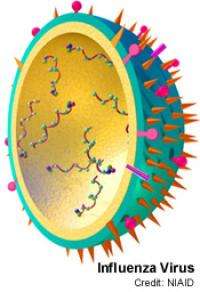
This is a diagram of the influenza virus. Credit: NIAID / Wikipedia

A new computerized method of testing could help world health officials better identify flu vaccines that are effective against multiple strains of the disease. Rice University scientists who created the method say tests of data from bird flu and seasonal flu outbreaks suggest their method can better gauge the efficacy of proposed vaccines than can tests used today.

Rice's Michael Deem, the lead scientist on the project, will present the group's results March 19 at the American Physical Society's 2009 meeting in Pittsburgh. The results are also slated to appear in the forthcoming book "Influenza: " from Horizon Scientific Press.

Avian , or , is a particularly deadly type of flu that's transmitted from birds to humans. It hasn't yet evolved into a form that can be transmitted readily between humans, but scientists and world health authorities are trying to prepare for a potential outbreak. Because the virus mutates continually, creating a vaccine in advance is problematic. For example, scientists have already found that a vaccine designed for the 1997 strain of bird flu does not work against a 2003 strain.

"Current vaccines contain only a single version of a given flu subtype," Deem said. "We wanted to gauge the effectiveness of a vaccine that contained multiple versions of a given subtype."

World health authorities currently test the efficacy of proposed flu vaccines using either ferrets, which can contract the same forms of flu as people, or genetic assays. Rice's new computerized method could be a cheaper and faster alternative.

With the new method, flu virus mutations are assigned numerical scores. Deem, Rice's John W. Cox Professor of and professor of physics and astronomy, and colleagues developed the method so they could assign a number that captured the amount of difference or similarity between . The method can also be used to test how effective a vaccine will be against divergent strains. To verify this, the team checked their results against data collected by the World Health Organization from 1971 to 2004.

"For seasonal influenza, we validated our model against observational data compiled by the World Health Organization's Global Influenza Surveillance Network," Deem said. "We also ran tests against bird flu data. We found that multiple-component bird flu vaccines appeared to be helpful in controlling the simultaneous multiple introduction of bird flu strains."

Influenza viruses are like chameleons. They constantly change the patterns on their outer surface to avoid being targeted by antibodies. This rapid mutation rate is the reason seasonal flu vaccines must be changed annually. However, the vaccines sometimes offer less than ideal protection against newly evolved strains. It takes about six months to produce annual vaccine supplies; also, ideal vaccine strains are often difficult to produce by the standard hen's egg technology, and alternative strains are substituted.

"Oftentimes, bird flu seems to emerge with multiple strains, and something similar can happen with newly released or evolved strains of seasonal flu as well," Deem said. The computational approach Deem will discuss is able to estimate the need for and the efficacy of a multiple-component vaccine in the face of the emergence of multiple flu strains.

Each year, world health authorities create a flu vaccine that protects against three types of seasonal flu -- two subtypes of type A flu and one subtype of type B.

Source: Rice University (news : web)


Rank not rated yet
Related Stories
Relevant PhysicsForums posts
  • Is Everyday Technology Killing Us?
    createdFeb 08, 2012
  • Exercise and weight loss
    createdFeb 08, 2012
  • Why do we have head aches? Our brains can't feel anything.
    createdFeb 07, 2012
  • "The end of diseases" by David Agus, interview from Daily Show with Jon Stewart
    createdFeb 04, 2012
  • Oncolytic adenovirus
    createdFeb 04, 2012
  • Nutrition label stuffs and diets
    createdFeb 02, 2012
  • More from Physics Forums - Medical Sciences

More news stories

Starve a virus, feed a cure? Findings show how some cells protect themselves against HIV

A protein that protects some of our immune cells from the most common and virulent form of HIV works by starving the virus of the molecular building blocks that it needs to replicate, according to research published online ...

Medicine & Health / Research

created 2 hours ago | popularity 5 / 5 (1) | comments 0 | with audio podcast

Injured boomers beware: Know when to see doctor

(AP) -- It happened to nurse Jane Byron years after an in-line skating fall, business owner Haralee Weintraub while doing "men's" push-ups, and avid cyclist Gene Wilberg while lifting a heavy box.

Medicine & Health / Health

created 3 hours ago | popularity 5 / 5 (1) | comments 0

FDA-approved drug rapidly clears amyloid from the brain, reverses Alzheimer's symptoms in mice

Neuroscientists at Case Western Reserve University School of Medicine have made a dramatic breakthrough in their efforts to find a cure for Alzheimer's disease. The researchers' findings, published in the journal Science, show t ...

Medicine & Health / Neuroscience

created Feb 09, 2012 | popularity 4.9 / 5 (55) | comments 21 | with audio podcast

Green tea found to reduce disability in the elderly

(Medical Xpress) -- A lot of research has been done over the past several years looking into the health benefits of green tea. As a result, scientists have found that regular consumption of the beverage leads ...

Medicine & Health / Health

created Feb 07, 2012 | popularity 4.4 / 5 (15) | comments 11 | with audio podcast report

Teen school drop-outs three times as likely to be on benefits in later life

Teen school drop-outs are almost three times as likely to be on benefits in later life as their peers who complete their schooling, indicates research published online in the Journal of Epidemiology and Community Health.

Medicine & Health / Health

created Feb 06, 2012 | popularity not rated yet | comments 13


Scientists discover molecular secrets of 2,000-year-old Chinese herbal remedy

For roughly two thousand years, Chinese herbalists have treated Malaria using a root extract, commonly known as Chang Shan, from a type of hydrangea that grows in Tibet and Nepal. More recent studies suggest that halofuginone, ...

New method to examine batteries -- MRI from the inside

There is an ever-increasing need for advanced batteries for portable electronics, such as phones, cameras, and music players, but also to power electric vehicles and to facilitate the distribution and storage of energy derived ...

Lab study raises questions over nano-particle impact

Tests involving chickens have raised questions about the impact on health from engineered nano-particles, the ultra-fine grains commonly used in drugs and processed foods, scientists said on Sunday.

Google might launch Drive for cloud storage soon

(PhysOrg.com) -- Google's next big move, according to the Wall Street Journal, is a cloud storage service called Drive. Hardly first to the plate, Google is simply catching up to introducing its cloud reposi ...

A mitosis mystery solved: How chromosomes align perfectly in a dividing cell

Although the process of mitotic cell division has been studied intensely for more than 50 years, Whitehead Institute researchers have only now solved the mystery of how cells correctly align their chromosomes during symmetric ...

Researchers find extensive RNA editing in human transcriptome

In a new study published online in Nature Biotechnology, researchers from BGI, the world's largest genomics organization, reported the evidence of extensive RNA editing in a human cell line by analysis of RNA-seq data, demons ...