Liquid saltwater is likely present on Mars, new analysis shows
March 17, 2009 Liquid saltwater is likely present on Mars, new analysis shows

Enlarge

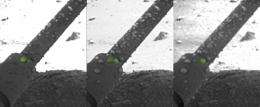
Droplets on a leg of the Mars Phoenix lander are seen to darken and coalesce. Nilton Renno, a professor in the Department of Atmospheric, Oceanic and Space Sciences says this is evidence that they are made of liquid water. Credit: NASA/JPL-Caltech/University of Arizona/Max Planck Institute

(PhysOrg.com) -- Salty, liquid water has been detected on a leg of the Mars Phoenix Lander and therefore could be present at other locations on the planet, according to analysis by a group of mission scientists led by a University of Michigan professor. This is the first time liquid water has been detected and photographed outside the Earth.

"A large number of independent physical and thermodynamical evidence shows that saline water may actually be common on ," said Nilton Renno, a professor in the U-M Department of Atmospheric, Oceanic and Space Sciences and a co-investigator on the mission.

" is an essential ingredient for life. This discovery has important implications to many areas of planetary exploration, including the habitability of Mars."

Renno will present these findings March 23 at the Lunar and Planetary Science Conference in Houston.

Previously, scientists believed that water existed on Mars only as ice or water vapor because of the planet's low temperature and . They thought that ice in the Red Planet's current climate could sublimate, or vaporize, but they didn't think it could melt.

This analysis shows how that assumption may be incorrect. Temperature fluctuation in the arctic region of Mars where Phoenix landed and salts in the soil could create pockets of water too salty to freeze in the climate of the landing site, Renno says.

Photos of one of the lander's legs show droplets that grew during the polar summer. Based on the temperature of the leg and the presence of large amounts of "perchlorate" salts detected in the soil, scientists believe the droplets were most likely water and mud that splashed on the spacecraft when it touched down. The lander was guided down by rockets whose exhaust melted the top layer of ice below a thin sheet of soil.

Some of the mud droplets that splashed on the lander's leg appear to have grown by absorbing water from the atmosphere, Renno says. Images suggest that some of the droplets darkened, then moved and merged—physical evidence that they were liquid.

The wet chemistry lab on Phoenix found evidence of , which likely include magnesium and calcium perchlorate hydrates. These compounds have freezing temperatures of about -90 and -105 Fahrenheit respectively. The temperature at the landing site ranged from approximately -5 to -140 Fahrenheit, with a median temperature around -75 Fahrenheit. Temperatures at the landing site were mostly warmer than this during the first months of the mission.

Thermodynamic calculations offer additional evidence that salty liquid water can exist where Phoenix landed and elsewhere on Mars. The calculations also predicts a droplet growth rate that is consistent with what was observed. And they show that it is impossible for ice to sublimate from the cold ground just under the strut of the lander's leg and be deposited on a warmer strut, a hypothesis that has been suggested.

Certain bacteria on Earth can exist in extremely salty and cold conditions.

"This discovery is the result of the talent and dedication of the entire Phoenix team and NASA, whose strategy for Mars exploration and the Phoenix mission is "follow the water," Renno said.

Phoenix landed on Mars on May 25, 2008 and transmitted data back to Earth until Nov. 10. Scientists are still analyzing the information Phoenix gathered.

The mission was led by NASA's Jet Propulsion Laboratory and the University of Arizona. Among its preliminary findings, Phoenix verified that water ice exists in the just beneath the surface of Mars. It sent back more than 25,000 photos and deployed the first atomic force microscope ever used outside Earth. The lander was the first Martian spacecraft to document a mildly alkaline soil and perchlorate salts. It also observed snow falling from clouds on the Red Planet.

A paper on this research, written by Renno and dozens of his colleagues on the Phoenix mission, including principal investigator Peter Smith, is under review at the Journal of Geophysical Research. Other U-M contributors to this research are Manish Mehta and Jasper Kok, doctoral students in the Department of Atmospheric, Oceanic and Space Sciences.

Provided by University of Michigan (news : web)


print this article email this article download pdf blog this article bookmark this article     Stumble it Digg this share on Facebook retweet share on Reddit add to delicious
Rate this story - 4.7 /5 (18 votes)

Rank Filter

Move the slider to adjust rank threshold, so that you can hide some of the comments.


Display comments: newest first

  • jordanfel - Mar 17, 2009
    • Rank: 4.5 / 5 (2)
    The science section of the New York Times 3/16/09 (http://www.nytime...tml?_r=1&emc=eta1) presents a debate on how the information is interpreted. Why didn't the phyorg article attend to such questioning?
  • Mercury_01 - Mar 18, 2009
    • Rank: 2.5 / 5 (2)
    because its BORING. Go water! Wooo!
  • Ibeltimes - Mar 18, 2009
    • Rank: not rated yet
    The low temperature may help to be water.Salts also contribute to find Water.
  • deatopmg - Mar 18, 2009
    • Rank: 3.7 / 5 (3)
    SO, after all these years the "official" evidence is finally beginning to be metered out, but:

    - "This discovery is the result of the talent and dedication of the entire Phoenix team and NASA, whose strategy for Mars exploration and the Phoenix mission is "follow the water," Renno said.-

    is transparent PR BS and clearly obfuscation of the truth.


    The photo evidence of flowing water (salt or fresh, depends on the region), the photos of the rovers driving into and out of mud, soil, SOIL, not atmospheric, temperatures of 20 deg.C or more, the fact that the atmosphere is nearly saturated with water (the water vapor must be in equilibrium w/ surface water), and much more "official" evidence are proof of that obfuscation.


    The parent organization has known for 10's of years that there is liquid water is present on Mars; and by inference, they probably know much, much more.

  • docknowledge - Mar 18, 2009
    • Rank: 1 / 5 (1)
    In case you didn't know, deatopmg, almost everything that NASA does for the space program goes into the public domain. I worked for years there, on many projects, and don't know of a single secret project that's related to Mars. I.e., all the evidence is there for anyone who wants to look.

    What is amusing about this article, though, is that a significant discovery comes, not from the designed experiments, but from some clever person noticing that objects in the pictures of the lander legs changed. Nice work.
  • deatopmg - Mar 20, 2009
    • Rank: not rated yet
    @docknowledge

    ALL of the photo's first pass thru a private company (individual) before the "agency" gets them so that the FOI act becomes null and void. This allows the organization to decide which photo's to release, and which ones to diddle with before release. Most are altered, in the early days by air brushing and now in the digital age automatically. Simply converting the raw data into jpg's then the jpg's into tiff's to make it look like you are getting higher resolution pictures is only the tip of the obfuscation iceberg. It is so obvious that many (most?) of the photo's have been altered to hide something. do a search for Hale crater and see what you come up with.


    I suspect there you are correct in that there are no (overt) secret Mars projects but it is the way the collected information is so tightly managed and manipulated that Never A Straight Answer best describes the agency.


    What is amusing about the article is it had to be approved by the Agency otherwise the authors will never see any more funding. It's the dribs and drabs of information that is "allowed" to trickle out that is so frustrating and suspicious.

March 17, 2009 all stories

Comments: 6

4.7 /5 (18 votes)
  • Stumble this up

  • Digg this

  • share this

  • hide
  • Related Stories

  • Report: Images from Mars lander show liquid water
    created Mar 11, 2009 | popularity not rated yet | comments 0
  • Simulations predicted Mars lander would hit sub-surface
    created Jun 02, 2008 | popularity not rated yet | comments 0
  • Phoenix Heads for Mars
    created Aug 04, 2007 | popularity not rated yet | comments 0
  • NASA says Phoenix Mars mission has ended (Update 2)
    created Nov 10, 2008 | popularity not rated yet | comments 0
  • Phoenix Lander Prepares for Microscopy, Wet Chemistry on Mars
    created Jun 24, 2008 | popularity not rated yet | comments 0


  • hide
  • Relevant PhysicsForums posts

  • Sideral question
    created 18 hours ago
  • Doppler shifted blackbody spectrum
    created 21 hours ago
  • Earth v. Moon
    created 23 hours ago
  • help me with coordinates and orbits
    created 23 hours ago
  • basic 'our universe' question..
    created Nov 20, 2009
  • deriving keplers law
    created Nov 19, 2009
  • More from Physics Forums - General Astronomy

Other News

Astronauts finish another spacewalk, still no baby (AP)

Astronauts finish another spacewalk, still no baby

Space & Earth / Space Exploration

created 9 hours ago | popularity 3 / 5 (2) | comments 0

(AP) -- A spacewalking astronaut put aside the impending birth of his daughter and blazed through his first-ever venture outside the International Space Station on Saturday.


Unseasonably hot and dry weather combined with strong winds to fan scores of blazes in the country's southeastern states

Australia issues 'catastrophic' alerts as fires rage

Space & Earth / Environment

created 15 hours ago | popularity 4 / 5 (3) | comments 0

Australia has issued "catastrophic" alerts after record-breaking temperatures and wild lightning storms sparked more than 100 fires across the country, officials said Saturday.


Commuters wait on the platform shrouded by fog in London

Climate change not man-made, say majority of Britons: poll

Space & Earth / Environment

created Nov 15, 2009 | popularity 3.3 / 5 (15) | comments 46

Less than half of Britons believes that human activity is to blame for global warming, according to a poll carried out for The Times newspaper and published on Saturday.


Mysteriously warm times in Antarctica

Mysteriously warm times in Antarctica

Space & Earth / Earth Sciences

created Nov 18, 2009 | popularity 4.2 / 5 (21) | comments 28

(PhysOrg.com) -- A new study of Antarctica's past climate reveals that temperatures during the warm periods between ice ages (interglacials) may have been higher than previously thought. The latest analysis ...


UN: Fight climate change with free condoms (AP)

UN: Fight climate change with free condoms

Space & Earth / Environment

created Nov 18, 2009 | popularity 3.1 / 5 (11) | comments 24

(AP) -- The battle against global warming could be helped if the world slowed population growth by making free condoms and family planning advice more widely available, the U.N. Population Fund said Wednesday.