Study: 'Smart drug' Provigil may be habit-forming
March 17, 2009 By CARLA K. JOHNSON , AP Medical Writer
Study: 'Smart drug' Provigil may be habit-forming (AP)

Enlarge

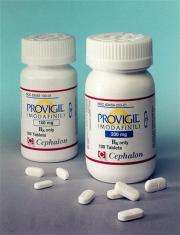
An undated photo provided by Frazer, Pa.-based Cephalon, Inc., shows bottles of its presription drug Provigil. A small government study shows that the popular brain-boosting drug may carry a risk of addiction like other popular stimulants. Provigil is approved to treat excessive daytime sleepiness caused by narcolepsy. On the market since 1999, it's the company's flagship product. (AP Photo/Cephalon Inc.)

(AP) -- A so-called "smart drug" popular with young people may carry more of an addiction risk than thought, a small government study suggests. Scans of 10 healthy men showed that the prescription drug Provigil caused changes in the brain's pleasure center, very much like potentially habit-forming classic stimulants. Modafinil, the drug's generic name, is sometimes used as an illegal study aid by college students.

"It would be wonderful if one could take a and be smarter, faster or have more energy," said Dr. Nora Volkow, director of the National Institute on Drug Abuse, who led the study with a Brookhaven National Laboratory scientist. "But that is like fairy tales. We currently have nothing that has those benefits without side effects."

The study, appearing in Wednesday's , may bust the myth that the drug is safe for healthy people, experts said.

is approved to treat excessive daytime sleepiness caused by narcolepsy. On the market since 1999, it's the flagship product of Cephalon Inc. of Frazer, Pa., and its sales approached $1 billion last year. The company is developing a spin-off called Nuvigil.

Modafinil's reputation as a brain enhancer stems from an Air Force study that found it improved the performance of sleep-deprived fighter pilots. College students buy and sell it illegally, as they do Ritalin and Adderall, to stay alert while studying.

Several scientists recently wrote in the journal Nature that healthy people should have the right to boost their brains with pills like Provigil. One author of that commentary, brain scientist Martha Farah of the University of Pennsylvania, said the new study "goes to show that we need a little caution and a little humility when we're messing around with our brain chemistry."

"But even now, after all the years that it has been on the market, we are still learning things about it that are relevant to its safety," Farah said.

The men in the study were 23 to 46 years old. They received either a dummy pill or modafinil. Effects were measured by PET scans, which showed that the drug increased dopamine, the brain's "feel-good" neurotransmitters.

Modafinil once was thought to be safer than conventional stimulants because it was believed that it did not engage the brain's dopamine system, which is linked with addiction. Studies in mice and monkeys suggested otherwise.

The new study is the first human evidence that a typical dose of modafinil affects dopamine in the brain as much as a dose of Ritalin, a controlled substance with clear potential for dependence.

Volkow said modafinil acts slowly when swallowed and is difficult to inject, making it less likely to be abused. Its high price, about $10 per pill compared to Ritalin at $2 per pill, also makes it less attractive to people seeking a high. That may change when generics become available in 2012, Volkow said.

Jeffry Vaught, chief science officer for Cephalon, said the company has seen no evidence the drug is highly abused.

"If abuse is a problem with modafinil, it's minimal at best," Vaught said. "We're not seeing it used at rave scenes."

Prescribing information for the drug warns of severe rashes and other side effects such as headache, nausea and anxiety. Cephalon doesn't support the drug's use as a cognitive enhancer.

"There's no substitute for sleep," Vaught said.

---

On the Net:

JAMA: http://jama.ama-assn.org

©2009 The Associated Press. All rights reserved. This material may not be published, broadcast, rewritten or redistributed.


Rank not rated yet
Relevant PhysicsForums posts
  • Is Everyday Technology Killing Us?
    createdFeb 08, 2012
  • Exercise and weight loss
    createdFeb 08, 2012
  • Why do we have head aches? Our brains can't feel anything.
    createdFeb 07, 2012
  • "The end of diseases" by David Agus, interview from Daily Show with Jon Stewart
    createdFeb 04, 2012
  • Oncolytic adenovirus
    createdFeb 04, 2012
  • Nutrition label stuffs and diets
    createdFeb 02, 2012
  • More from Physics Forums - Medical Sciences

More news stories

Researchers make breakthrough in stem cell research

(Medical Xpress) -- University of Queensland scientists have developed a world-first method for producing adult stem cells that will substantially impact patients who have a range of serious diseases.

Medicine & Health / Research

created 20 minutes ago | popularity 5 / 5 (1) | comments 0 | with audio podcast

Georgia Tech develops software for the rapid analysis of foodborne pathogens

2011 brought two of the deadliest bacterial outbreaks the world has seen during the last 25 years. The two epidemics accounted for more than 4,200 cases of infectious disease and 80 deaths. Software developed at Georgia Tech ...

Medicine & Health / Diseases

created 12 minutes ago | popularity not rated yet | comments 0

Social psychologist: Lust makes you smarter and evidence that seven deadly sins are good for you

(Medical Xpress) -- Good news for lovers on Valentine’s Day - the seven deadly sins, including Lust, are good for you. University of Melbourne social psychologist Dr Simon Laham uses modern research to make a compelling ...

Medicine & Health / Psychology & Psychiatry

created 42 minutes ago | popularity 4 / 5 (1) | comments 0

Couples in the same place emotionally stay together, study says

(Medical Xpress) -- Despite life’s ups and downs, couples whose feelings are in sync consistently over time are more likely to stay together, says a University of California, Davis, study.

Medicine & Health / Psychology & Psychiatry

created 7 minutes ago | popularity not rated yet | comments 0 | with audio podcast

Low levels of amplitude-modulated electromagnetic fields elicit therapeutic responses cancer patients

Ryne Ramaker, a senior UALR Donaghey Scholar and University Science Scholar with a double major in biology and chemistry, is a co-author of a cancer research paper creating excitement among other researchers. The article ...

Medicine & Health / Cancer

created 29 minutes ago | popularity not rated yet | comments 0


New molecule has potential to help treat genetic diseases and HIV

(PhysOrg.com) -- Chemists at The University of Texas at Austin have created a molecule that's so good at tangling itself inside the double helix of a DNA sequence that it can stay there for up to 16 days before ...

With climate change, today's '100-year floods' may happen every three to 20 years: research

Last August, Hurricane Irene spun through the Caribbean and parts of the eastern United States, leaving widespread wreckage in its wake. The Category 3 storm whipped up water levels, generating storm surges ...

The joy of cheques

An electronic cheque which eliminates the need for costly processing by banks but preserves the simplicity and ease of a traditional cheque book has been designed by a team of academics in the UK.

Research shows promise in converting camelina oil into jet fuel

(PhysOrg.com) -- Researchers at Montana State University-Northern have developed a process to convert camelina oil to jet fuel and other high-value chemicals. MSU has applied for a U.S. patent and research is ongoing.

Omega-3 fatty acid on trial: Study to evaluate long-term effects on intelligence, behavior

University of Kansas researchers John Colombo and Susan Carlson have been awarded $2.5 million for the next five years of a 10-year, double-blind randomized controlled trial to determine whether prenatal nutritional supplementation ...

Research finds injuries to professional athletes from routine play or practice often reported as 'freak accidents' in me

(Medical Xpress) -- A new report from the Johns Hopkins Center for Injury Research and Policy finds injuries to professional athletes from routine play or practice are often characterized as “freak accidents” in ...