Shuttle Discovery zooms toward space station
March 17, 2009 By MARCIA DUNN , AP Aerospace Writer Shuttle Discovery zooms toward space station (AP)

Enlarge

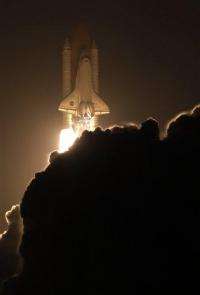
The space shuttle Discovery and a seven member crew liftoff at the Kennedy Space Center in Cape Canaveral, Fla. on Sunday, March 15, 2009. (AP Photo/Chris O'Meara)

(AP) -- With a kick of its rocket thrusters, space shuttle Discovery zoomed to the international space station Tuesday to deliver one last set of solar wings that should bring the orbiting complex to full power.

The 220-mile-high linkup was set to occur late in the afternoon.

As the pilots steered Discovery over its final 10-mile course, Mission Control informed the residents that visitors were nearby: "Looks like your company is heading straight to you now."

"Fantastic," replied Mike Fincke, the space station's skipper. "That's excellent news. We'll be ready for them."

Discovery and its of seven have been circling Earth, slowly catching up with the space station, since Sunday night's launch. They're bringing two solar wings to be installed later this week; the electricity-producing panels will join six others already in place.

The 115-foot wings are folded on a framework that also holds a radiator. Altogether, the $300 million segment is the last major American-made space station piece needed.

Discovery also is dropping off badly needed equipment for the space station's new water-recycling system - a spare urine processor and flush to kill bacteria. NASA would like to have the system working before the crew at the orbiting outpost jumps from three to six at the end of May.

The system is designed to convert astronauts' urine and condensation into drinking water. It arrived in November.

The space station also is getting a new crew member, Koichi Wakata, who will become the first Japanese to live there. When the hatches between the spacecraft are opened, he will trade places with Sandra Magnus, who has been on board since the last shuttle visit in November.

Discovery will spend eight days at the space station, and its crew will perform three spacewalks. That's two days and one less than originally planned. Shuttle launch delays cut the mission short, and Discovery needs to be gone so a Russian spacecraft can bring two fresh station crew members. That mission is set to begin late next week.

---

On the Net:

NASA: http://spaceflight.nasa.gov

©2009 The Associated Press. All rights reserved. This material may not be published, broadcast, rewritten or redistributed.


print this article email this article download pdf blog this article bookmark this article     Stumble it Digg this share on Facebook retweet share on Reddit add to delicious
Rate this story - 5 /5 (1 vote)


March 17, 2009 all stories

Comments: 0

5 /5 (1 vote)
  • Stumble this up

  • Digg this

  • share this

  • hide
  • Related Stories

  • NASA fuels Discovery for mission to space station
    created Mar 15, 2009 | popularity not rated yet | comments 0
  • NASA shooting for Sunday shuttle Discovery launch
    created Mar 12, 2009 | popularity not rated yet | comments 0
  • NASA fuels Discovery for flight to space station
    created Mar 11, 2009 | popularity not rated yet | comments 0
  • NASA eyes debris as Discovery nears space station
    created Mar 16, 2009 | popularity not rated yet | comments 0
  • Discovery Separates From Space Station
    created Aug 06, 2005 | popularity not rated yet | comments 0


  • hide
  • Relevant PhysicsForums posts

  • The shape of our solar system's orbits.
    created Nov 07, 2009
  • Above or Below the Line of Nodes
    created Nov 07, 2009
  • Supernova vs. Nova?
    created Nov 07, 2009
  • Supernova's Gamma Rays and Comets
    created Nov 06, 2009
  • More from Physics Forums - General Astronomy

Other News

Deep creep means milder, more frequent earthquakes along Southern California's San Jacinto fault

Deep creep means milder, more frequent earthquakes along Southern California's San Jacinto fault

Space & Earth / Earth Sciences

created 10 hours ago | popularity 4.7 / 5 (3) | comments 0

With an average of four mini-earthquakes per day, Southern California's San Jacinto fault constantly adjusts to make it a less likely candidate for a major earthquake than its quiet neighbor to the east, the ...


Success in 'space elevator' competition (AP)

Success in 'space elevator' competition (Update 3)

Space & Earth / Space Exploration

created Nov 05, 2009 | popularity 4.3 / 5 (33) | comments 50

(AP) -- A robot powered by a ground-based laser beam climbed a long cable dangling from a helicopter on Wednesday to qualify for prize money in a $2 million competition to test the potential reality of the ...


In a Galaxy Far, Far Away...

In a Galaxy Far, Far Away...

Space & Earth / Astronomy

created Nov 06, 2009 | popularity 4.8 / 5 (5) | comments 15

(PhysOrg.com) -- Astronomers have published the discovery of the farthest known object in the cosmos: a star that exploded when the universe was only 630 million years old -- only 4.6% of its current age. ...


'Dropouts' pinpoint earliest galaxies

'Dropouts' pinpoint earliest galaxies

Space & Earth / Astronomy

created Nov 06, 2009 | popularity 4.2 / 5 (10) | comments 13

Astronomers, conducting the broadest survey to date of galaxies from about 800 million years after the Big Bang, have found 22 early galaxies and confirmed the age of one by its characteristic hydrogen signature ...


Space hotel taking bookings for 2012 opening

Space hotel taking bookings for 2012 opening

Space & Earth / Space Exploration

created Nov 05, 2009 | popularity 4.4 / 5 (21) | comments 11

(PhysOrg.com) -- The first orbiting space hotel is on track to open for its first customers in 2012, but hurry, as bookings are filling fast.