Salt Water System Could Generate Hydrogen
March 18, 2009 by Lisa Zyga weblog
Salt Water System

Enlarge

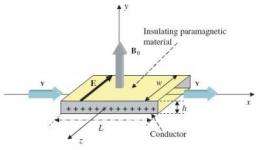
In this illustration of the system, salt water flows through a rectangular pipe under the influence of a perpendicular magnetic field, B0. The Lorentz force causes the charged sodium and chlorine ions to accumulate near the metal plates on the sides of the pipe, generating a constant electric field, E. Image credit: R. De Luca.

(PhysOrg.com) -- The idea of generating hydrogen from salt water has often been claimed to work effectively. However, the systems proposed so far generally require a much greater energy input than the energy they produce, making them impractical for energy generation. Now, a recently revived system may be able to cheaply generate a small amount of power.

In the proposal, physicist Roberto De Luca from the University of Salerno in Italy has suggested that flowing could generate an , which in turn could generate an electric power output. In his theoretical analysis, he considers letting salt water (containing sodium and ) run through a rectangular pipe that has two metal electrodes on the sides, under the influence of a perpendicular . In this set-up, the Lorentz force acts on the sodium and chlorine ions in the salt water, creating a Faraday voltage across the two electrodes, and producing an electromotive force.

"I started considering the question Dr. Pasquale Desideri, a Roman chemist, asked," De Luca told PhysOrg.com. "If a transverse magnetic field is applied to salt water flowing in a thin rectangular pipe, would an electromotive force appear at the sides of the pipe itself? This question was interesting both from a didactical and a scientific point of view. Didactically, one could come up with an interdisciplinary lecture, making a comparison between the properties of the 'Fermi sea' (the collection of in a metal) and the 'ordinary sea' (which a physicist could conceive as a collection of rather free Na+ and Cl- ionic charges diluted in water, besides a place to go in summertime)."

De Luca discovered that an experiment conducted in 1972 (by Wright and Van Der Beken) had demonstrated that Desideri's hypothesis was true: salt water flowing in a pipe under a transverse magnetic field does show an effect, similar to the Hall effect, in conducting metals. De Luca thought that this simple fact deserved more attention.

As he showed in his analysis, in order to produce a steady current in this device, the positive and negative electrodes experience different reactions. At one electrode, water is reduced to its components, resulting in oxygen and . At the other electrode, chlorine ions are oxidized, producing chlorine gas.

De Luca investigated the minimum concentration of sodium chloride in the water required to maintain a steady current. He calculated that only a small concentration of the ions is needed to establish a potential difference between the electrodes, and normal salt water has a significantly higher concentration than required. (The average salinity of seawater is about 3.5%, and about 78% of these salts is sodium chloride.)

The technique also requires that the salt water flow through rectangular pipes with a very small height (so that they are nearly one-dimensional). Although the technique wouldn't work in most natural locations, De Luca suggests that some desalination plants - where salt water is forced to run through small ducts - may provide an adequate infrastructure for the system. If so, desalination plants might also function as alternative electric power sources.

"When I was sure that an electromotive force and hydrogen gas could be obtained from letting salt water circulate in the presence of a transverse magnetic field, I thought about the huge desalination plants, where intake of salt water from the sea is needed. In general, these plants are run by oil, even though they are mostly located in places where solar power is present in abundance. Getting some power out of these plants simply by applying a transverse magnetic field to pipes could mean saving some power. Besides, getting hydrogen gas from sea water could gives us hope that in the future we would not easily run out of fuel.'"

There are still some challenges that this scheme faces, but De Luca has showed the potential using this method to produce hydrogen gas in a natural and inexpensive way. Apart from applications, the concept could be used in introductory physics classes to teach students about the transport properties of ionic aqueous solutions and conducting materials.

"I am now sure that most people will come up saying that these applications are rather difficult to implement and, even though some uses of this simple theoretical analysis can be envisioned, the amount of power one can derive from these systems is rather small," he said. "Scientifically, however, one is mainly concerned with the clear statement of some well-defined facts. In particular, I can say that it can be nowadays stated that hydrogen gas can be cheaply produced by solar energy, as already noticed in a previous paper, and can also be produced by simple electrodynamic effects. How cheaply in the latter case? Consider that seas do not ever stand still and that, luckily enough, there exist so called permanent magnets."

More information: De Luca, R. "Lorentz force on sodium and chlorine ions in a salt water solution flow under a transverse magnetic field." European Journal of Physics, 30 (2009) 459-466.

© 2009 PhysOrg.com

3.8 /5 (33 votes)  

Filter


Move the slider to adjust rank threshold, so that you can hide some of the comments.


Display comments: newest first

barakn
Mar 18, 2009

Rank: 3.4 / 5 (5)
Exactly where in this article was it mentioned that this method was more efficient than ordinary electrolysis?
mjp
Mar 18, 2009

Rank: 4.3 / 5 (6)
Moving a conductor (ionized water) in a magnetic field and producing current or hydrogen and oxygen is a linear generator powered by moving water, whether by gravity or a pump, its the same thing. There an experimental, "no moving parts" drive for submarines (In salt water) based on the same design, but the Inverse of what's being described here. "Magnetohydrodynamics" The losses in this system would be mechanical "pumping" or fluid friction losses. If the water (Pumping)pressure was "free" you wouldn't care.
nkalanaga
Mar 18, 2009

Rank: 3.3 / 5 (3)
Or if the costs could be offset by profits from another product. In this case, the desalination plant HAS to pump the water, and if permanent magnets work, this could be a useful byproduct. It wouldn't be "free", but it also wouldn't have to bear the full cost of the pumps.
earls
Mar 18, 2009

Rank: 4 / 5 (1)
How do you siphon off the gases though?
Yogaman
Mar 18, 2009

Rank: 5 / 5 (3)
How do you siphon off the gases though?


Since the gases are lighter than the water, they will collect at the top of the pipe, so vertical pressure-release pipes should work. By making the water pipe a flattened U shape, you should get mostly chlorine in one set of gas pipes, and mostly hydrox in another. Then you'd probably want to separate the oxygen and hydrogen, unless you're going to burn it all up right away.
Fazer
Mar 18, 2009

Rank: 4 / 5 (3)
Pretty neat. I suppose natural movement of seawater (from tidal or wave action) would supply free energy for this system, but in the case of the desalination plant, I would think that the energy you get out of the system would be at the cost of more drag on the water. They would expend more energy in pumping, and get back SOME of it in the form of electricity and usefull by-products.
Husky
Mar 19, 2009

Rank: 4 / 5 (1)
Fazer, exactly my thought, still pretty interesting phenomena, would find niche spots in low current flows where turbine efficiency dont shine, or maybe with advances in nanocapillar materials they can getmore out of it
Ant
Mar 19, 2009

Rank: 4 / 5 (1)
One should always remember , however, That "yo dunna get ouwt for nout" The perpetual engine has and never will work. payback is always there somewhere.

But clever thinking
Nik_2213
Mar 19, 2009

Rank: not rated yet
Um, perhaps he should check out homopolar motors & generators. IIRC, they've been around since Mr Faraday...
Shootist
Mar 19, 2009

Rank: not rated yet
"The idea of generating hydrogen from salt water has often been claimed to work effectively. However, the systems proposed so far generally require a much greater energy input than the energy they produce, making them impractical for energy generation. "

If the US would build 100 1GW reactors it wouldn't matter how energy intensive electrolysis is.
E_L_Earnhardt
Mar 19, 2009

Rank: 2.3 / 5 (3)
Enlarged - this has GREAT potential! Oceans flow by tidal pumps - no charge! The only cost is decay of the elements. Giagantic scale is feasable! I DO HOPE someone will develop this!
nkalanaga
Mar 19, 2009

Rank: 4 / 5 (1)
True, you won't get "something for nothing", and the energy you get from the hydrogen will be less than the energy required to produce it. But that's the case with any energy-conversion system. If you need portable energy, losing a little electricity or whatever, to produce hydrogen would be worth it. It's easier to transport the hydrogen than the moving water, and it doesn't require wires like electricity.
Squalo
Mar 20, 2009

Rank: 4 / 5 (1)
Thanks to Roberto.
Theory has to be developed by technology, and comments show how interest in this matter could lead to a promising future. Thans to all.
twango
Mar 21, 2009

Rank: 3 / 5 (2)
As the very end of the article suggests, this can be a NO-COST (apart from fabrication) way to produce hydrogen!!

Impressive. This is the kind of thinking about basics, driven by the end of reliance on fossil-fuels, that might produce amazing results that were under our nose the whole time.
bowzak
Mar 22, 2009

Rank: 3 / 5 (2)
If the US would build 100 1GW reactors it wouldn't matter how energy intensive electrolysis is.


Good point, shootist. Maybe instead of spending over 1 trillion in "stimulus" we could invest in a real hydrogen economy and accelerate the science. Too bad killing 5 birds with one stone is an idea our politicians cannot grasp.
jasonpatterson
Mar 23, 2009

Rank: 5 / 5 (2)
This is an interesting effect, but the whole idea of power generation using the thing is flawed. The only way you could actually produce usable energy with this is if you had a spot where salt water was already flowing downhill (due to tides, presumably) and you slowed it down. In a desalination plant, the water is being pumped already, so if you tried to introduce this as a supplement to the plant's power, you'd have to pump the water harder (it will slow down because of this system.) The extra energy input would be greater than the energy output and you'd lose.

Now if the goal was to produce hydrogen and nothing more, then this could be a more efficient way than direct electrolysis (could being the operative word) but they don't give any information about how efficient the process it, so it's hard to tell. How much of the water is converted? Are we talking a cubic meter of hydrogen per meter of tubing per second? Per minute? Per year? Would we have to pump tons of water through it to get a cubic meter of hydrogen? I guess I'd like to know more before I get all hot and bothered about it.
MisteR33
Mar 31, 2009

Rank: not rated yet
1972
2009
100x1GW nuclear or geothermic.

The pacific region is a verry good place for geothermic energy:
volcanism; water from the ocean; old gold mines to get-in the salt, after the destilation, to give more water in thise region!
But the trusts in Washington DC dont interessed, there will commercial working with the old technologies!

Maybe, after the climate warming - when the athmosphare is red in the sun all houers of the day, then the politics give a chance to change the way.
But than we make a trip of a death planet, to make a new planet, on our old earth.
We can wait to 2065 and then we (the commercial interessed groups and patend holder) change the system.
But if we work the next ~50years - take it easy - we will have a permanently catastrophe for our followers for more than the rest of the time (before the amargeddon).

The problems begins in 1750. And the "Biosphare" is word from ~1885. We have peoples in the '60: Robert Jungk and other!

You remember?

To the technical of Robert De Luca:
how much energy and how much quarter meters brought one Giga Watt Hydrogenium Fuell with this technology?
Or how much electrical energy and how much quarter meters for produced 1000 billion Liters/year of octasilan-fuel as a directly change now?
HYDRODRIVE
Jul 03, 2009

Rank: 1 / 5 (1)
The proposal of physicist Roberto De Luca from the University of Salerno in Italy is already applied for the deprotonation of water H leaving behind oxidised water with an increased pH by using the patented process for molecular engineering and the synthesizer cum electronic catalytic convertor with reduced power of direct current.With a reduced alternating power,the same process and the synthesizer increse the pH value of water indicating Hydrogen addition.The electronic catalytic convertor cum synthesizer has immense applications in molecular engineering of materials from lipids,pharmaceuticals,proteins,life sciences,water for good health,accelerating algae growth for biofuel,certain crops and fruits yield enhancements, second generation bio fuels production,enhancing fuel cell output including reforming the input fuel,synthesis of several liquids including petrol,diesel,petro products, gases and materials including hydrogen production from water,sea water,effluent water and steam.It also synthesis carbon monoxide to carbon di oxide making water act as a catalyst(normally water poison the catalysts) for oxidation to carbon di oxide or help to produce synthetic gas using carbon monoxide and hydrogen at reduced power.Dr.Paul De Vadder of Belgium has also carried out studies to confirm deprotonation of water and the activation characteristics of the synthesizer in Romania and Belgium.The details of the synthesizer cum electronic catalytic convertor. Details of the synthesizer cum electronic catalytic convertor is available at:
http://www.hydrod.../ECC.htm

An ONDEMAND petrol and diesel emulsification system for the boilers,external furnaces and for use with power generators have also been tested successfully with 25% water in diesel DELIVERING SAME THERMAL EFFICIENCY at reduced fuel cost.

The synthesizer is an ideal and economical solution for ondemand hydrogen production from sea water and using the hydrogen with the biomass or wood gas produced carbon monoxide to synthesis both as the producer gas for economical energy use.
Rank 3.8 /5 (33 votes)
Relevant PhysicsForums posts
  • Worked Physics Examples
    created49 minutes ago
  • electrostatic induction in a conductor should be immpossible
    created2 hours ago
  • Help! Physics Momentum/Impulse problem!
    created5 hours ago
  • Gauss' law cubes, how to prove
    created6 hours ago
  • A grandfather pulls his granddaughter, whose mass is 20.5 kg
    created8 hours ago
  • what is significance of torque
    created8 hours ago
  • More from Physics Forums - General Physics

More news stories

Explained: Sigma

It's a question that arises with virtually every major new finding in science or medicine: What makes a result reliable enough to be taken seriously? The answer has to do with statistical significance -- but ...

Physics / General Physics

created 22 hours ago | popularity 5 / 5 (12) | comments 32

Borexino Collaboration succeeds in spotting pep neutrinos emitted from the sun

(PhysOrg.com) -- To learn more about how the sun works, scientists study particles that are emitted from it into space due to thermonuclear reactions that occur inside; by applying known physics principles, ...

Physics / General Physics

created 22 hours ago | popularity 4.6 / 5 (7) | comments 0 | with audio podcast report

Physics research suggests new pathways for cancer progression

Observing that certain cancer cells may exhibit greater flexibility than normal cells, some scientists believe that this capability promotes rapid tumor growth. Now computer simulations developed by Boston University Biomedical ...

Physics / General Physics

created 19 hours ago | popularity 5 / 5 (1) | comments 0

Quantum physicist explains $100K offer for proof scaled-up quantum computing is impossible

(PhysOrg.com) -- MIT researcher Scott Aaronson has certainly riled the physics community with his offer this past Friday, of $100,000 to anyone who can prove that scaled-up quantum computing is impossible. ...

Physics / Quantum Physics

created Feb 08, 2012 | popularity 4.1 / 5 (11) | comments 32 | with audio podcast weblog

Physicists 'record' magnetic breakthrough

An international team of scientists has demonstrated a revolutionary new way of magnetic recording which will allow information to be processed hundreds of times faster than by current hard drive technology.

Physics / General Physics

created Feb 07, 2012 | popularity 4.5 / 5 (39) | comments 14 | with audio podcast


Humans may have helped the decline of African rainforests 3000 years ago

(PhysOrg.com) -- Large areas of rainforests in Central Africa mysteriously disappeared over three thousand years ago, to be replaced by savannas. The prevailing theory has been that the cause was a change ...

Japan scientist makes 'Avatar' robot

A Japanese-developed robot that mimics the movements of its human controller is bringing the Hollywood blockbuster "Avatar" one step closer to reality.

Fighting crimes against biodiversity: How to catch a killer weed

Invasive species which have the potential to destroy biodiversity and influence global change could be tracked and controlled in the same way as wanted criminals, according to new research from Queen Mary, University of London.

Metastatic breast cancer hitches a free ride from the immune system

Inflammatory breast cancer (IBC) is the most lethal form of breast cancer . It spreads easily through the lymphatic and blood vessels, forming metastasis which can lead to multi-organ failure. New research published in BioMed ...

A novel method for simultaneously measuring blood pressure and arterial stiffness

Arterial stiffness due to is a major contributor to cardiovascular disease but is very difficult to measure. It also can influence blood pressure readings since these rely on the time taken for arteries to return to normal ...

India's global pharmacy role threatened by EU pact

(AP) -- Efforts by India and the European Union to strengthen trade are threatening India's ability to deliver lifesaving medicines to the world's poorest, analysts say as the two sides push through protracted ...