Swimming pool game inspires robot detection
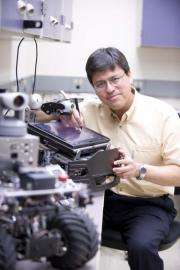
Scientists have used a popular kids swimming pool game to guide their development of a system for controlling moving robots that can autonomously detect and capture other moving targets.
Engineers from Duke University and the University of New Mexico have used the simple pursuit-evasion game "Marco Polo" to solve a complex problem -- namely, how to create a system that allows robots to not only "sense" a moving target, but intercept it.
Such systems have broad applications, ranging from security systems to track unwanted intruders like enemy ships or burglars, to systems that create radiation or environmental hazard maps, or even track endangered species.
The main challenge facing researchers is developing the artificial intelligence to control the robots and their sensors without direct human guidance.
The goal of the game "Marco Polo" is for the person who is "it" to tag another person, who then becomes the new pursuer. However, pursuers must keep their eyes closed. At any time, the pursuer can call out "Marco," and everyone else must respond by saying "Polo." In this way, the pursuer can gradually estimate where the targets are in the pool and where they might go.
"Games give us a good way of making these highly complex problems easier to visualize," said Silvia Ferrari, assistant professor of mechanical engineering and materials science at Duke's Pratt School of Engineering. Ferrari and colleague Rafael Fierro, associate professor of electrical engineering at the University of New Mexico, published the results from their latest experiments online in the Journal on Control and Optimization, a publication of the Society for Industrial and Applied Mathematics.
"Just as in 'Marco Polo,' we needed to create a way that permits mobile robots to detect other moving objects and make predictions about where the targets might go," Ferrari said. "When done efficiently, the mobile sensor switches from pursuit mode to capture mode in the shortest amount of time."
Ferrari's laboratory had already developed a similar type of algorithm, known as cell decomposition, in which space is broken down into a series of distinct cells. Past experiments allowed a robot to move through space without colliding with stationary obstacles.
The latest experiments included not only robots equipped with camera sensors, but also stationary camera sensors, which allowed for "coverage" of all the cells within the space.
"The idea is that multiple sensors are deployed in the space to cooperatively detect moving targets within that space," Fierro said. "As the sensor makes more detections, it is better able to predict the likely path of the intruder. The ultimate path taken by the robot sensor is one that maximizes the probability of detection and minimizes the distance needed to capture the target."
While the security and military applications of this type of detection system are obvious, Fierro also points out that the new algorithms can be used in other ways to detect targets that aren't necessarily intruders.
"Targets could be completely different things, like mines or explosives, or chemical or radiation leaks," Fierro said. "The robots can use their sensors to keep track of the detected locations and build a 'map' to let people know where to go or not to go."
The algorithms could also be used to help explain natural phenomena, such as the behaviors of members of a wolf pack as they chase and capture their prey.
The latest experiments were conducted at the University of New Mexico and involved intruders moving in straight lines at a constant speed.
"We are now developing algorithms that will more closely mimic the real world by giving intruders the ability to take evasive actions," Ferrari said. "The other main issue is to ensure that all the different mobile sensors can communicate with each other at all times and coordinate their activities based on that communication."
Source: Duke University (news : web)


