Preterm birth rate drops
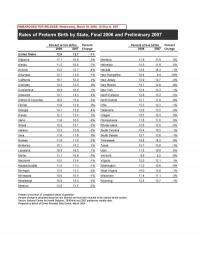
March 18, 2009 State Preterm Birth Rates

Enlarge

These are the rates of preterm birth by state, final 2006 and preliminary 2007 data.Source: National Center for Health Statistics, 2006 final and 2007 preliminary natality data. Prepared by March of Dimes Perinatal Data Center, March 2009.

The nation's preterm birth rate declined slightly in 2007 - a finding that the March of Dimes hopes will prove to be the start of a new trend in improved maternal and infant health.

The rate declined for babies born at 34-36 weeks gestation (late preterm) and among babies born to African American and white women.

"We're encouraged by this drop in the preterm , and hope that the emphasis we've put on the problem of late preterm birth is beginning to make a difference," said Jennifer L. Howse, Ph.D., president of the March of Dimes. "Through our Prematurity Campaign, we can build on this success and begin to give more babies a healthy start in life."

The rate of preterm births (less than 37 weeks gestation) dropped to 12.7 percent from 12.8 percent in 2006, a small but statistically significant decrease, according to preliminary birth data for 2007 released by the National Center for Health Statistics.

The preterm birth rate has increased by 36 percent since the 1980s, and despite the decline in the 2007 preterm birth rate, the number of babies born too soon continues to top more than 540,000 each year.

Preterm birth is a serious health problem that costs the United States more than $26 billion annually, according to the Institute of Medicine. It is the leading cause of and babies who survive an early birth often face the risk of lifetime health challenges, such as , mental retardation and others. Even babies born just a few weeks too soon (34-36 weeks gestation, also known as late preterm birth) have higher rates of death and disability than full-term babies.

Source: March of Dimes Foundation


print this article email this article download pdf blog this article bookmark this article     Stumble it Digg this share on Facebook retweet share on Reddit add to delicious
Rate this story - not rated yet


March 18, 2009 all stories

Comments: 0

not rated yet
  • Stumble this up

  • Digg this

  • share this

  • hide
  • Related Stories


  • hide
  • Relevant PhysicsForums posts

Other News

Connection between depression and osteoporosis detailed

Medicine & Health / Psychology & Psychiatry

created 57 minutes ago | popularity not rated yet | comments 0

Research carried out among thousands of people has shown a clear connection between depression and a loss of bone mass, leading to osteoporosis and fractures.


Study finds those with more difficult to treat forms of HCV are half as likely to get treated

Medicine & Health / Health

created 48 minutes ago | popularity not rated yet | comments 0

A new study by Mount Sinai researchers has for the first time found that patients with more difficult to treat forms of hepatitis C are half as likely to initiate treatment for the disease, when compared to patients with ...


Male factor infertility associated with comorbidities

Medicine & Health / Diseases

created 18 minutes ago | popularity not rated yet | comments 0

The December issue of European Urology, the official journal of the European Association of Urology, features an article entitled 'Are Infertile Men Less Healthy than Fertile Men? Results of a Prospective Case-Control Survey ...


Squeak, squeak -- can you hear me now?

Squeak, squeak -- can you hear me now?

Medicine & Health / Neuroscience

created 4 hours ago | popularity 5 / 5 (1) | comments 0

What do you get when you cross a mouse with poor hearing and a mouse with even worse hearing? Ironically, a new strain of mice with "golden ears" - mice that have outstanding hearing as they age.


For young boys with cancer, testicular tissue banking may be option to preserve fertility

Medicine & Health / Cancer

created 1hour ago | popularity not rated yet | comments 0

For parents of children with cancer, the hopeful news is that pediatric survival rates have steadily improved for decades. Among the bad news—treatments that enable survival often cause infertility.