West Antarctic ice comes and goes, rapidly
March 18, 2009 Ice Progression

Enlarge

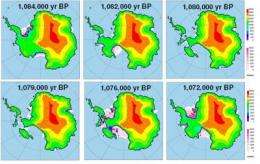
Modeled Antarctic ice sheet at particular times through the warm Marine Isotope Stage 31 event, around 1.07 million years ago. Ice-sheet elevations and floating ice-shelf thicknesses shown by two different color scales, "yr BP" is "years before present." Credit: David Pollard, Penn State

Researchers today worry about the collapse of West Antarctic ice shelves and loss of the West Antarctic ice sheet, but little is known about the past movements of this ice. Now climatologists from Penn State and the University of Massachusetts have modeled the past 5 million years of the West Antarctic ice sheet and found the ice expanse changes rapidly and is most influenced by ocean temperatures near the continent.

"We found that the West sheet varied a lot, collapsed and regrew multiple times over that period," said David Pollard, senior scientist, Penn State's College of Earth and Mineral Sciences' Earth and Environmental Systems Institute. "The ice sheets in our model changed in ways that agree well with the data collected by the ANDRILL project."

Pollard and Robert M. DeConto, professor of , U. Mass, report their findings in today's (Mar. 19) issue of Nature. The results of the first ANDRILL drill core near McMurdo Station, Antarctica, are reported in a companion paper in the same issue. The geological is a multinational collaboration to drill back in time into sediment to recover a history of paleoenvironmental changes.

"We found, as expected, that the East Antarctic is stable and did not change," said Pollard.

The East Antarctic ice sheet does not slide into the sea and melt away because most of the bedrock below East Antarctic ice is above sea level. However, on the other side of the continent, to the Pacific side of the Transantarctic Mountain Range, much of the bedrock below the ice lies from several hundred to several thousand feet below sea level, leaving the West Antarctic ice vulnerable to melting.

"We found that the ocean's warming and melting the bottom of the shelves has been the dominant control on West Antarctic ice variations," said Pollard.

When the floating ice shelves melt sufficiently, they no longer buttress the grounded ice upstream, which then flows faster and rapidly drains the massive interior ice. The grounding line, the junction between the floating ice shelf and upstream ice resting on bedrock, retreats converting more grounded ice to floating ice shelves. Eventually, nearly all of the ice sheet on the Pacific side of Antarctica can disappear as it has in the past.

The researchers' computer model needs past variations of snowfall, snow melt and ocean melting below the floating ice to be specified. These are not obtained from the General Circulation Models often used in climate reconstruction because running those models to create 5 million years of climate history would take years. Instead, the researchers related past variations of these quantities to records of deep sea oxygen isotope ratios that indicate temperature changes in the oceans.

"We assume this is all driven by global-scale climate variations including Northern Hemispheric glacial cycles, so we used the changes in the oxygen 18 record to deduce the Antarctic changes," says Pollard. "Our next step will be to test whether this record really represents sea temperatures around Antarctica."

The researchers compared their model's output with the sediment core record from ANDRILL. In these cores, coarse pebbly glacial till represent the glacial periods, while intervals filled with the shells of tiny ocean-living diatoms represent the nonglacial periods. One way the ANDRILL researchers date the layers is using existing datable volcanic layers within the core.

Pollard and DeConto not only looked at the modeling of the overall West Antarctic ice sheet, they also looked at the nearest grid point in their model to the ANDRILL drilling location. They found that, for the most part, the data trend at that grid point matched the data obtained from the sediment core.

"Our modeling extends the reach of the drilling data to justify that the data represent the entire West Antarctic area and not just the spot where they drilled," said Pollard.

Along with the rapid appearance and disappearance of the ice, the researchers noted that both in the ANDRILL record and the model results, during the early portion of the 5 million years, the periodicity of the glaciation and melting was about 40,000 years which matches the Northern Hemisphere's pattern of glaciation and glacier retreat. The basic driver is very likely the tilt of the Earth's axis which varies with the same period, according to Pollard. However, nearer to the present, the cycle time increased to about 100,000 years as expected, driven by Northern Hemispheric ice age cycles.

During past warm periods, the major collapses in the model take a few thousand years. This is also the expected time scale of future collapse of the West Antarctic ice sheet if warm sufficiently - longer than a few centuries but shorter than ten thousand years.

The researchers note that when atmospheric carbon dioxide levels in the past were about 400 parts per million, in the early part of the ANDRILL record, West Antarctic ice sheet collapses were much more frequent..

"We are a little below 400 parts per million now and heading higher," says Pollard. "One of the next steps is to determine if human activity will make it warm enough to start the collapse."

Source: Pennsylvania State University (news : web)


print this article email this article download pdf blog this article bookmark this article     Stumble it Digg this share on Facebook retweet share on Reddit add to delicious
Rate this story - 4.3 /5 (16 votes)

Rank Filter

Move the slider to adjust rank threshold, so that you can hide some of the comments.


Display comments: newest first

  • GrayMouser - Mar 18, 2009
    • Rank: 3 / 5 (6)
    "The researchers note that when atmospheric carbon dioxide levels in the past were about 400 parts per million, in the early part of the ANDRILL record, West Antarctic ice sheet collapses were much more frequent.."

    A correlation doesn't proven cause and effect.
  • dachpyarvile - Mar 19, 2009
    • Rank: 3.4 / 5 (5)
    "The researchers note that when atmospheric carbon dioxide levels in the past were about 400 parts per million..."

    Man wasn't on the scene with burning of fossil fuels at that time, either. Examination of the ice and other data also shows that there is an oscillation of periods of melting and ice formation that matches up nicely with Northern hemispheric data. Again, man was not involved. It still has not been proven that AGW provides a needed correlation which has not yet been seen.
  • mikiwud - Mar 19, 2009
    • Rank: 3 / 5 (6)
    The CO2 reference in only tagged on at the end so as not to upset the grant givers. It is not given as a cause earlier in the paper, warm currents and the Milankovitch cycles are. If the oceans warm, CO2 is released to the atmosphere, the real main cause and effect of varying CO2 levels.
  • Velanarris - Mar 19, 2009
    • Rank: 3 / 5 (6)
    Hold on guys, this goes directly in line with the theory that CO2 works as an indicator of climate change.


    If the ice sheet is most greatly affected by warmer ocean currents then it's only natural that the CO2 would be higher as the warm current would outgas CO2 leaving a larger CO2 footprint in the resultant ice cores.


    Read the paper, these guys think AGW is unproven as well.

    And before the AGW proponents jump all over this one, you should read the paper as well. The abstract was rather obviously written by a proponent, but the research and the paper itself are rather well done and very objective.
  • GrayMouser - Mar 19, 2009
    • Rank: 5 / 5 (4)
    Hold on guys, this goes directly in line with the theory that CO2 works as an indicator of climate change.


    Now there is a Be10 indicator:
    http://wattsupwit...ore-6286
  • Velanarris - Mar 19, 2009
    • Rank: 3.4 / 5 (5)
    Ryu, since you seem to like to silence facts I'll give you another comment to downrank.

    And here is the article by Sir Monckton, former advisor to Minster Thatcher:
    http://www.telegr...ars.html

    Feel free to go over his facts and figures and try to find fault with them.
  • lengould100 - Mar 23, 2009
    • Rank: 1 / 5 (1)
    Pass the mixed nuts.
  • Velanarris - Mar 23, 2009
    • Rank: 5 / 5 (1)
    Pass the mixed nuts.

    Here you go.
    http://realclimate.org

March 18, 2009 all stories

Comments: 8

4.3 /5 (16 votes)
  • Stumble this up

  • Digg this

  • share this

  • hide
  • Related Stories

  • New structure found deep within West Antarctic Ice Sheet
    created Sep 23, 2004 | popularity not rated yet | comments 0
  • New Antarctic Drilling Record to Yield Major Climate Data
    created Dec 22, 2006 | popularity not rated yet | comments 0
  • Tidal motion influences Antarctic ice sheet
    created Dec 20, 2006 | popularity not rated yet | comments 0
  • Antarctic Ice Loss
    created Jan 13, 2008 | popularity not rated yet | comments 0
  • First evidence of under-ice volcanic eruption in Antarctica
    created Jan 20, 2008 | popularity not rated yet | comments 0


  • hide
  • Relevant PhysicsForums posts

  • cycles
    created 16 hours ago
  • The Origin of the term 'fossil' fuels
    created Nov 05, 2009
  • co2
    created Nov 03, 2009
  • Early Earths Sulfidic Ocean Conditions
    created Oct 30, 2009
  • vegetation
    created Oct 29, 2009
  • climate change
    created Oct 29, 2009
  • More from Physics Forums - Earth

Other News

Deep creep means milder, more frequent earthquakes along Southern California's San Jacinto fault

Deep creep means milder, more frequent earthquakes along Southern California's San Jacinto fault

Space & Earth / Earth Sciences

created 15 hours ago | popularity 4.7 / 5 (3) | comments 0

With an average of four mini-earthquakes per day, Southern California's San Jacinto fault constantly adjusts to make it a less likely candidate for a major earthquake than its quiet neighbor to the east, the ...


Success in 'space elevator' competition (AP)

Success in 'space elevator' competition (Update 3)

Space & Earth / Space Exploration

created Nov 05, 2009 | popularity 4.3 / 5 (33) | comments 50

(AP) -- A robot powered by a ground-based laser beam climbed a long cable dangling from a helicopter on Wednesday to qualify for prize money in a $2 million competition to test the potential reality of the ...


In a Galaxy Far, Far Away...

In a Galaxy Far, Far Away...

Space & Earth / Astronomy

created Nov 06, 2009 | popularity 4.8 / 5 (5) | comments 17

(PhysOrg.com) -- Astronomers have published the discovery of the farthest known object in the cosmos: a star that exploded when the universe was only 630 million years old -- only 4.6% of its current age. ...


'Dropouts' pinpoint earliest galaxies

'Dropouts' pinpoint earliest galaxies

Space & Earth / Astronomy

created Nov 06, 2009 | popularity 4.2 / 5 (10) | comments 13

Astronomers, conducting the broadest survey to date of galaxies from about 800 million years after the Big Bang, have found 22 early galaxies and confirmed the age of one by its characteristic hydrogen signature ...


Space hotel taking bookings for 2012 opening

Space hotel taking bookings for 2012 opening

Space & Earth / Space Exploration

created Nov 05, 2009 | popularity 4.4 / 5 (21) | comments 11

(PhysOrg.com) -- The first orbiting space hotel is on track to open for its first customers in 2012, but hurry, as bookings are filling fast.