Tongan inspection team heads to undersea volcano
March 19, 2009
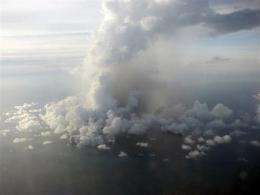
An undersea volcano erupts off the coast of Tonga, tossing clouds of smoke, steam and ash thousands of feet (meters) into the sky above the South Pacific ocean, Tuesday, March 17, 2009. The eruption was at sea about 6 miles (10 kilometers) from the southwest coast of the main island of Tongatapu an area where up to 36 undersea volcanoes are clustered.(AP Photo/Trevor Gregory)
(AP) -- Scientists sailed Thursday to inspect an undersea volcano that has been erupting for days near Tonga - shooting smoke, steam and ash thousands of feet (meters) into the sky above the South Pacific ocean.
Authorities said Thursday the eruption does not pose any danger to islanders at this stage, and there have been no reports of fish or other animals being affected.
Spectacular columns are spewing out of the sea about 6 miles (10 kilometers) from the southwest coast off the main island of Tongatapu - an area where up to 36 undersea volcanoes are clustered, geologists said.
Trade winds continued to blow gas and steam away from the island Thursday.
Tonga's police deputy commander Taniela Faletau said coastal villages close to the roiling ocean site were not yet at risk and that no warnings had been issued.
Police were waiting for a government team of officials and scientists to survey the area and report on their observations before taking any action.
Coastal residents said the steam and ash column first appeared on Monday morning, after a series of sharp earthquakes were felt in the capital, Nuku'alofa.
"This is not unusual for this area and we expect this to happen here at any time," said Keleti Mafi, Tonga's geological service head.
The underwater eruption was taking place near the low-lying twin volcanic islands of Hunga Tonga and Hunga Ha'apai, and within sight of the capital, Nuku'alofa.
Large amounts of pumice thrown up by the erupting volcano would likely clog beaches on the southern coast of nearby Fiji islands within a short time, Mafi said.
Tonga, a 170-island archipelago about halfway between Australia and Tahiti, is part of the Pacific "ring of fire" - an arc of earthquake and volcanic zones stretching from Chile in South America through Alaska and down through Vanuatu to Tonga.
©2009 The Associated Press. All rights reserved. This material may not be published, broadcast, rewritten or redistributed.
-
Discovered: world's largest tsunami debris
Sep 25, 2008 |
not rated yet |
0
-
Kamchatka volcano blows its top
Jul 05, 2007 |
not rated yet |
0
-
Chile's Chaiten volcano one of scores of active volcanoes in region
May 07, 2008 |
not rated yet |
0
-
450 quakes recorded on Russian peninsula
Oct 26, 2006 |
not rated yet |
0
-
Engineers build first sub-10-nm carbon nanotube transistor
Feb 01, 2012 |
4.9 / 5 (31) |
30
-
Something old, something new: Evolution and the structural divergence of duplicate genes
Jan 31, 2012 |
4.6 / 5 (7) |
1
-
The hidden nanoworld of ice crystals: Revealing the dynamic behavior of quasi-liquid layers
Jan 30, 2012 |
5 / 5 (3) |
1
-
Stock market network reveals investor clustering
Jan 27, 2012 |
3.9 / 5 (23) |
8
-
Of microchemistry and molecules: Electronic microfluidic device synthesizes biocompatible probes
Jan 26, 2012 |
5 / 5 (1) |
0
-
Discrepancy between oxygen and carbon-dioxide levels
Feb 09, 2012
-
where gems are found in the world
Feb 09, 2012
-
Wind Waves in Reservoir ~ Wind run-up and Wind set-up
Feb 08, 2012
-
Balance of oxygen in the atmosphere
Feb 01, 2012
-
The case for a methanol-based economy
Jan 30, 2012
-
Weather in a rotating cylinder
Jan 25, 2012
- More from Physics Forums - Earth
More news stories
Humans may have helped the decline of African rainforests 3000 years ago
(PhysOrg.com) -- Large areas of rainforests in Central Africa mysteriously disappeared over three thousand years ago, to be replaced by savannas. The prevailing theory has been that the cause was a change ...
Could Venus be shifting gear?
(PhysOrg.com) -- ESAs Venus Express spacecraft has discovered that our cloud-covered neighbour spins a little slower than previously measured. Peering through the dense atmosphere in the infrared, the ...
Space & Earth / Space Exploration
17 hours ago |
5 / 5 (7) |
7
|
NASA budget will axe Mars deal with Europe: scientists
US President Barack Obama's budget proposal to be submitted next week for 2013 will cut NASA's budget by 20 percent and eliminate a major partnership with Europe on Mars exploration, scientists said Thursday.
Space & Earth / Space Exploration
20 hours ago |
5 / 5 (2) |
18
Two new moons for Jupiter
Advances in technology have lead to the discovery of new planets outside of our Solar System, and now even new moons in our own backyard.
Space & Earth / Space Exploration
17 hours ago |
4 / 5 (1) |
7
Mars Science Laboratory computer issue resolved
(PhysOrg.com) -- Engineers have found the root cause of a computer reset that occurred two months ago on NASA's Mars Science Laboratory and have determined how to correct it.
Space & Earth / Space Exploration
18 hours ago |
4.7 / 5 (6) |
3
|
Anonymous knocks CIA website offline (Update)
The website of the Central Intelligence Agency was inaccessible on Friday after the hacker group Anonymous claimed to have knocked it offline.
Google users warned of threat to smartphone wallets
Users of Google smartphone wallets were being warned on Friday that there is a way to crack pass codes intended to thwart thieves from going on illicit shopping sprees.
New error-correcting codes guarantee the fastest possible rate of data transmission
Error-correcting codes are one of the triumphs of the digital age. Theyre a way of encoding information so that it can be transmitted across a communication channel such as an optical fiber o ...
New power source discovered
(PhysOrg.com) -- Researchers at the Massachusetts Institute of Technology (MIT) and RMIT University have made a breakthrough in energy storage and power generation.
Small modular reactor design could be a 'SUPERSTAR'
(PhysOrg.com) -- Though most of today's nuclear reactors are cooled by water, we've long known that there are alternatives; in fact, the world's first nuclear-powered electricity in 1951 came from a reactor ...
The power of estrogen -- male snakes attract other males
A new study has shown that boosting the estrogen levels of male garter snakes causes them to secrete the same pheromones that females use to attract suitors, and turned the males into just about the sexiest ...
Mar 19, 2009
Rank: 5 / 5 (1)
Does PhysOrg.asm have no editorial standard what so ever? I think it's payola.