March 19, 2009 feature
Latest 3D TV Technology Offers Interactive Control
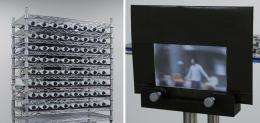
(PhysOrg.com) -- Three-dimensional TV is now closer than ever to becoming a reality for consumers, and the latest research is investigating the full extent of 3D TV’s possibilities. In a recent study, researchers at the University of Tokyo and Hitachi, Ltd., have presented a 3D TV system that captures a live scene in real time and reproduces it on an autostereoscopic display. The system also offers interactive control, allowing viewers to adjust viewing parameters such as cropping a scene and reproducing an appropriate amount of depth.
“The greatest advantage of our system is to provide interactive control of the viewing parameters,” lead author of the study Yuichi Taguchi, a Ph.D. student at the University of Tokyo, told PhysOrg.com. “The interactive control is essential for reproducing a dynamic 3D scene with desirable conditions, which depend on the contents of the scene, the viewer's preference, and the display specifications.”
The 3D TV system, called TransCAIP, captures a live scene using an array of 64 video cameras that are all connected via Ethernet cables to one PC, which converts images from all the video cameras into images for the display. Each video camera contains a built-in HTTP server, which sends motion JPEG sequences to the PC.
The PC then converts the 64 input views captured by the cameras to an “integral photography image” made of 60 views, which correspond to the viewing directions of the display. Using an image-based rendering technique, the PC converts the images in real-time, and then arranges the pixels to produce the integral photography image. The entire process, called light field conversion, is implemented on the single PC in real-time, requiring a few hundred milliseconds per frame.
Like all autostereoscopic displays, the new 3D TV system doesn’t require viewers to wear special glasses. Instead, the display reproduces various viewpoint images, allowing viewers to see a different image in each eye or by moving their head (the parallax effect). Although the basic principles of autostereoscopic 3D displays were developed more than a century ago, only with recent technological advances has it been possible to actually build autostereoscopic displays since they require such a large number of light rays (the resolution of a view times the number of viewpoints).
The integral photography display works by integrating tiny images each with their own tiny lenses to convey a 3D image. An integral photography display has the advantage that it can provide both horizontal and vertical parallax. Other 3D TV displays, such as lenticular lens arrays, can only provide either horizontal or vertical parallax.
The researchers’ light field conversion method, which converts the different viewpoint layouts between the input and output devices, also offers advantages. For one thing, it enables viewers to control the viewing parameters based on their individual preferences or to help sharpen a scene. Using only the software, viewers can control the amount of depth on the display as well as choose a smaller viewing angle to view only a targeted location. Also, the light field conversion technique doesn’t require the capture system to have large lenses or long imaging distances, as some existing systems do.
As the researchers explain, the main technical challenge for their 3D TV system is the fast and flexible conversion of the input images from the 64 cameras to the 60 images in the integral photography format. In this study, their light field conversion method shows that real-time conversion is possible. In the future, the researchers plan to improve the visual quality of the system, such as by reducing blur and other unwanted artifacts caused by depth reproduction.
“Systems reproducing higher-resolution images are desirable for commercialization,” Taguchi added. “Further advances in hardware technology could make possible the development of such systems over the next 5 to 10 years.”
More information: Taguchi, Yuichi; Koike, Takafumi; Takahashi, Keita; Naemura, Takeshi. “TransCAIP: A Live 3D TV System Using a Camera Array and an Integral Photography Display with Interactive Control of Viewing Parameters.” IEEE Transactions on Visualization and Computer Graphics. To be published.
Copyright 2009 PhysOrg.com.
All rights reserved. This material may not be published, broadcast, rewritten or redistributed in whole or part without the express written permission of PhysOrg.com


