Mars Express zeroes in on erosion features
March 19, 2009 Mars Express zeroes in on erosion features

Enlarge

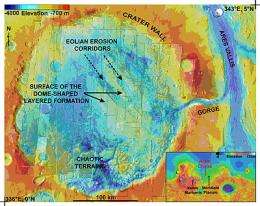
This map shows the Aram Chaos region of Mars - a crater 280 km in diameter lying almost directly on the martian equator. In this region, the OMEGA instrument on board ESA's Mars Express found mineralogical evidence for large-scale deposits of ferric oxides (commonly known as 'rust' on Earth) and sulphates. The findings are relevant as these features are also common to other regions of Mars, widely separated from Aram Chaos, providing new hints to understand the past martian climate. This image is the results of the superimposition of a MOLA digital elevation model with THEMIS visible images. The inset indicates the location of Aram Chaos on a MOLA topographic map of Mars. Credits: NASA/MGS/MOLA/THEMIS

(PhysOrg.com) -- Mars Express has uncovered geological evidence suggesting that some depositional process, revealed by erosion, has been at work on large scales in the equatorial regions of the planet. If so, this would provide another jigsaw piece to be fitted into the emerging picture of Mars’ past climate.

The evidence comes from the mineralogical composition of the Aram Chaos region, a crater 280 km in diameter lying almost directly on the . Data from ’ OMEGA instrument, the Visible and Infrared Mineralogical Mapping Spectrometer, has revealed that this region shows a significant amount of and ferric oxides. On Earth, is more commonly known as rust.

Observations from Mars Express show that the bright covering much of the planet is enriched in ferric oxides. Yet in the dark deposits of Aram Chaos, there is a four-fold increase in the spectral signature of ferric oxides, revealing a specific concentration mechanism. Ferric oxides are generally found with sulphates but, in this case, the lighter sulphates have been blown away, leaving the ferric oxides exposed.

“They have accumulated in dark deposits at the bottom of sulphate cliffs,” says Stéphane Le Mouélic, Université de Nantes, a member of the team who performed the investigation. This suggests that the ferric oxides have been uncovered by before dropping to the base of the cliffs. The dunes in this region are also enriched in ferric oxides.

Perhaps significantly, this phenomenon is not unique to the Aram Chaos region. The NASA Opportunity rover discovered ferric oxide deposits in Meridiani Planum, about 1000 km away. The scientists called the deposits ‘blueberries’, because of their spherical shape. Valles Marineris, 3000 km away, also shows similar deposits. So Mars Express’ detection of ferric oxides in Aram Chaos links together widely separated areas of Mars.

There may even be other regions that have witnessed the same accumulation process but now lie hidden from Mars Express’ view. “OMEGA is sensitive to the first hundreds of microns of the surface. So, a layer of Martian dust just one millimetre thick will hide the signature from us,” says Marion Massé, Université de Nantes, lead author on the paper describing these results. Fortunately, in many regions of Mars, such as Aram Chaos, wind erosion has blown the dust cover away, leaving bulk rocks exposed.

Although the true extent and nature of the accumulation process of sulphates and ferric oxides remains elusive, the team are now investigating possible hypotheses that could have caused it in the first place. At this stage, they are ruling nothing out. It could be anything from atmospheric precipitation such as rain or snow, to volcanic ashes or glacial deposits.

More information: The findings appear in the article 'Mineralogical composition, structure, morphology, and geological history of Aram Chaos crater fill on Mars derived from OMEGA Mars Express data,' by M. Massé et al., published in the Journal of Geophysical Research (VOL. 113, E12006, doi:10.1029/2008JE003131).

Provided by European Space Agency (news : web)


print this article email this article download pdf blog this article bookmark this article     Stumble it Digg this share on Facebook retweet share on Reddit add to delicious
Rate this story - 5 /5 (2 votes)

Rank Filter

Move the slider to adjust rank threshold, so that you can hide some of the comments.


Display comments: newest first

  • deatopmg - Mar 20, 2009
    • Rank: not rated yet
    All these oxidized compounds; iron oxide, sulfates, PERCHLORATE! just like on Earth.


    to get these oxidized compounds no denying that one first needs free oxygen or higher energy forms like peroxide, ozone, etc. to get perchlorate. Earth had life for billions of years before there was enough free oxygen to make iron oxide, sulfate.


    to get the oxygen needed to form all those oxidized products no denying one needs photosynthesis (although all kinds of cockamamie smoke and mirror theories can be conjured up).


    to have photosynthesis one needs.......life, no doubt about it.


    has it survived? why does NASA flatly refuse to send any more proper instruments to detect it (again)? why all the smoke and mirrors around liquid water? Could it be that if life is "officially" identified on Mars then any "maned" mission would, for safety reasons, have to be one way only and therefore never get funding?

    Or, are there other reasons???

March 19, 2009 all stories

Comments: 1

5 /5 (2 votes)
  • Stumble this up

  • Digg this

  • share this

  • hide
  • Related Stories

  • A young Mars most likely to support life, new mineral history shows
    created Apr 20, 2006 | popularity not rated yet | comments 0
  • Mars has a big watery past
    created Nov 30, 2005 | popularity not rated yet | comments 0
  • The origin of perennial water-ice at the South Pole of Mars
    created Jul 13, 2007 | popularity not rated yet | comments 0
  • Mars Express and the story of water on Mars
    created Oct 16, 2006 | popularity not rated yet | comments 0
  • Mars Express Probes Red Planet's Unusual Deposits
    created Nov 01, 2007 | popularity not rated yet | comments 0


  • hide
  • Relevant PhysicsForums posts

  • Question about 2-body gravity
    created Nov 24, 2009
  • life on Mars
    created Nov 24, 2009
  • Semi-major axis from cartesian co-ordinates
    created Nov 23, 2009
  • Primary Mirror grinding
    created Nov 23, 2009
  • More from Physics Forums - General Astronomy

Other News

Monster Waves on the Sun are Real

Monster Waves on the Sun are Real (w/ Video)

Space & Earth / Astronomy

created 9 hours ago | popularity 4.8 / 5 (11) | comments 1

Sometimes you really can believe your eyes. That's what NASA's STEREO (Solar Terrestrial Relations Observatory) spacecraft are telling researchers about a controversial phenomenon on the sun known as the "solar ...


Cosmic 'dig' reveals vestiges of the Milky Way's building blocks

Cosmic 'Dig' Reveals Vestiges of the Milky Way's Building Blocks

Space & Earth / Astronomy

created 14 hours ago | popularity 4.9 / 5 (14) | comments 1

(PhysOrg.com) -- Peering through the thick dust clouds of our galaxy's "bulge" (the myriads of stars surrounding its center), a team of astronomers has unveiled an unusual mix of stars in the stellar grouping ...


No Wheel Stall in Diagnostic Drive

Spirit Mars Rover: No Wheel Stall in Diagnostic Drive

Space & Earth / Space Exploration

created 9 hours ago | popularity 4.5 / 5 (2) | comments 0

(PhysOrg.com) -- On Sol 2095 (Tuesday, Nov. 24), Spirit performed a set of diagnostic actions related to a stall of the right-rear wheel on the previous drive, three days earlier.


Climate experts debate strategies for reducing atmospheric carbon and future warming

Climate experts debate strategies for reducing atmospheric carbon and future warming

Space & Earth / Environment

created 10 hours ago | popularity 2.6 / 5 (7) | comments 8

(PhysOrg.com) -- Reducing carbon dioxide to safe levels may require extracting carbon from the air, says Cornell climate researcher.


Cutting greenhouse pollutants could directly save millions of lives worldwide

Space & Earth / Environment

created 16 hours ago | popularity 2.2 / 5 (10) | comments 6

Tackling climate change by reducing carbon dioxide and other greenhouse emissions will have major direct health benefits in addition to reducing the risk of climate change, especially in low-income countries, according to ...