GOCE satellite: Critical operations ongoing
March 19, 2009 GOCE satellite: Critical operations ongoing

Enlarge

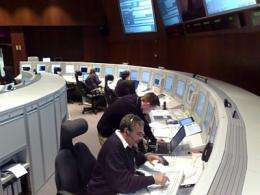
GOCE Flight Control Team in Main Control Room round-the-clock during the critical LEOP phase. Credits: ESA

(PhysOrg.com) -- After liftoff 17 March, ESA's GOCE spacecraft is performing very well, having achieved an extremely accurate injection altitude of 283.5 km, just 1.5 km lower than planned. The Mission Control Team is now working round-the-clock shifts to implement a series of critical check-out procedures.

The Team at ESOC, ESA's Space Operations Centre in Darmstadt, Germany, are now conducting the complex and critical 'Launch and Early Operations Phase' (LEOP) for , which was successfully launched into a polar orbit at 15:21:13 CET yesterday on a Rockot launcher.
Following yesterday's liftoff, separation of GOCE from the launcher and first acquisition of signals from the were confirmed by Operations Director Pier Paolo Emanuelli during a long day working with the Mission Control Team in the Main Control Room from two hours before until 10 hours after launch.

"Our first status report was issued yesterday evening five hours after launch, reporting that everything was nominal with the spacecraft," said Emanuelli.

The night shift came on console at 23:00 CET, under Deputy Director Paolo Ferri.

FLV player

ESA's first Earth Explorer Core mission GOCE (Gravity field and steady-state Ocean Circulation Explorer) will measure high-accuracy gravity gradients and provide global models of the Earth's gravity field and of the geoid. An improved gravity-field map will provide insight into the physics and dynamics of the Earth's interior and an accurate global geoid model will contribute to an improved understanding of ocean circulation, which plays a crucial role in energy exchanges around the globe and hence climate. This mission will also lead to a greater insight into sea-level change and to a global unification of height systems. Credits: ESA - AOES Medialab

"Overnight, we had a few minor problems, but nothing out of the ordinary. Overall, everything is going well and we are very happy with the booster performance and the spacecraft," said Ferri, speaking this morning in the Main Control Room at ESOC.

LEOP: Three intense days to ensure GOCE stability

During the three-day LEOP, on-board flight control systems will be thoroughly checked-out and the spacecraft brought step-wise through several modes of operation to achieve a stable, fully functioning status.

Communications with the and steady-state Ocean Circulation Explorer (GOCE) spacecraft during LEOP are being enhanced by a network of four ground tracking stations, which are providing additional communications capacity.

The spacecraft is currently in Coarse Pointing Mode, the most basic level of functioning, which was entered immediately after separation from the launcher.

Today's work includes preparing the spacecraft to switch to Extended Coarse Pointing Mode (ECPM), which enables a higher level of autonomous flight control; this is scheduled for 20:00 CET this evening.

ECPM also includes orienting the satellite so as to minimise the cross-section exposed to the atmosphere, thus limiting altitude decay. As planned, GOCE is orbiting in free flight and the electric-ion propulsion has not yet been switched on.

Another crucial LEOP step is calibrating the on-board magnetometers, which enable full attitude control to be established; this was done overnight.

Later today, the team will issue commands to switch on the Satellite-to-Satellite Tracking Instrument - a state-of-the-art GPS (Global Positioning Satellite) receiver on board GOCE that has been specially adapted to operate in a low-Earth orbit environment. As well as supporting scientific data analysis, the SSTI will also provide real-time navigation data to the on-board orbit control system.

ESOC Flight Dynamics: Running the numbers

ESOC's Flight Dynamics team is also providing round-the-clock support, and will today perform a series of calculations to enable the spacecraft to be switched into Fine Pointing Mode.

FPM is a higher level of functioning that can be maintained indefinitely while the on-board scientific instruments are commissioned. This is planned for 18:00 CET, 19 March.

Provided by European Space Agency (news : web)


print this article email this article download pdf blog this article bookmark this article     Stumble it Digg this share on Facebook retweet share on Reddit add to delicious
Rate this story - not rated yet


March 19, 2009 all stories

Comments: 0

not rated yet
  • Stumble this up

  • Digg this

  • share this

  • hide
  • Related Stories

  • GOCE gravity satellite moves to launch pad
    created Mar 11, 2009 | popularity not rated yet | comments 0
  • September launch for ESA's gravity mission GOCE
    created May 27, 2008 | popularity not rated yet | comments 0
  • Last-ever look at ESA's gravity satellite GOCE
    created Sep 04, 2008 | popularity not rated yet | comments 0
  • GIOVE-B spacecraft in good health
    created Apr 30, 2008 | popularity not rated yet | comments 0
  • GOCE begins its journey to launch site
    created Jul 29, 2008 | popularity not rated yet | comments 0


  • hide
  • Relevant PhysicsForums posts

  • SIMBAD/NED help
    created 1hour ago
  • Black hole confusion
    created Nov 14, 2009
  • Moon tied to Earth
    created Nov 13, 2009
  • Water on the Moon!
    created Nov 13, 2009
  • Is it possible for a single super-massive black hole...
    created Nov 13, 2009
  • Why are tides stronger at ...
    created Nov 13, 2009
  • More from Physics Forums - General Astronomy

Other News

MIT scientists pinpoint origin of dissolved arsenic in Bangladesh drinking water

Scientists pinpoint origin of dissolved arsenic in Bangladesh drinking water

Space & Earth / Environment

created 12 hours ago | popularity 5 / 5 (9) | comments 0

Researchers in MIT's Department of Civil and Environmental Engineering believe they have pinpointed a pathway by which arsenic may be contaminating the drinking water in Bangladesh, a phenomenon that has puzzled ...


Commuters wait on the platform shrouded by fog in London

Climate change not man-made, say majority of Britons: poll

Space & Earth / Environment

created 18 hours ago | popularity 2.7 / 5 (9) | comments 22

Less than half of Britons believes that human activity is to blame for global warming, according to a poll carried out for The Times newspaper and published on Saturday.


Warmer means windier on world's biggest lake

Space & Earth / Earth Sciences

created 12 hours ago | popularity 3.3 / 5 (3) | comments 0

Rising water temperatures are kicking up more powerful winds on Lake Superior, with consequences for currents, biological cycles, pollution and more on the world's largest lake and its smaller brethren.


Geeky 'tweeters' to report on space shuttle launch (AP)

Geeky 'tweeters' to report on space shuttle launch

Space & Earth / Space Exploration

created 12 hours ago | popularity not rated yet | comments 0

(AP) -- Fingers will be flying when space shuttle Atlantis blasts off Monday: About 100 of NASA's geekiest fans will be on hand, pecking away at iPhones, BlackBerrys, laptops and other Twittering gadgets.


Hawaii's famed white sandy beaches are shrinking (AP)

Hawaii's famed white sandy beaches are shrinking

Space & Earth / Environment

created 18 hours ago | popularity 5 / 5 (1) | comments 1

(AP) -- Jenn Boneza remembers when the white sandy beach near the boat ramp in her hometown was wide enough for people to build sand castles.