Graphene could lead to faster chips
March 19, 2009 By David Chandler
Graphene may solve communications speed limit

Enlarge

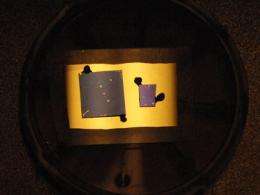
The graphene microchip. Photo / Donna Coveney

(PhysOrg.com) -- New research findings at MIT could lead to microchips that operate at much higher speeds than is possible with today's standard silicon chips, leading to cell phones and other communications systems that can transmit data much faster.

The key to the superfast chips is the use of a material called , a form of pure carbon that was first identified in 2004. Researchers at other institutions have already used the one-atom-thick layer of carbon atoms to make prototype and other simple devices, but the latest MIT results could open up a range of new applications.

The MIT researchers built an experimental graphene chip known as a frequency multiplier, meaning it is capable of taking an incoming electrical signal of a certain frequency -- for example, the that determines how fast a computer chip can carry out its computations -- and producing an output signal that is a multiple of that frequency. In this case, the MIT graphene chip can double the frequency of an electromagnetic signal.

Frequency multipliers are widely used in radio communications and other applications. But existing systems require multiple components, produce "noisy" signals that require filtering and consume large power, whereas the new graphene system has just a single transistor and produces, in a highly efficient manner, a clean output that needs no filtering.

The findings are being reported in a paper next month in and also in a talk this week at the American Physical Society meeting by Tomás Palacios, assistant professor in MIT's Department of Electrical Engineering and Computer Science and a core member of the Microsystems Technology Laboratories. The work was done by Palacios along with EECS Assistant Professor Jing Kong and two of their students, Han Wang and Daniel Nezich.

"In electronics, we're always trying to increase the frequency," Palacios says, in order to make "faster and faster computers" and cellphones that can send data at higher rates, for example. "It's very difficult to generate high frequencies above 4 or 5 gigahertz," he says, but the new graphene technology could lead to practical systems in the 500 to 1,000 gigahertz range.

"Researchers have been trying to find uses for this material since its discovery in 2004," he says. "I believe this application will have tremendous implications in high-frequency communications and electronics." By running several of the frequency-doubling chips in series, it should be possible to attain frequencies many times higher than are now feasible.

While the work is still at the laboratory stage, Palacios says, because it is mostly based on relatively standard chip processing technology he thinks developing it to a stage that could become a commercial product "may take a year of work, maximum two." This project is currently being partially funded by the MIT Institute for Soldier Nanotechnology and by the Interconnect Focus Center program, and it has already attracted the interest of "many other offices in the federal government and major chip-making companies," according to Palacios.

Graphene is related to the better-known buckyballs and carbon nanotubes, which also are made of one-atom-thick sheets of carbon. But in those , the carbon sheets are rolled up in the form of a tube or a ball. While physicists had long speculated that flat sheets of the material should be theoretically possible, some had doubted that it could ever remain stable in the real world.

"In physics today, graphene is, arguably, the most exciting topic," Palacios says. It is the strongest material ever discovered, and also has a number of unsurpassed electrical properties, such as "mobility" -- the ease with which electrons can start moving in the material, key to use in electronics -- which is 100 times that of silicon, the standard material of .

One key factor in enabling widespread use of graphene will be perfecting methods for making the material in sufficient quantity. The material was first identified, and most of the early work was based on, using "sticky tape technology," Palacios explains. That involves taking a block of graphite, pressing a piece of sticky tape against it, peeling it off and then applying the tape to a wafer of silicon or other material.

But Kong has been developing a method for growing entire wafers of graphene directly, which could make the material practical for electronics. Kong and Palacios' groups are currently working to transfer the frequency multipliers to these new graphene wafers.

"Graphene will play a key role in future of electronics," Palacios says. "We just need to identify the right devices to take full advantage of its outstanding properties. Frequency multipliers could be one of these devices."

Provided by Massachusetts Institute of Technology (news : web)

4.9 /5 (10 votes)  

Filter


Move the slider to adjust rank threshold, so that you can hide some of the comments.


Display comments: newest first

poi
Mar 19, 2009

Rank: not rated yet
""It's very difficult to generate high frequencies above 4 or 5 gigahertz," he says, but the new graphene technology could lead to practical systems in the 500 to 1,000 gigahertz range."
--- and I nearly fell off my seat, literally.

"While the work is still at the laboratory stage, Palacios says, because it is mostly based on relatively standard chip processing technology he thinks developing it to a stage that could become a commercial product "may take a year of work, maximum two.""
--- please do so.

"This project is currently being partially funded by the MIT Institute for Soldier Nanotechnology and by the Interconnect Focus Center program..."

From the site [http://web.mit.ed...dex.html]:
"The ultimate goal is to help the Army create a 21st century battlesuit that combines high-tech capabilities with light weight and comfort. Imagine a bullet-resistant jumpsuit, no thicker than ordinary spandex, that monitors health, eases injuries, communicates automatically, and reacts instantly to chemical and biological agents. It%u2019s a long-range vision for how fundamental nanoscience can make Soldiers less vulnerable to enemy and environmental threats."

Scalability is always an issue:
"One key factor in enabling widespread use of graphene will be perfecting methods for making the material in sufficient quantity."
...and the article is short on this.
"But Kong has been developing a method for growing entire wafers of graphene directly, which could make the material practical for electronics."
---which leaves much to be desired.
Let's hope he delivers also on this.
Good job!
Rank 4.9 /5 (10 votes)
Relevant PhysicsForums posts
  • Books To Inspire a Beginnig Physics Student
    created1 hour ago
  • Pith balls problem
    created2 hours ago
  • Electrostatics
    created2 hours ago
  • what is phase constant
    created2 hours ago
  • Basics In electromagnetic wave
    created2 hours ago
  • How to calculate theoretical initial velocity?
    created3 hours ago
  • More from Physics Forums - General Physics

More news stories

Putting the squeeze on planets outside our solar system

(PhysOrg.com) -- Using high-powered lasers, scientists at Lawrence Livermore National Laboratory and collaborators discovered that molten magnesium silicate undergoes a phase change in the liquid state, abruptly ...

Physics / Condensed Matter

created 12 hours ago | popularity 4.3 / 5 (7) | comments 0 | with audio podcast

Hovering not hard if you're top-heavy, researchers find

Top-heavy structures are more likely to maintain their balance while hovering in the air than are those that bear a lower center of gravity, researchers at New York University's Courant Institute of Mathematical Sciences ...

Physics / General Physics

created 13 hours ago | popularity 5 / 5 (1) | comments 1 | with audio podcast

SLAC, Stanford team focuses on high-energy electrons to treat cancer

Accelerator physicists at SLAC and cancer specialists from Stanford are working on a new technology that could dramatically reduce the time needed for cancer radiation treatments. The team ran an initial experiment ...

Physics / General Physics

created 16 hours ago | popularity 5 / 5 (2) | comments 0

Measurements from high-energy collisions lead to better understanding of why meson particles disappear

For several years, physicists at the Relativistic Heavy Ion Collider (RHIC) at Brookhaven National Laboratory (BNL), USA, have studied an unusual state of matter called the quark–gluon plasma, which they ...

Physics / General Physics

created 17 hours ago | popularity 4.5 / 5 (4) | comments 0

Explained: Sigma

It's a question that arises with virtually every major new finding in science or medicine: What makes a result reliable enough to be taken seriously? The answer has to do with statistical significance -- but ...

Physics / General Physics

created Feb 09, 2012 | popularity 5 / 5 (16) | comments 53


Anonymous knocks CIA website offline (Update)

The website of the Central Intelligence Agency was inaccessible on Friday after the hacker group Anonymous claimed to have knocked it offline.

Google users warned of threat to smartphone wallets

Users of Google smartphone wallets were being warned on Friday that there is a way to crack pass codes intended to thwart thieves from going on illicit shopping sprees.

New error-correcting codes guarantee the fastest possible rate of data transmission

Error-correcting codes are one of the triumphs of the digital age. They’re a way of encoding information so that it can be transmitted across a communication channel — such as an optical fiber o ...

Humans may have helped the decline of African rainforests 3000 years ago

(PhysOrg.com) -- Large areas of rainforests in Central Africa mysteriously disappeared over three thousand years ago, to be replaced by savannas. The prevailing theory has been that the cause was a change ...

New power source discovered

(PhysOrg.com) -- Researchers at the Massachusetts Institute of Technology (MIT) and RMIT University have made a breakthrough in energy storage and power generation.

Small modular reactor design could be a 'SUPERSTAR'

(PhysOrg.com) -- Though most of today's nuclear reactors are cooled by water, we've long known that there are alternatives; in fact, the world's first nuclear-powered electricity in 1951 came from a reactor ...