Flying car takes wing: MIT alums' invention makes its first test flights (w/Video)
March 19, 2009 by David Chandler
Terrafugia Transition

Enlarge

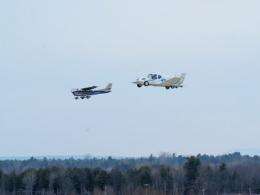
The Terrafugia Transition flying in formation with the chase aircraft. Photo courtesy / Terrafugia

(PhysOrg.com) -- A prototype of what is being touted as the world's first practical flying car took to the air for the first time this month, a milestone in a project started four years ago by students in MIT's Department of Aeronautics and Astronautics.

At 7:40 a.m. on March 5, the winged car taxied down a runway in Plattsburgh, N.Y., took off, flew for 37 seconds and landed further down the runway -- a it would repeat about a half dozen times over the next two days. In the coming months the company, a Woburn-based startup called Terrafugia, will test the plane in a series of ever-longer flights and a variety of maneuvers to learn about its handling characteristics.

have spent nearly a century pursuing the dream of a flying car, but the broader public has tended to view the idea as something of a novelty. Still, such a vehicle could have more practical appeal now that the has created a new class of plane -- Light Sport -- and a new license category just for pilots of such craft, including Terrafugia's two-seater Transition. The "sport pilot" license required to fly the Transition takes only about 20 hours of training time, about half that required to earn a regular pilot's license.

This video is not supported by your browser at this time.

The street-legal Transition is powered on land and in the air by a recently developed 100 hp Rotax engine that gets 30 mpg on the highway using regular unleaded gasoline. As a plane, its 20-gallon tank gives it a 450-mile range with a 115 mph cruising speed. The pilot can switch from one mode to the other from the driver's seat, simultaneously folding up the wings and shifting the engine power from the rear-mounted propeller to the front wheels in about 30 seconds.

Speaking at a March 18 news conference in which the Transition's first test flight was announced, Terrafugia CEO and co-founder Carl Dietrich '99, SM '03, PhD '07 said the FAA rule change and the Transition could help transform the way people move around the country -- especially in rural areas. "One of the biggest problems pilots have right now is that most of the 5,000 general aviation airports in the U.S. don't have any car rental facilities, or even a cab stand," he said, noting that the Transition could open many of these underused airports to easier, more practical use by private pilots.

The vehicle may also lead to improved safety. "One of the largest causes of accidents is pilots flying in bad weather," he said. With the Transition, a pilot who spotted bad weather ahead could simply land at the nearest airport, fold up the wings, drive through the weather on local roads, and take off from another airport once past the storm.

The first testing of Terrafugia's car-plane concept took place with a one-fifth scale model in MIT's Wright Brothers Wind Tunnel in 2005, while Dietrich and his wife, Anna Mracek Dietrich '04, SM '06, now the company's COO, and VP of Engineering Samuel Schweighart SM '01, PhD '05, were all students here, as were two of the other company principals.

The full-sized version being tested now is a proof-of-concept vehicle, to be followed later this year by a production prototype. The company is taking deposits now and hopes to start delivering its first Transitions -- or "roadable planes," as the company calls them -- in late 2011.

Test pilot Phil Meteer, who was at the controls in Plattsburgh, said that the short and simple first flight was both "remarkably unremarkable" and vitally important: "Ninety percent of the risk in the total program comes in the first flight, and now we're past that."

A retired U.S. Air Force colonel, Meteer said the plane handled so smoothly in the test flights that all of the possible contingencies he had practiced became irrelevant. "You're in a hypervigilant state" during the initial takeoff, he said, but as he saw how smoothly the flight was going he had a "wahoo moment: none of this is happening!"


Join PhysOrg.com on Facebook!
Follow PhysOrg.com on Twitter!
Provided by Massachusetts Institute of Technology (news : web)

3.5 /5 (11 votes)  

Filter


Move the slider to adjust rank threshold, so that you can hide some of the comments.


Display comments: newest first

Szkeptik
Mar 19, 2009

Rank: 4.8 / 5 (6)
This is not a flying car. This is a plane with a cockpit that resembles a car.
Edylc
Mar 19, 2009

Rank: 5 / 5 (2)
haha, that's exactly what I thought.
As if that could ever go on the freeway.
Suzu
Mar 19, 2009

Rank: 5 / 5 (2)
Seems like we are doing 1 step forward and 3 steps back.
PhoenixRising
Mar 19, 2009

Rank: 4.5 / 5 (2)
Hmmm.... The first???? I beleive that honor goes to the Taylor Aerocar... Circa 1949. Google it and see!
barkster
Mar 19, 2009

Rank: not rated yet
Now imagine the day when your 16 year old comes to you and asks "Daddy, can I have the keys to the car?"
SmartK8
Mar 19, 2009

Rank: 4.5 / 5 (2)
Well it has four wheels at least but I can't imagine those tiny plane-like wheels driving across an icy road. Thumbs up thou for reminding me that this is plain (or plane?) stupid.
Truth
Mar 19, 2009

Rank: 5 / 5 (4)
Okay, over the past 60 years there have been MANY so-called car-planes which have been built, flown and ultimately abandoned. The main drawback are the folded wings, which make the car ungainly and impractical on any road. The amazing thing is that even MIT people get sucked into the childish fantasy, completely overlooking that one simple fact.
Truth
Mar 19, 2009

Rank: 5 / 5 (3)
Also, there are no highways in any city where a driver can just decide to switch from car to a plane and takeoff over traffic, or for that matter, switch from a plane and land on a busy, crowded highway. Try that and you will get nailed for a multitude of violations, not to mention the very obvious safety problems!
baddream
Mar 20, 2009

Rank: 4 / 5 (2)
In my experience Americans have a terrible fatality rate moving about in two dimensions. This would add a third.
DozerIAm
Mar 20, 2009

Rank: 5 / 5 (1)
This problem here boils down to this: The characteristics that make a car perform well and safely are inconsistent with the characteristics that make an airplane perform well and safely. Any merging of the 2 necessarily then involve unacceptible compromises in performanace and safety.
Caltech_Mark
Mar 20, 2009

Rank: not rated yet
This is better understood from a pilot's perspective. The goal here is a "road-able airplane", NOT a "flyable car". The idea is to drive the craft to an airfield, take off, fly to another airfield, land, and drive to a destination (or to a restaurant, motel, etc).
When you get into the seat of this craft, you are sitting in an airplane cockpit, not an automobile seat. The tradeoffs that allow an aircraft to also be street drivable are what is being worked through, not what makes a car flyable.
This is not the vehicle you would use to drive the kids to soccer practice.
Rank 3.5 /5 (11 votes)
Related Stories
Relevant PhysicsForums posts
  • Need help reading 3-D
    created8 hours ago
  • A way to send and receive wireless data
    created14 hours ago
  • Tabletop Cold Fusion Reactor
    created15 hours ago
  • Calling function with no input argument
    createdFeb 10, 2012
  • Force free body diagram problem on gym equipment
    createdFeb 10, 2012
  • Empirical data regarding shower heads and water
    createdFeb 10, 2012
  • More from Physics Forums - General Engineering

More news stories

Walney offshore wind farm is world's biggest (for now)

(PhysOrg.com) -- The Walney wind farm on the Irish Sea--characterized by high tides, waves and windy weather--officially opened this week. The farm is treated in the press as a very big deal as the Walney ...

Technology / Energy & Green Tech

created 17 hours ago | popularity 3.9 / 5 (10) | comments 32 | with audio podcast weblog

GPS court ruling leaves US phone tracking unclear

A US Supreme Court decision requiring a warrant to place a GPS device on the car of a criminal suspect leaves unresolved the bigger issue of police tracking using mobile phones, legal experts say.

Technology / Telecom

created 17 hours ago | popularity 4 / 5 (2) | comments 0

Europeans protest controversial Internet pact

Tens of thousands of people marched in protests in more than a dozen European cities Saturday against a controversial anti-online piracy pact that critics say could curtail Internet freedom.

Technology / Internet

created 13 hours ago | popularity 4.5 / 5 (8) | comments 0

Netflix settlement trims 14 pct off 4Q earnings

(AP) -- Netflix pressed the rewind button on its fourth-quarter earnings after settling allegations that the video subscription service violated a consumer-privacy law.

Technology / Business

created 17 hours ago | popularity not rated yet | comments 0

Navy to begin tests on electromagnetic railgun prototype launcher

The Office of Naval Research (ONR)'s Electromagnetic (EM) Railgun program will take an important step forward in the coming weeks when the first industry railgun prototype launcher is tested at a facility ...

Technology / Engineering

created Feb 06, 2012 | popularity 4.7 / 5 (15) | comments 92 | with audio podcast


Europe stakes billion-dollar bet on new rocket

A pencil-slim rocket is scheduled to lift into space from South America on Monday, carrying a billion-dollar bet that Europe can grab a juicy slice of the market to place satellites in low orbit.

Study finds that anti-diabetic medication can prevent the long-term effects of maternal obesity

In a study to be presented today at the Society for Maternal-Fetal Medicine's annual meeting, The Pregnancy Meeting, in Dallas, Texas, researchers will report findings that show that short therapy with the anti-diabetic medication ...

Explained: Sigma

It's a question that arises with virtually every major new finding in science or medicine: What makes a result reliable enough to be taken seriously? The answer has to do with statistical significance -- but ...

Political leaders play key role in how worried Americans are by climate change: study

More than extreme weather events and the work of scientists, it is national political leaders who influence how much Americans worry about the threat of climate change, new research finds.

New power source discovered

(PhysOrg.com) -- Researchers at the Massachusetts Institute of Technology (MIT) and RMIT University have made a breakthrough in energy storage and power generation.

NASA budget will axe Mars deal with Europe: scientists

US President Barack Obama's budget proposal to be submitted next week for 2013 will cut NASA's budget by 20 percent and eliminate a major partnership with Europe on Mars exploration, scientists said Thursday.