Fetal alcohol syndrome testing expands
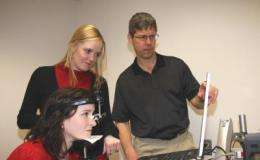
Improved technology, partnerships and collaboration across two provinces have allowed Queen's University scientists to dramatically expand the use of eye-movement tests that help identify and assess children with Fetal Alcohol Spectrum Disorder (FASD).
"Our initial study was carried out with a relatively small group of children who had to travel to Queen's to participate in the experiment," notes Pharmacology and Toxicology professor James Reynolds, who leads the project. "Establishing a mobile laboratory allowed us to go where the kids are, and carry out these experiments in community settings."
Thanks to the cooperation of local health professionals and community members, the researchers tested more than 200 children in nine different Ontario and Alberta locations.
"Now we know that the results of eye movement testing are consistent across different geographical locations - something that is absolutely critical if this type of testing is to be widely applicable," says Dr. Reynolds.
Until now, there have been few objective tools that will accurately measure brain function in young children. This breakthrough will add eye movement testing to the standard clinical assessment protocols currently in use, to determine the potential for identifying at-risk children.
The work was sponsored by the Canadian Institutes of Health Research (CIHR) as part of a multi-university New Emerging Team project. The findings are highlighted today in an on-line article in the European Journal of Neuroscience.
"This is a most original finding, with clear clinical application," says Dr. Rémi Quirion, Scientific Director of the CIHR Institute of Neurosciences, Mental Health and Addiction. "Fetal Alcohol Spectrum Disorder is a significant health issue in Canada. The work of Dr Reynolds and his team is an excellent example of what CIHR aims for: improving the health of Canadians through cutting-edge, innovative research."
The Queen's researchers are continuing to develop novel approaches for using eye movements to assess brain function. In collaboration with Doug Munoz, director of Queen's Centre for Neuroscience Studies, they are using the university's functional MRI (magnetic resonance imaging) facility to measure differences in brain activity in children with developmental disorders such as FASD and ADHD (Attention Deficit Hyperactivity Disorder). They are building a database of task performance and brain functioning across many clinical populations.
"This is very exciting because it points us toward using eye movements to show differences in clinical populations," says Dr. Reynolds. "Once we understand what 'typical' development looks like, we can use the same tools to identify signature characteristics of each of the disorders."
Defined as birth defects resulting from a mother's consumption of alcohol during pregnancy, FASD is believed to affect approximately one per cent of children in Canada. FASD is associated with hyperactivity, difficulty in learning, and deficits in memory, understanding and reasoning, as well as problems dealing with stress.
In the absence of confirmed maternal alcohol consumption during pregnancy, the diagnosis of FASD remains a significant clinical challenge. "The ability to objectively assess brain function at earlier and earlier ages will be hugely beneficial in the long term, because it will help identify the at-risk children for whom targeted interventions will have the greatest impact," says Dr. Reynolds.
Source: Queen's University


