Variations in blood circulation immediately visible with fast camera
March 19, 2009
Variations in blood circulation immediately visible with fast camera

Enlarge

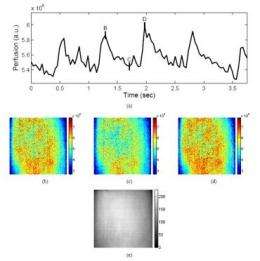
A continuous recording of the blood circulation of the hand of a healthy test person; the graph (above) shows the average blood circulation, and b through d show the entire situation for the period of time on the graph: the heart beat can be observed.

(PhysOrg.com) -- Burns or other disorders that disrupt the blood flow in tissues will soon be easier to assess thanks to a camera that is capable of imaging blood circulation in real time. Compared to an earlier version, the new optical perfusion camera (TOPCam) from Twente, the Netherlands, is a significant improvement with regard to speed, so that even small variations in blood circulation are immediately visible.

The is now ready for . Researchers of the Institute for Biomedical Technology (BMTI) are publishing an article on the camera in the March number of .

After earlier successful tests at the Martini Hospital in Groningen, the Netherlands, the researchers have made a number of significant improvements to the camera. The speed of the earlier version was commended by doctors and nurses, but real-time images of variations in the were not yet possible. They are now, though, according to researcher Wiendelt Steenbergen: “We can now see rapid variations in , too, for example when the circulation gets going again after of an arm or after a transplant.” The measured reaction gives an immediate impression of the condition of the vascular bed.

This video is not supported by your browser at this time.

A continuous recording of the blood circulation of the hand of a healthy test person.

The researchers were able to reach these high speeds by using a broad to simultaneously illuminate the entire area of skin in question. Images are made of the tissue with a high-speed camera. Laser light that is scattered by moving gives variation in the clarity of the pixels as a result of the Doppler Effect. Up till now it had been a problem transferring all the data to the computer quickly enough, but real time images are now enabled by making better use of the camera memory.

Now that the newest modifications have been made, the camera is ready for clinical application, Steenbergen says. The TOPCam is also suitable for other applications such as the assessment of blood circulation in diabetics.

More information: The article Twente Optical Perfusion Camera: system overview and performance for video rate laser Doppler perfusion imaging by Matthijs Draijer, Erwin Hondebrink, Ton van Leeuwen and Wiendelt Steenbergen is appearing in the March number of Optics Express.

Provided by Universiteit Twente

3.5 /5 (2 votes)  

Rank 3.5 /5 (2 votes)
Related Stories
Relevant PhysicsForums posts

More news stories

Explained: Sigma

It's a question that arises with virtually every major new finding in science or medicine: What makes a result reliable enough to be taken seriously? The answer has to do with statistical significance -- but ...

Physics / General Physics

created Feb 09, 2012 | popularity 5 / 5 (20) | comments 76

Quantum physicist explains $100K offer for proof scaled-up quantum computing is impossible

(PhysOrg.com) -- MIT researcher Scott Aaronson has certainly riled the physics community with his offer this past Friday, of $100,000 to anyone who can prove that scaled-up quantum computing is impossible. ...

Physics / Quantum Physics

created Feb 08, 2012 | popularity 4.3 / 5 (14) | comments 37 | with audio podcast weblog

Diamond light, brighter than the sun

It’s the size of five football pitches and generates light 10 billion times brighter than the sun. As the Diamond Light Source celebrates its tenth anniversary this year, Penny Bailey visits one of the ...

Physics / General Physics

created Feb 07, 2012 | popularity 4.4 / 5 (9) | comments 18 | with audio podcast

Physicists 'record' magnetic breakthrough

An international team of scientists has demonstrated a revolutionary new way of magnetic recording which will allow information to be processed hundreds of times faster than by current hard drive technology.

Physics / General Physics

created Feb 07, 2012 | popularity 4.6 / 5 (43) | comments 14 | with audio podcast

Hints of the Higgs - papers are submitted

Back in December 2011, the ATLAS and CMS experiments at CERN presented some exciting results that provided tantalising hints of the Higgs boson.

Physics / General Physics

created Feb 08, 2012 | popularity 4.3 / 5 (8) | comments 10


Overeating may double risk of memory loss

New research suggests that consuming between 2,100 and 6,000 calories per day may double the risk of memory loss, or mild cognitive impairment (MCI), among people age 70 and older. The study was released today and will be ...

Google might launch Drive for cloud storage soon

(PhysOrg.com) -- Google's next big move, according to the Wall Street Journal, is a cloud storage service called Drive. Hardly first to the plate, Google is simply catching up to introducing its cloud reposi ...

Scientists discover molecular secrets of 2,000-year-old Chinese herbal remedy

For roughly two thousand years, Chinese herbalists have treated Malaria using a root extract, commonly known as Chang Shan, from a type of hydrangea that grows in Tibet and Nepal. More recent studies suggest that halofuginone, ...

New method to examine batteries -- MRI from the inside

There is an ever-increasing need for advanced batteries for portable electronics, such as phones, cameras, and music players, but also to power electric vehicles and to facilitate the distribution and storage of energy derived ...

Injured boomers beware: Know when to see doctor

(AP) -- It happened to nurse Jane Byron years after an in-line skating fall, business owner Haralee Weintraub while doing "men's" push-ups, and avid cyclist Gene Wilberg while lifting a heavy box.

Lab study raises questions over nano-particle impact

Tests involving chickens have raised questions about the impact on health from engineered nano-particles, the ultra-fine grains commonly used in drugs and processed foods, scientists said on Sunday.