'Buckyballs' to treat multiple sclerosis
March 19, 2009 'Buckyballs' to treat multiple sclerosis

Enlarge

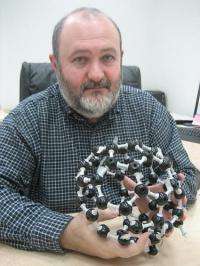
This is Dr. Michael Gozin from Tel Aviv University. Credit: AFTAU

If you're of a certain age, you'll remember Buckminster Fuller's distinctive "geodesic domes" - soccer-ball-shaped structures that the late futurist envisioned as ideal human domiciles. Tel Aviv University chemists remember them too - and are now putting them to use in the treatment of multiple sclerosis (MS).

In partnership with a group of Prof. Howard Weiner from Brigham and Women's Hospital at Harvard Medical School, Dr. Michael Gozin from TAU's School of Chemistry is attempting to create the next generation drug based on a delivery platform of "," small soccer-ball-shaped molecules sometimes called fullerenes. Made from pure carbon, the buckyballs can function as invigorating antioxidants to keep neurons in the brain alive and kicking.

There is currently no cure for MS, which slowly paralyzes and then kills.

Buckyballs and related carbon nanotubes have enormous potential to be used in sensors and electronic applications allowing scientists to manufacture much more smaller and faster processors. These carbon-based materials have a huge range of possibilities in as well.

Until now, buckyball-derived therapeutics have not been used in medicine. But the TAU and Harvard teams believe that they may resolve issues related to this nanomaterial development, and are seeking to commercialize their patented invention. If successful, the TAU-Harvard collaboration could provide new hope to millions of MS sufferers, and would make Bucky himself proud.

The TAU team is the first in the world to have synthesized a brain-targeted antioxidant to treat affected neurons in the brain. Pre-clinical trials, the researchers report, proved successful in animal models. They are also attempting to apply the same technology to the treatment of Alzheimers disease, but a reliable and effective treatment for MS is their primary goal.

MS is an autoimmune disease that robs people of the ability to control their motor movements. No one knows exactly how many people are afflicted with MS. According to the National Institute of Neurological Disorders and Stroke, it is estimated that there are currently more than 350,000 people in the United States, who have been diagnosed with MS, where approximately 200 new cases are diagnosed each week. Current state-of-the-art therapies like the Israeli-invented Copaxone clearly help, but may not be enough, says Dr. Gozin, whose wide-ranging research has included work on classified projects for the U.S. Department of Defense.

" is a very serious clinical condition," says Dr. Gozin. "I had a dream, an idea for a new kind of drug." He took this idea to MS expert Prof. Howard Weiner at Harvard University, and the two began a collaboration.

"I wanted to target with antioxidants specific receptors in the brain, which are involved in the disease progress, to stall the deterioration of motor function in MS sufferers," Dr. Gozin says. The US-Israeli researchers started from the belief that buckyballs, and brain-targeted moieties attached to them, may be able to achieve success in treating MS.

"We've created a molecule based on the C60 fullerene, a soccer-ball-shape, with great biomedical potential," says Dr. Gozin. The Tel Aviv University team, including graduate student Amnon Bar-Shir, was the first to synthesize and patent this application, which is "programmed" to target specific receptors in the brain. "We are presently working on the next generation of this type of molecules, containing less exotic and more natural building blocks," Dr. Gozin reports.

Source: Tel Aviv University (news : web)


print this article email this article download pdf blog this article bookmark this article     Stumble it Digg this share on Facebook retweet share on Reddit add to delicious
Rate this story - 5 /5 (2 votes)

Rank Filter

Move the slider to adjust rank threshold, so that you can hide some of the comments.


Display comments: newest first

  • stuart_59 - Mar 20, 2009
    • Rank: not rated yet
    MS DOES NOT KILL !!!!!! Whomever justified this article should print a retraction. Why scare the general community with this verbiage?

    Want to read top notch MS information? Click this site (http://www.msviewsandnews.org) and then register to receive their weekly MS e-Newsletter.
    Click to view their MS Blog as well: http://wwwmsviews...pot.com/
    ===================

March 19, 2009 all stories

Comments: 1

5 /5 (2 votes)
  • Stumble this up

  • Digg this

  • share this

  • hide
  • Related Stories

  • New drug protects nerve cells from damage in mice
    created Mar 14, 2008 | popularity not rated yet | comments 0
  • Milestone for cannabinoid MS study
    created Jul 21, 2008 | popularity not rated yet | comments 0
  • New MRI finding sheds light on multiple sclerosis disease progression
    created Aug 28, 2007 | popularity not rated yet | comments 0
  • If MRI shows signs of MS, will the disease develop?
    created Dec 10, 2008 | popularity not rated yet | comments 0
  • Young smokers increase risk for multiple sclerosis
    created Feb 23, 2009 | popularity not rated yet | comments 0


  • hide
  • Relevant PhysicsForums posts

Other News

Findings show nanomedicine promising for treating spinal cord injuries

Findings show nanomedicine promising for treating spinal cord injuries

Nanotechnology / Bio & Medicine

created 11 hours ago | popularity 4.5 / 5 (4) | comments 0

(PhysOrg.com) -- Researchers at Purdue University have discovered a new approach for repairing damaged nerve fibers in spinal cord injuries using nano-spheres that could be injected into the blood shortly ...


New Digital 'Electronics' Concept May Continue Moore's Law

New Digital 'Electronics' Concept May Continue Moore's Law

Nanotechnology / Nanophysics

created Nov 05, 2009 | popularity 4.6 / 5 (53) | comments 9

(PhysOrg.com) -- Computers of the future could be operating not on electrons, but on tiny waves traveling through an electron "fluid," if a new proposal is successful. The new circuit design, recently introduced ...


Nanoparticles for gene therapy improve

Nanoparticles for gene therapy improve

Nanotechnology / Bio & Medicine

created Nov 06, 2009 | popularity 5 / 5 (4) | comments 3

(PhysOrg.com) -- About five years ago, Professor Janet Sawicki at the Lankenau Institute in Pennsylvania read an article about nanoparticles developed by MIT's Robert Langer for gene therapy, the insertion ...


Breakthrough in industrial-scale nanotube processing

Breakthrough in industrial-scale nanotube processing

Nanotechnology / Nanomaterials

created Nov 02, 2009 | popularity 4.9 / 5 (20) | comments 3

(PhysOrg.com) -- Rice University scientists today unveiled a method for the industrial-scale processing of pure carbon-nanotube fibers that could lead to revolutionary advances in materials science, power ...


Scientists witness nature's complexity unfold in self-assembling quasicrystals

Scientists witness nature's complexity unfold in self-assembling quasicrystals

Nanotechnology / Nanomaterials

created Oct 31, 2009 | popularity 4.9 / 5 (17) | comments 3

(PhysOrg.com) -- Just a few decades ago, scientists believed that all ordered matter consists of self-repeating building blocks -- atoms, ions or molecules. In this view, the ordinary solids of everyday life ...