Scientists find giant solar twists
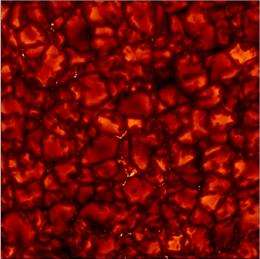
(PhysOrg.com) -- Scientists have, for the first time, detected giant twisting waves in the lower atmosphere of the Sun, shedding light on the mystery of the Sun's corona (the region around the Sun, extending more than one million kilometres from its surface) having a vastly higher temperature than its surface. The findings of this investigation, which will help us understand more about the turbulent solar weather and its affect on our planet, are published today in Science.
The massive solar twists, known as Alfvén waves, were discovered in the lower atmosphere with the Swedish Solar Telescope in the Canary Islands by scientists from Queen's University Belfast, the University of Sheffield and California State University Northridge.
The increase in solar temperature from approximately 6000 degrees on the visible surface of the Sun (photosphere) to well over a million degrees in the higher overlaying solar corona, has remained at the forefront of astrophysical research for over half a century. The new observations reveal the process behind this phenomenon, whereby these unique magnetic oscillations spread upward from the solar surface to the Sun's corona with an average speed of over 20km per second, carrying enough energy to heat the plasma to well over a few million degrees.
Prof. Mathioudakis, the leader of the Queen's University Belfast Solar Group, said, "Understanding solar activity and its influence on the Earth's climate is of paramount importance for human kind. The Sun is not as quiet as many people think. The solar corona, visible from Earth only during a total solar eclipse, is a very dynamic environment which can erupt suddenly, releasing more energy than 10 billion atomic bombs. Our study makes a major advancement in the understanding of how the million-degree corona manages to achieve this feat."
Alfvén waves are caused by the twisting of structures in the Sun's atmosphere and can be detected by the periodic velocity signals emitted. The Alfvén waves detected in this study were found to be associated with a large magnetic field concentration on the surface of the Sun, approximately twice the size of the British Isles. These strong magnetic fields manifest as bright features, often with lifetimes exceeding one hour. The Swedish Solar Telescope is the largest solar telescope in Europe and produces some of the sharpest images currently available. Bearing in mind that the Sun is 150 million kilometres away, the measurements carried out are equivalent to reading the time on Big Ben in London from Tokyo.
Dr. David Jess, from Queen's University Belfast and lead author of the Science paper, said, "Often, waves can be visualized by the rippling of water when a stone is dropped into a pond, or by the motions of a guitar string when plucked. However, Alfvén waves cannot be seen so easily. In fact, they are completely invisible to the naked eye. Only by examining the motions of structures and their corresponding velocities in the Sun's turbulent atmosphere could we find, for the first time, the presence of these elusive Alfvén waves."
Prof. Erdélyi, Head of the Solar Physics and Space Plasma Research Centre (SP2RC), who lead the theoretical interpretation of Alfvén waves, added, "The heat was on to find evidence for the existence of Alfvén waves. International space agencies have invested considerable resources trying to find purely magnetic oscillations of plasmas in space, particularly in the Sun. These waves, once detected, can be used to determine the physical conditions in the invisible regions of the Sun and other stars, through the technique of magneto-seismology. It was a real thrilling experience to interpret the data found by my colleagues at Queen's University."
Professor Keith Mason, CEO of the Science and technology Facilities Council (STFC), said, "These are extremely interesting results. Understanding the processes of our Sun is incredibly important as it provides the energy which allows life to exist on Earth and can affect our planet in many different ways. This new finding of magnetic waves in the Sun's lower atmosphere brings us closer to understanding its complex workings and its future effects on the Earth's atmosphere."
The existence of purely magnetic waves in highly magnetized environments was first proposed by Hannes Alfvén in 1942, who received a Nobel Prize for his work in this area of research.
The work is funded by the Science and Technology Facilities Council (STFC).
Provided by Science and Technology Facilities Council


