Report: Birds endangered by energy development
March 19, 2009 By DINA CAPPIELLO , Associated Press Writer
Report: Birds endangered by energy development (AP)

Enlarge

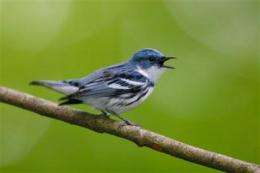
In this June 2006 handout photo provided by the National Audubon Society, an adult male cerulean warbler is seen in Litchfield County, Conn. As the Obama administration pursues more homegrown energy sources, a new government report faults energy production of all types _ wind, ethanol and mountaintop coal mining _ for contributing to steep drops in bird populations. (AP Photo/National Audubon Society, Brian E. Small)

(AP) -- As the Obama administration pursues more homegrown energy sources, a new government report faults energy production of all types - wind, ethanol and mountaintop coal mining - for contributing to steep drops in bird populations.

The first-of-its-kind government report chronicles a four-decade decline in many of the country's and provides many reasons for it, from suburban sprawl to the spread of exotic species to global warming.

In almost every case, is also playing a role.

"Energy development has significant negative effects on in North America," the report concludes.

Birds can collide with wind turbines and oil and gas wells, and studies have shown that some species, such as prairie chickens and , will avoid nesting near the structures.

Ponds created during the extraction of coal-bed methane gas breed mosquitoes that carry West Nile virus, leading to more bird deaths. Transmission lines, roads to access energy fields and mountaintop removal to harvest coal can destroy and fragment birds' living spaces.

Environmentalists and scientists say the report should signal to the Obama administration to act cautiously as it seeks to expand renewable energy production and the electricity grid on public lands and tries to harness wind energy along the nation's coastlines.

The report also shows that conservation efforts can work. Birds that reside in wetlands and the nation's waterfowl have rebounded over the past 40 years, a period marked by increased protections for wetlands.

"We need to go into these energies with our environmental eyes open," said John Fitzpatrick, the director of the Cornell Lab of Ornithology, which helped draft the report along with non-profit advocacy groups. "We need to attend to any form of energy development, not just oil and gas."

Many of the bird groups with the most rapid declines in the last 40 years inhabit areas with the greatest potential for energy development.

Among the energy-bird conflicts cited by the report:

- More than half of the monitored bird species that live on prairies have experienced population losses. These birds, such as the lesser prairie-chicken, are threatened by farmers converting grasslands into corn fields to meet demand for biofuels.

- In the Arctic, where two-thirds of all shorebirds are species of concern, melting ice brought about by climate change could open up more areas to oil and gas production. Studies show that trash near drilling rigs attracts gulls that prey on other species.

- Mountaintop coal mining in Appalachia clears patches of forest contributing to the decline of birds like the cerulean warbler that breeds and forests in treetops.

The U.S. State of Birds report, released by the Interior Secretary Ken Salazar on Tuesday, was requested in October 2007 by President George W. Bush.

Salazar, who wants to establish renewable energy zones and is drawing up rules for offshore wind energy production, said Thursday the report should "be a call to action, but it is action in our reach."

The report uses data from three long-running bird censuses to establish trends over time. It shows that birds in Hawaii are more in danger of becoming extinct than anywhere else in the United States. In the last 40 years, populations of birds living on prairies, deserts and at sea have declined between 30 and 40 percent.

While its findings are similar to earlier studies, it is the first to be issued by the government and the agency in charge of managing energy production on public lands and protecting the nation's wildlife.

The report did not indicate whether one form of energy production is more detrimental than the other.

---

On the Net:

State of The Birds report: http://www.stateofthebirds.org

Department of Interior: http://www.doi.gov

©2009 The Associated Press. All rights reserved. This material may not be published, broadcast, rewritten or redistributed.

4.5 /5 (2 votes)  

Rank 4.5 /5 (2 votes)
Related Stories
Relevant PhysicsForums posts
  • Factors affecting beet root cell membrane
    created10 hours ago
  • Stem cell question.
    createdFeb 10, 2012
  • Protease cleavage
    createdFeb 10, 2012
  • Pertubance in a model
    createdFeb 10, 2012
  • Cancer drugs and Alzheimer's, Oh my!
    createdFeb 09, 2012
  • Squishing cells
    createdFeb 09, 2012
  • More from Physics Forums - Biology

More news stories

A mitosis mystery solved: How chromosomes align perfectly in a dividing cell

Although the process of mitotic cell division has been studied intensely for more than 50 years, Whitehead Institute researchers have only now solved the mystery of how cells correctly align their chromosomes during symmetric ...

Biology / Cell & Microbiology

created 6 hours ago | popularity 4.4 / 5 (10) | comments 0 | with audio podcast

Researchers find extensive RNA editing in human transcriptome

In a new study published online in Nature Biotechnology, researchers from BGI, the world's largest genomics organization, reported the evidence of extensive RNA editing in a human cell line by analysis of RNA-seq data, demons ...

Biology / Biotechnology

created 6 hours ago | popularity 5 / 5 (4) | comments 0 | with audio podcast

The proteins ensuring genome protection

Researchers from the University of Geneva (UNIGE), Switzerland, have discovered the crucial role of two proteins in developing a cell 'anti-enzyme shield'. This protection system, which operates at the level of molecular ...

Biology / Cell & Microbiology

created 6 hours ago | popularity 5 / 5 (3) | comments 0 | with audio podcast

Entire genome of extinct human decoded from fossil

(PhysOrg.com) -- In 2010, Svante Pääbo and his colleagues presented a draft version of the genome from a small fragment of a human finger bone discovered in Denisova Cave in southern Siberia. The ...

Biology / Biotechnology

created Feb 07, 2012 | popularity 4.7 / 5 (59) | comments 48 | with audio podcast

Why are there so few fish in the Earth's oceans?

(PhysOrg.com) -- A Stony Brook University researcher has found that, contrary to popular belief, there are not plenty of fish in the sea.

Biology / Plants & Animals

created Feb 08, 2012 | popularity 4.2 / 5 (18) | comments 27 | with audio podcast


Declining health-care productivity in England: Who says so?

Reports that the National Health Service in England has been declining in productivity in the last decade appear to have been accepted as fact. However, a Viewpoint published Online First by The Lancet disputes this. The Vi ...

Scientists discover molecular secrets of 2,000-year-old Chinese herbal remedy

For roughly two thousand years, Chinese herbalists have treated Malaria using a root extract, commonly known as Chang Shan, from a type of hydrangea that grows in Tibet and Nepal. More recent studies suggest that halofuginone, ...

New method to examine batteries -- MRI from the inside

There is an ever-increasing need for advanced batteries for portable electronics, such as phones, cameras, and music players, but also to power electric vehicles and to facilitate the distribution and storage of energy derived ...

Overeating may double risk of memory loss

New research suggests that consuming between 2,100 and 6,000 calories per day may double the risk of memory loss, or mild cognitive impairment (MCI), among people age 70 and older. The study was released today and will be ...

Lab study raises questions over nano-particle impact

Tests involving chickens have raised questions about the impact on health from engineered nano-particles, the ultra-fine grains commonly used in drugs and processed foods, scientists said on Sunday.

Google might launch Drive for cloud storage soon

(PhysOrg.com) -- Google's next big move, according to the Wall Street Journal, is a cloud storage service called Drive. Hardly first to the plate, Google is simply catching up to introducing its cloud reposi ...