High-speed signal mixer demonstrates capabilities of transistor laser
March 19, 2009 By James E. Kloeppel
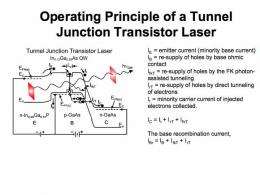
Operating principle of a tunnel-junction transistor laser.
(PhysOrg.com) -- Scientists at the University of Illinois have successfully demonstrated a microwave signal mixer made from a tunnel-junction transistor laser. Development of the device brings researchers a big step closer to higher speed electronics and higher performance electrical and optical integrated circuits.
The mixing device accepts two electrical inputs and produces an optical signal that was measured at frequencies of up to 22.7 gigahertz. The frequency range was limited by the bandwidth of the detector employed in the measurements, not by the transistor device.
"In addition to the usual current-modulation capability, the tunnel junction provides an enhanced means for voltage-controlled modulation of the photon output of the transistor laser,” said Nick Holonyak Jr., a John Bardeen Chair Professor of Electrical and Computer Engineering and Physics at the U. of I. “This offers new capabilities and a much greater sensitivity for unique signal-mixing and signal-processing applications."
To make the device, the researchers first placed a quantum well inside the base region of a transistor laser. Then they created a tunnel junction within the collector region. They describe the fabrication and operation of the mixing device in the March 13 issue of the journal Applied Physics Letters.
“Within the transistor laser, the tunneling process occurs predominantly through a process called photon-assisted absorption,” said Milton Feng, the Holonyak Chair Professor of Electrical and Computer Engineering.
The tunneling process begins in the quantum well, where electrons and holes combine and generate photons, Feng said. Those photons are then reabsorbed to create new pairs of electrons and holes used for voltage modulation.
“The tunnel junction makes it possible to annihilate an electron in the quantum well, and then tunnel an electron out to the collector by the tunnel contact,” Feng said.
The transistor output is sensitive to third-terminal voltage control because of the electrons tunneling from the base to the collector, which also creates an efficient supply of holes to the quantum well for recombination.
“This is a new type of transistor,” said Holonyak, who also is a professor in the university’s Center for Advanced Study, one of the highest forms of campus recognition. “We are using the photon internally to modify the electrical operation and make the transistor itself a different device with additional properties.”
High-speed signal mixing, for example, is made possible by the nonlinear coupling of the internal optical field to the base electron-hole recombination, minority carrier emitter-to-collector transport, and the base-to-collector electron tunneling at the collector junction, the researchers report.
The sensitivity of the tunnel-junction transistor laser to voltage control enables the device to be directly modulated by both current and voltage. This flexibility facilitates the design of new nonlinear signal processing devices for improved optical power output.
“The metamorphosis of the transistor is not yet complete,” Holonyak said. “We’re still working on it, and the transistor is still changing.”
Co-authors of the paper are graduate research assistant and lead author Han Wui Then, graduate student Hsin-Yu Wu and senior research scientist Gabriel Walter.
Provided by University of Illinois at Urbana-Champaign (news : web)
-
Hidden structure revealed in characteristics of transistor laser
Apr 06, 2006 |
not rated yet |
0
-
Transistor laser functions as non-linear electronic switch, processor
Feb 06, 2006 |
not rated yet |
0
-
Room-temperature transistor laser is step closer to commercialization
Sep 27, 2005 |
not rated yet |
0
-
New material structure produces world's fastest transistor
Apr 11, 2005 |
not rated yet |
0
-
World's fastest transistor approaches goal of terahertz device
Dec 11, 2006 |
not rated yet |
0
-
Engineers build first sub-10-nm carbon nanotube transistor
Feb 01, 2012 |
4.9 / 5 (31) |
30
-
Something old, something new: Evolution and the structural divergence of duplicate genes
Jan 31, 2012 |
4.6 / 5 (7) |
1
-
The hidden nanoworld of ice crystals: Revealing the dynamic behavior of quasi-liquid layers
Jan 30, 2012 |
5 / 5 (3) |
1
-
Stock market network reveals investor clustering
Jan 27, 2012 |
3.9 / 5 (23) |
8
-
Of microchemistry and molecules: Electronic microfluidic device synthesizes biocompatible probes
Jan 26, 2012 |
5 / 5 (1) |
0
-
Liverpool vs Manchester United
38 minutes ago
-
Wearing black in a desert
1 hour ago
-
Did space exist before mass?
1 hour ago
-
How can E&M Waves be polarized?
1 hour ago
-
Does light travel for ever?
2 hours ago
-
Infinity by Particles
3 hours ago
- More from Physics Forums - General Physics
More news stories
Putting the squeeze on planets outside our solar system
(PhysOrg.com) -- Using high-powered lasers, scientists at Lawrence Livermore National Laboratory and collaborators discovered that molten magnesium silicate undergoes a phase change in the liquid state, abruptly ...
8 hours ago |
4.4 / 5 (5) |
0
|
Hovering not hard if you're top-heavy, researchers find
Top-heavy structures are more likely to maintain their balance while hovering in the air than are those that bear a lower center of gravity, researchers at New York University's Courant Institute of Mathematical Sciences ...
9 hours ago |
5 / 5 (1) |
1
|
SLAC, Stanford team focuses on high-energy electrons to treat cancer
Accelerator physicists at SLAC and cancer specialists from Stanford are working on a new technology that could dramatically reduce the time needed for cancer radiation treatments. The team ran an initial experiment ...
12 hours ago |
5 / 5 (1) |
0
Measurements from high-energy collisions lead to better understanding of why meson particles disappear
For several years, physicists at the Relativistic Heavy Ion Collider (RHIC) at Brookhaven National Laboratory (BNL), USA, have studied an unusual state of matter called the quarkgluon plasma, which they ...
13 hours ago |
4.5 / 5 (2) |
0
Explained: Sigma
It's a question that arises with virtually every major new finding in science or medicine: What makes a result reliable enough to be taken seriously? The answer has to do with statistical significance -- but ...
Feb 09, 2012 |
5 / 5 (16) |
53
Google users warned of threat to smartphone wallets
Users of Google smartphone wallets were being warned on Friday that there is a way to crack pass codes intended to thwart thieves from going on illicit shopping sprees.
Anonymous knocks CIA website offline (Update)
The website of the Central Intelligence Agency was inaccessible on Friday after the hacker group Anonymous claimed to have knocked it offline.
Complex wiring of the nervous system may rely on a just a handful of genes and proteins
Researchers at the Salk Institute have discovered a startling feature of early brain development that helps to explain how complex neuron wiring patterns are programmed using just a handful of critical genes. ...
New error-correcting codes guarantee the fastest possible rate of data transmission
Error-correcting codes are one of the triumphs of the digital age. Theyre a way of encoding information so that it can be transmitted across a communication channel such as an optical fiber o ...
The power of estrogen -- male snakes attract other males
A new study has shown that boosting the estrogen levels of male garter snakes causes them to secrete the same pheromones that females use to attract suitors, and turned the males into just about the sexiest ...
Humans may have helped the decline of African rainforests 3000 years ago
(PhysOrg.com) -- Large areas of rainforests in Central Africa mysteriously disappeared over three thousand years ago, to be replaced by savannas. The prevailing theory has been that the cause was a change ...