Researchers work in Ghana to create biofuels from native tree seeds
March 19, 2009 K-State researchers work with university in Ghana to create biofuels from native tree seeds

Enlarge

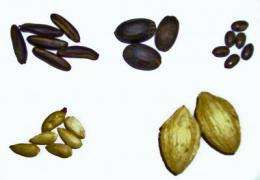
From left to right, top to bottom the seeds are: Delonix regia, Jatropha curcas, Ricinus communis, Azadirachta indica and Balanites aegyptiaca. Credit: Kansas State University Division of Biology

A short rainy season and desertification make growing food in northern Ghana difficult enough. It doesn't help that in this western African country there is little fuel available to power tractors for planting crops or to power grain milling.

Researchers at Kansas State University think that the from some native may be able to help.

K-State biologists are working with a researcher in to create biodiesel from the seeds of trees that are common and well adapted to the climate of northern Ghana. Walter Kpikpi from the University for Development Studies, Navrongo Campus, in Ghana visited K-State in November 2008 with funding from K-State's African Studies Center. He is leading a project that will make biodiesel for local farmers in Ghana from seeds collected by local farmers.

Funded by K-State's African Studies Center, K-State biologists analyzed the of four common tree species in Ghana. Ariel Burns, research technician in K-State's Division of Biology, was joined by Richard Jeannotte, research associate in biology, and Ruth Welti, professor of biology. They found that two tree species, Jatropha curcas and Azadirachta indica -- also known as neem -- have seeds with high oil content. They now are finalizing the analysis of the lipids in the seeds.

Burns will present the work March 30 at K-State's African Issues Symposium: Food Security, Environmental Sustainability and Human Health.

Proposing that Jatropha curcas and Azadirachta indica seeds are best suited for biofuels, Kpikpi's project envisions cultivating these trees specifically for biodiesel production on land that isn't suitable to grow food. The project anticipates economic opportunities for people in Ghana by producing this type of biodiesel.

Wenqiao "Wayne" Yuan, K-State assistant professor of biological and agricultural engineering, has expertise in biodiesel reactor design and conversion. When funding is available for the pilot-scale biodiesel plant in Ghana, Yuan has offered to work with Kpikpi to create the facility to process tree seeds and convert them into biodiesel. The plant would include an oil extraction device and biodiesel reactor, Yuan said.

Source: Kansas State University


print this article email this article download pdf blog this article bookmark this article     Stumble it Digg this share on Facebook retweet share on Reddit add to delicious
Rate this story - 5 /5 (1 vote)


March 19, 2009 all stories

Comments: 0

5 /5 (1 vote)
  • Stumble this up

  • Digg this

  • share this

  • hide
  • Related Stories

  • Researchers examine world's potential to produce biodiesel
    created Oct 17, 2007 | popularity not rated yet | comments 0
  • Finding a better way to make biodiesel
    created Jun 19, 2006 | popularity not rated yet | comments 0
  • Waste coffee grounds offer new source of biodiesel fuel
    created Dec 10, 2008 | popularity not rated yet | comments 0
  • Biodiesel fuel use growing steadily
    created Jul 03, 2006 | popularity not rated yet | comments 0
  • Scientists work to improve water quality in Ghana
    created Apr 25, 2007 | popularity not rated yet | comments 0


  • hide
  • Relevant PhysicsForums posts

Other News

Prized mushroom collection returns to China

Biology / Plants & Animals

created 14 hours ago | popularity 5 / 5 (1) | comments 0

(AP) -- A Chinese scholar persecuted during the Cultural Revolution for smuggling a rare collection of mushrooms out of China before World War II was honored Saturday when the collection was returned more than 70 years later.


Sea lions killed, but Columbia salmon toll rises (AP)

Sea lions killed, but Columbia salmon toll rises

Biology / Ecology

created 15 hours ago | popularity not rated yet | comments 1

(AP) -- Killing or removing 25 California sea lions over the past two years has not reduced the toll on salmon at the base of Bonneville Dam in the Columbia River.


Laser etching safe alternative for labeling grapefruit

Laser etching safe alternative for labeling grapefruit

Biology / Other

created Nov 03, 2009 | popularity 4.4 / 5 (14) | comments 8

Laser labeling of fruit and vegetables is a new, patented technology in which a low-energy carbon dioxide laser beam is used to label, or "etch" information on produce, thereby eliminating the need for common ...


Wolves, moose and biodiversity: An unexpected connection

Wolves, moose and biodiversity: An unexpected connection

Biology / Ecology

created Nov 02, 2009 | popularity 4.8 / 5 (6) | comments 4

Moose eat plants; wolves kill moose. What difference does this classic predator-prey interaction make to biodiversity?


Caught in the act: Butterfly mate preference shows how 1 species can become 2

Caught in the act: Scientists find butterflies splitting into two species

Biology / Plants & Animals

created Nov 05, 2009 | popularity 4.5 / 5 (8) | comments 2

(PhysOrg.com) -- Breaking up may actually not be hard to do, say scientists who've found a population of tropical butterflies that may be on its way to a split into two distinct species.