Space station's new solar wings open easily (Update 2)
March 20, 2009 Space station's new solar wings open easily (AP)

Enlarge

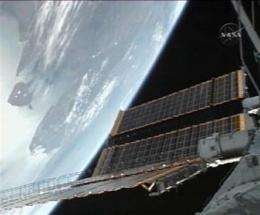
In this image from NASA TV, the international space station begins the process of opening new solar wings while orbiting Earth, Friday, March 20, 2009. (AP Photo/NASA TV)

(AP) -- Astronauts successfully unfurled the newly installed solar wings at the international space station Friday, a nerve-racking procedure that went exceedingly well and brought the orbiting outpost to full power.

To NASA's relief, both wings went out smoothly, one at a time. Nothing hung up, and none of the panels stuck together like they had on previous panels.

The wings stretched more than 240 feet, a glistening golden hue in the sunlight and a dazzling sight for the and everyone else involved.

"It's just really amazing," said Mike Fincke, the space station's skipper. He said there was "a shout of triumph" aboard the linked station-shuttle complex once the two wings were fully extended.

The work was a highlight of shuttle Discovery's mission. Completed 220 miles above Earth, the new panels are the final pair of electricity-generating wings and should boost the amount of science research at the orbiting outpost.

"Great work, guys," Mission Control told the astronauts. "We've got a whole bunch of happy people down here,"

The long, deliberate procedure began the morning after this last set of was hooked up to the orbiting complex.

Right on cue, astronaut John Phillips pushed the button that commanded the first wing to start unfurling. It slowly stretched out like a folded-up map. When the wing was halfway open, Phillips stopped the motion for nearly an hour so the panels could soak up sunlight and be less likely to stick.

The second wing, which had been boxed up for years, opened just as easily. A slight crinkle was spotted near the bottom, but flattened when the wing was stretched out.

Most if not all the astronauts watched the wings unfold, peering out windows and through camera lenses, ready to hit the "abort" button in case of trouble.

Flight controllers as well as managers anxiously monitored everything, given the past problems. The last time a solar wing was unfurled in 2007, it caught on a guide wire and ripped. Emergency spacewalking repairs were needed to fix it.

"We learned from that and made it very smoothly," Fincke said.

After 10 years of assembly, the space station now has eight full wings. Altogether, the wings will be capable of generating enough electrical power for about 42 large houses, according to .

On Thursday, a pair of spacewalking astronauts hooked up the $300 million framework that holds the wings. This last major American-made addition increased the mass of the space station to 670,000 pounds; it is now 81 percent complete. Construction is scheduled to wrap up next year with the retirement of NASA's shuttles.

Discovery is due to leave the space station Wednesday. Its landing, though, may be moved up a day to preserve science samples being returned from the station. Right now, touchdown is scheduled for March 28.

---

On the Net:

NASA: http://spaceflight.nasa.gov

©2009 The Associated Press. All rights reserved. This material may not be published, broadcast, rewritten or redistributed.


print this article email this article download pdf blog this article bookmark this article     Stumble it Digg this share on Facebook retweet share on Reddit add to delicious
Rate this story - 4.7 /5 (3 votes)


March 20, 2009 all stories

Comments: 0

4.7 /5 (3 votes)
  • Stumble this up

  • Digg this

  • share this

  • hide
  • Related Stories

  • Shuttle, station crews begin girder work
    created Mar 18, 2009 | popularity not rated yet | comments 0
  • Astronauts successfully install solar wings (Update)
    created Mar 19, 2009 | popularity not rated yet | comments 0
  • Shuttle Discovery zooms toward space station
    created Mar 17, 2009 | popularity not rated yet | comments 0
  • NASA fuels Discovery for flight to space station
    created Mar 11, 2009 | popularity not rated yet | comments 0


  • hide
  • Relevant PhysicsForums posts

  • The shape of our solar system's orbits.
    created Nov 07, 2009
  • Above or Below the Line of Nodes
    created Nov 07, 2009
  • Supernova vs. Nova?
    created Nov 07, 2009
  • Supernova's Gamma Rays and Comets
    created Nov 06, 2009
  • More from Physics Forums - General Astronomy

Other News

Planetary Society plans new 'solar sail'

Space & Earth / Space Exploration

created 3 hours ago | popularity 5 / 5 (1) | comments 0

(AP) -- Four years after its first solar sail ended up in the ocean instead of orbit, The Planetary Society announced Monday that by the end of 2010 it will try again to launch a spacecraft that will be propelled by the ...


L-R: Chiwetel Ejiofor, Amanda Peet and John Cusack at the premiere of "2012"

NASA on crusade to debunk 2012 apocalypse myths

Space & Earth / Space Exploration

created 8 hours ago | popularity 4 / 5 (1) | comments 1

The world is not coming to an end on December 21, 2012, the US space agency insisted Monday in a rare campaign to dispel widespread rumors fueled by the Internet and a new Hollywood movie.


Australian scientists call for urgent 'global cooling' to save coral reefs

Space & Earth / Environment

created 4 hours ago | popularity 3 / 5 (2) | comments 0

(PhysOrg.com) -- Australian marine scientists have issued an urgent call for massive and rapid worldwide cuts in carbon emissions, deep enough to prevent atmospheric CO2 levels rising to 450 parts per million (ppm).


Antarctica glacier retreat creates new carbon dioxide store

Antarctica glacier retreat creates new carbon dioxide store

Space & Earth / Earth Sciences

created 13 hours ago | popularity 3.5 / 5 (4) | comments 0

Large blooms of tiny marine plants called phytoplankton are flourishing in areas of open water left exposed by the recent and rapid melting of ice shelves and glaciers around the Antarctic Peninsula. This ...


NASA satellites see Ida spreading out before landfall

NASA satellites see Ida spreading out before landfall

Space & Earth / Earth Sciences

created 4 hours ago | popularity not rated yet | comments 0

NASA's Aqua and Terra satellites are keeping a close eye on Tropical Storm Ida, and both have instruments aboard that show her clouds and rains are already widespread inland over the U.S. Gulf coast states. ...